
Hailstone library to improve extreme weather forecasting
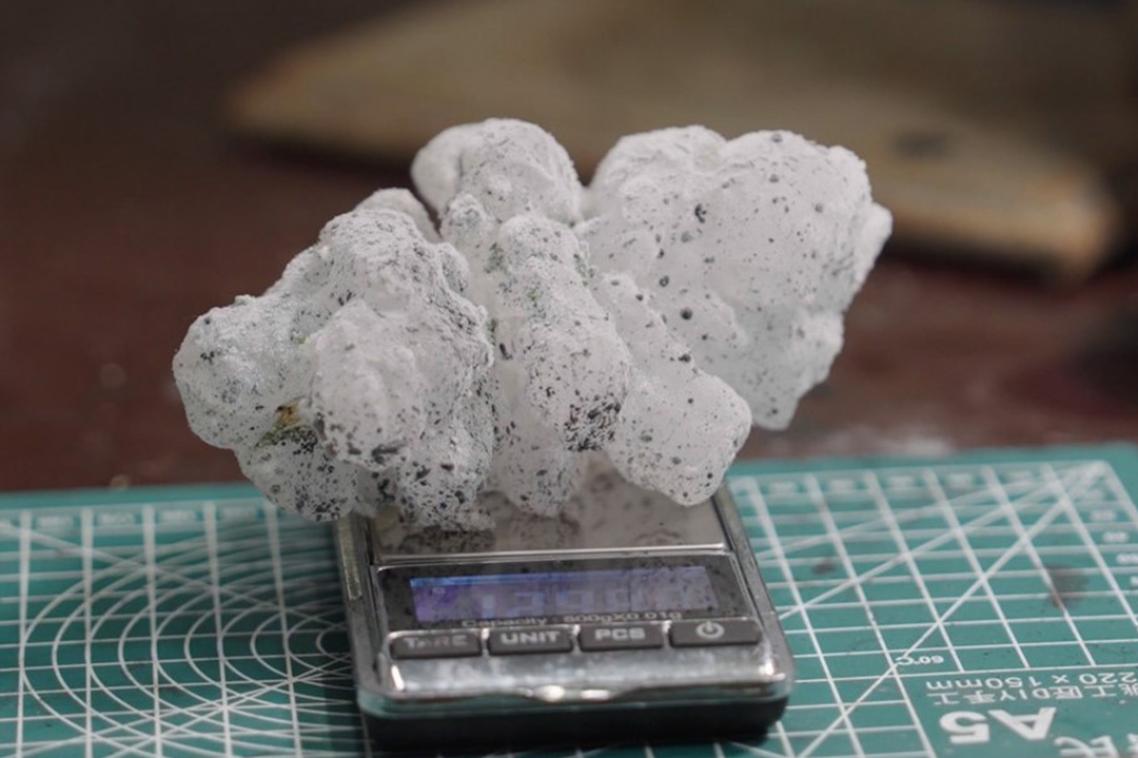
A hailstone, flecked with paint to assist in 3D scanning, is weighed as part of processing for the hailstone library.
(Photo credit: The University of Queensland. )
Key points
- Researchers are measuring and scanning samples for a global ‘hailstone library’.
- Storm simulations using 3-D modelling of real hailstones show it behaves differently than spherical hail shapes.
- Data from the hail library could lead to more accurate storm forecasts.
A University of Queensland library – full of hailstones instead of books – is helping researchers to better understand and predict damaging storms.
Dr Joshua Soderholm, an Honorary Senior Research Fellow from UQ’s School of the Environment, and lead researcher PhD candidate Yuzhu Lin from Penn State in the US, have found storm modelling outcomes change significantly when using real hailstones.
“People tend to think of a hailstone as a perfect sphere, like a golf ball or cricket ball,” Dr Soderholm said.
“But hail can be all sorts of weird shapes, from oblong to a flat disc or have spikes coming out – no two pieces of hail are the same.
“Conventional scientific modelling of hail assumes spherical hailstones, and we wanted to know if that changed when non-spherical, natural hail shapes are used.”
Ms Lin said they found the differences were dramatic.
“Modelling of the more naturally shaped hail showed it took different pathways through the storm, experienced different growth and landed in different places,” Ms Lin said.
“It also affected the speed and impact the hail had on the ground.
“This way of modelling had never been done before, so it’s exciting science.”
Dr Soderholm said building a ‘hailstone library’ was critical to further fine-tuning hailstorm simulations.
“This is effectively a dataset to represent the many and varied shapes of hailstones, to make weather modelling more accurate,” he said.
“Our study used data from 217 hail samples, which were 3-D scanned and then sliced in half, to tell us more about how the hailstone formed.
“This data is now part of a global library, as we try and get a really clear picture of hailstone shape and structure.”
Dr Soderholm said the research has significant potential.
“At the moment, the modelling is specifically for scientists studying storms, but the end game is to be able to predict in real-time how big hail will be, and where it will fall,” he said.
“More accurate forecasts would of course warn the public so they can stay safe during hailstorms and mitigate damage.
“But it could also significantly benefit industries such as insurance, agriculture and solar farming which are all sensitive to hail.”
The research paper was published in the Journal of the Atmospheric Sciences.
Collaboration and acknowledgements
Dr Soderholm is also a Research Scientist at the Australian Bureau of Meteorology.
Some hail samples for the UQ data set were provided by Higgins Storm Chasing.
Related articles
Hailstorm forecasting set to improve with new data gathering project
