
Laser-light tweezers help reveal cell secrets
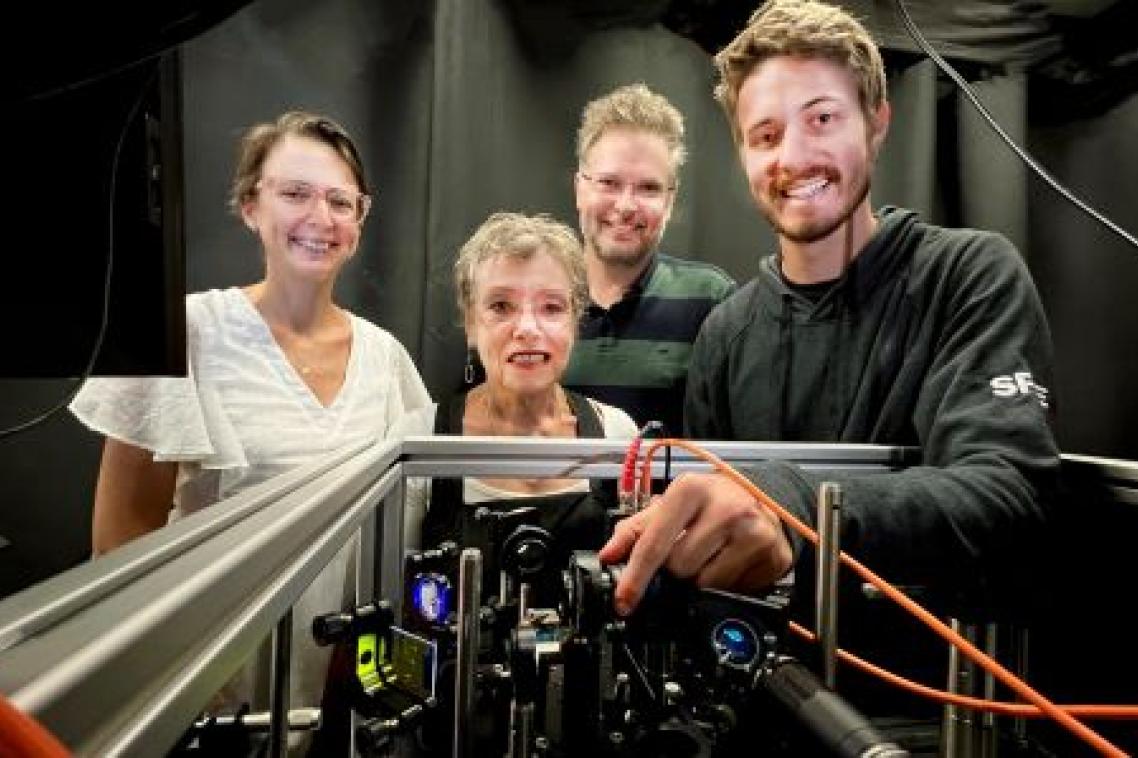
Researchers will soon be able to study biological changes at scales and speeds not previously possible to significantly expand knowledge in areas such as disease progression and drug delivery.
Physicists at The University of Queensland have used “tweezers made from light” to measure activity within microscopic systems over timeframes as short as milliseconds that approaches quantum limit.
Professor Halina Rubinsztein-Dunlop from UQ’s School of Mathematics and Physics said the method could help biologists understand what was happening within single living cells.
“For example, they will be able to look at how a cell is dividing, how it responds to outside stimuli, or even how chemical reactions affect cell properties,” Professor Rubinsztein-Dunlop said.
“Any development of a medical condition could be dependent upon the dynamic processes inside, say, cancer cells versus healthy cells on very short time scales.
“Making that knowledge available opens up the possibility of new drugs and ways to deliver them, or tests to see whether a cell is functioning as it should.”
The team’s method involved creating “ballistic rotating optical tweezers” – by shining a laser through a microscope and controlling its polarisation – to trap tiny probes that rotate in the fluids of the samples being studied and measure their rotation at exceedingly short time scales.
“How the probes rotate and interact with the surrounding environment allows us to track changes in properties like the viscosity of fluid within a biological cell,” PhD candidate Mark Watson said.
“After the light goes through the petri dish, we collect it and based on how the light has been changed, we can determine what's happened.
“With these tweezers made from light, we are able to apply pressure and grab microscopic items and turn them around, just like you would with physical tweezers in much larger environments.”
Having proven the method works, the researchers are teaming up with UQ biologists and are on the cusp of testing it in living cells.
Dr Alexander Stilgoe said they would be able to track dynamic changes in cells and systems on time scales existing methods had struggled to capture and had done so with better resolution.
He said the optical tweezers could also help researchers answer long-standing questions about much larger phenomena.
“Behaviour or movement in crowds, or patterns forming in large flocks of birds in the sky have so far escaped understanding,” Dr Stilgoe said.
“If we bring that to a nano or microscale, such as by observing similar behaviour in swimming bacteria, we might be able to resolve some of the questions that have remained unanswered for centuries.”
The research is published in the journal Optica.
Media
UQ Communications
communications@uq.edu.au
+61 429 056 139.
Topics
Related articles

UQ to support development of mobile launcher for high-speed flight R&D
