
Building soil carbon with beneficial microbes
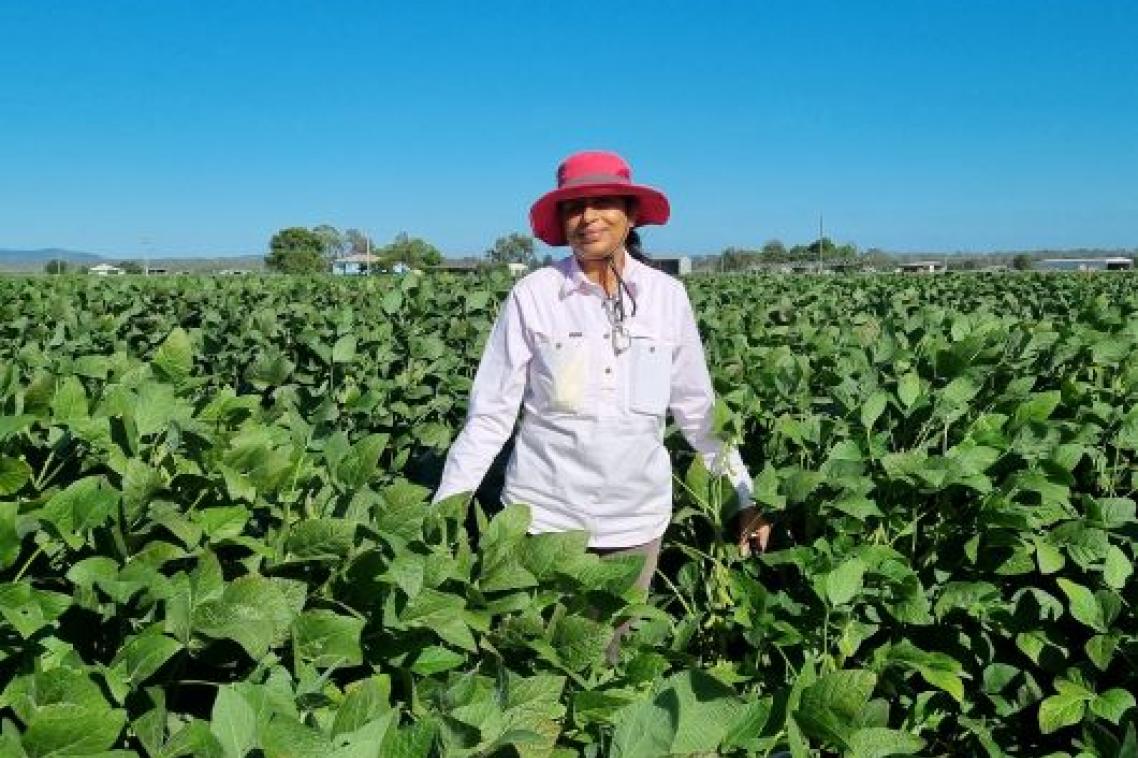
Field trials conducted at The University of Queensland show microbial biotechnology could be a game-changer for farming with simultaneous benefits for soil regeneration, crop yield and carbon sequestration.
UQ’s Queensland Alliance for Agriculture and Food Innovation and the School of Agriculture and Food Sustainability have collaborated with agri-biotech company Loam Bio to test fungal endophyte inoculants in soybean plants.
QAAFI Research Fellow Dr Vijaya Singh said fungal endophyte inoculants were beneficial microbes applied to seeds.
“It’s a symbiotic relationship – in return for providing the host plant with nutrients and water the fungal microbes get carbon as a food,” Dr Singh said.
“Atmospheric carbon fixed by the plant flows into the soil via fluids released by the roots, increasing the soil carbon rather than removing it.
“More carbon means more grain yield, which is why it’s exciting for me because we’re doing meaningful research.
“Building carbon in the soil improves the soil structure, increases the water content of the soil and nutrient availability and capture.”
Loam Bio has been developing the inoculants for more than 4 years.
Company researcher Dr Neeraj Purushotham said the results in the first year of trials at Gatton in Queensland were encouraging.
“What we are looking at with our UQ collaboration is to understand more deeply how our inoculant works and also understand how stable carbon is built because that is what stays in the soil,” Dr Purushotham said.
“By increasing the amount of carbon sequestered you’re helping the farmer because the healthier the soil, the less fertiliser you need.
“That would mean reducing the use of fertilisers while generating the same benefit in terms of yield, as well as getting carbon inside the soil.”
Dr Singh said the results warranted further investigation.
“Our findings suggest the endophytes have potentially beneficial impacts on crop growth, yield and play a role in altering soil organic matter,” Dr Singh said.
The research was published by Scientific Reports.
The Queensland Alliance for Agriculture and Food Innovation is a research institute at The University of Queensland established with and supported by the Department of Primary Industries.
Media Assets
Images available via Dropbox.
Media contacts
Dr Vijaya Singh
v.singh@uq.edu.au
+61 429 382 716
QAAFI Communications
Natalie MacGregor
n.macgregor@uq.edu.au
+61 409 135 651
Related articles
Superconducting germanium made with industry-compatible methods
