
Global partnership on wheat adaptation
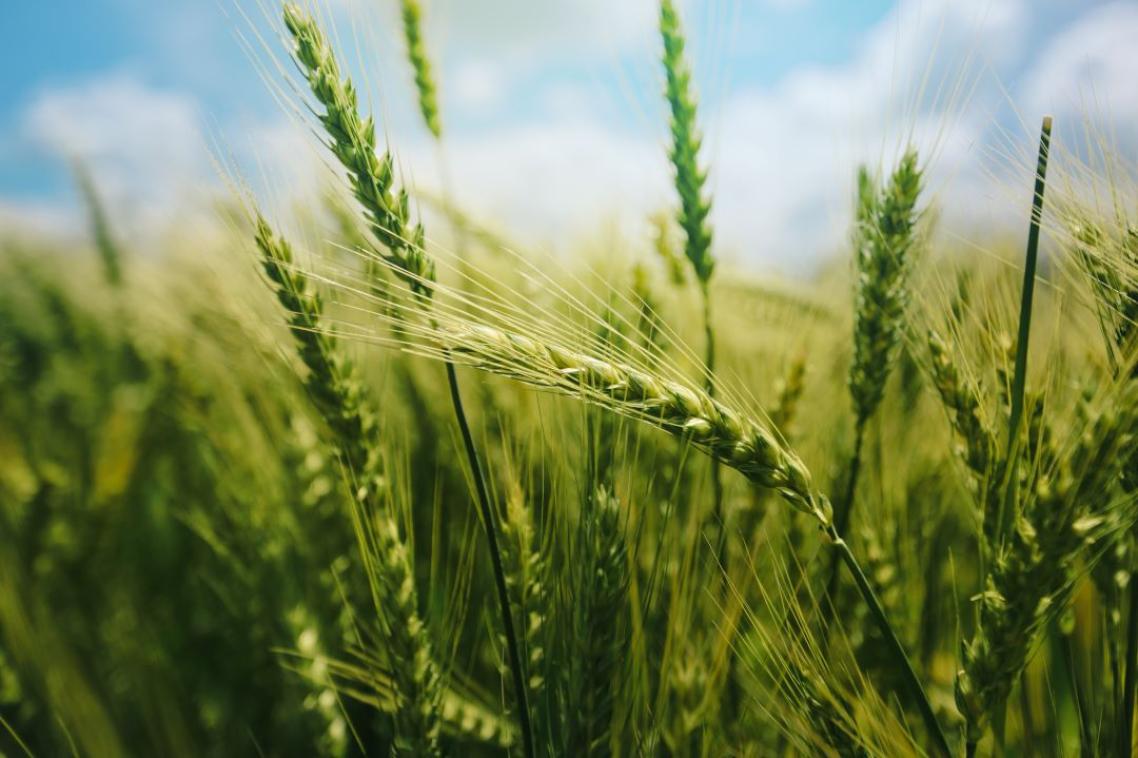
(Photo credit: Adobe )
A new collaborative laboratory will allow researchers to share expertise between Australia and France to boost wheat yields in the changing climate.
The International Associated Laboratory “Wheat Adaptation to changing environments (WheatACE) involves researchers from The University of Queensland, the French National Research Institute for Agriculture, Food and the Environment (INRAE), and University Clermont Auvergne in France.
UQ Principal Investigator Associate Professor Karine Chenu said the aim was to leverage the individual organisations’ expertise to increase high-quality grain production.
“Our French colleagues have been working for a long time on tillering, a pre-flowering trait where a wheat plant produces side shoots that can grow additional heads producing grains,” Dr Chenu said.
“This trait allows an increase in the number of stems, which is one of the key drivers for the grain number, which in turn is the main driver for yield – but mainly in good environments.
“That is where the Australian expertise comes in, because greater tillering and the resultant bigger canopy requires more water – an increasingly limited resource in major wheat-growing regions.
“An increased number of stems typically results in carbohydrate reserves being diluted among the stems, yet those reserves can play a key role in maintaining yield under drought.
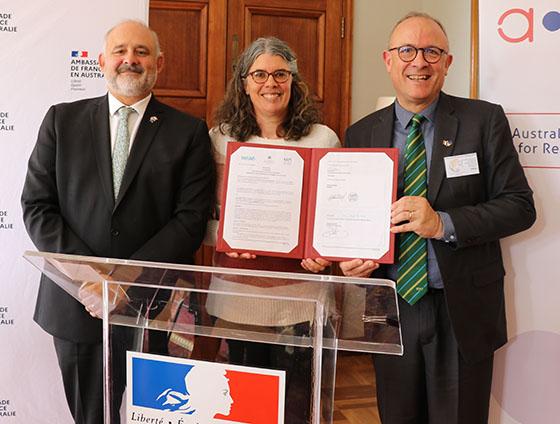
(L-R): HE Pierre-André Imbert, Ambassador of France, Assoc Prof Karine Chenu and Dr Jean-François Hocquette - Research Director and Scientific Officer - International Relationships for Australia and New Zealand
“In addition, our research also found that prolonging green leaf retention under drought is often associated with prolonging photosynthetic activity and increased yield – this is the stay-green trait.
Dr Chenu said the WheatACE would leverage results from both sides to better understand the link between these traits in different environments, improve yield prediction in genetic models, guide crop improvement and ultimately develop varieties that will thrive in future environments.
“We also want to develop a high-throughput method for phenotyping stem reserves," she said.
A five-year agreement was signed this month, which will see PhD candidates trained in both Australia and France.
“We want the PhDs to go between both labs and gain invaluable international experience,” Dr Chenu said.
“At UQ, we have several training centres such as the International Research Training Group and the ARC Training Centre in Predictive Breeding, which are great environments in which to learn.
“We also have state-of-the-art facilities to grow plants in future-like conditions with the new Plant Futures Facility."
Dr Chenu said the agreement was broadening an existing relationship.
“We’re starting to already seeing some benefits from WheatACE, and we’ve been approached by an international breeding company interested in working with us on a PhD project.
“We’re starting to see results, and it’s only the start of this exciting project.”
Collaboration and acknowledgements
The Queensland Alliance for Agriculture and Food Innovation is a research institute at The University of Queensland, established with and supported by the Department of Primary Industries.
Related articles

‘Forever renting’ is common in New York, California and Europe. What lessons can we learn?
