
Boulder washed inland a sign of Pacific tsunami history
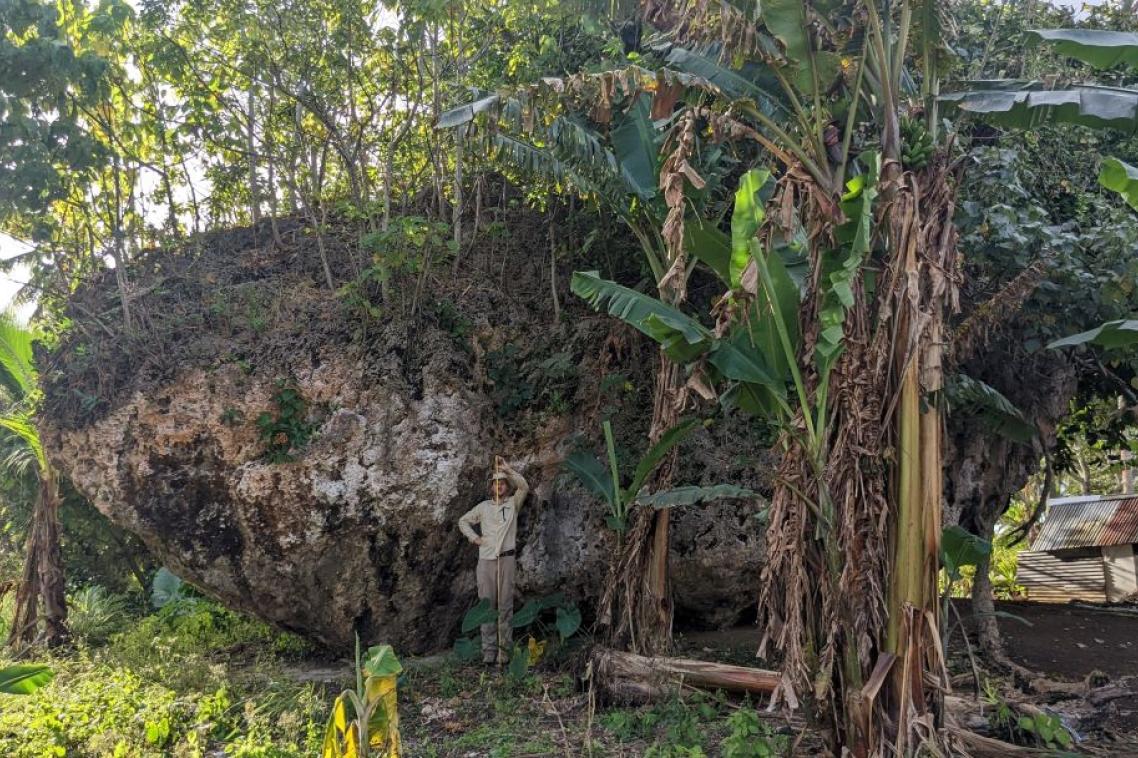
Martin Köhler stands in front of the Maka Lahi boulder.
Analysis has shown a boulder weighing almost 1,200 tonnes in Tonga is one of the largest known wave-transported rocks in the world, providing new insights into the Pacific region’s history and risk of tsunamis.
Analysis has shown a boulder weighing almost 1,200 tonnes in Tonga is one of the largest known wave-transported rocks in the world, providing new insights into the Pacific region’s history and risk of tsunamis.
PhD candidate Martin Köhler from The University of Queensland’s School of the Environment says the Maka Lahi boulder measuring 14 x 12 x 6.7 metres was moved more than 200 metres inland by a tsunami around 7,000 years ago.
“We had been surveying the southern side of the island of Tongatapu looking along the coastal cliffs at evidence of past tsunamis,” Mr Köhler said.
“It was late in the day, and we were talking to some farmers when they directed us to this boulder.
“I was so surprised; it is located far inland outside of our field work area and must have been carried by a very big tsunami.
“It was quite unbelievable to see this big piece of rock sitting there covered in and surrounded by vegetation.
“We made a 3D model and then went back to the coast and found the spot the boulder could have come from, on a cliff over 30 metres above the sea level.”
The Maka Lahi boulder is the world’s largest known cliff-top boulder.
Numerical modelling has established that wave heights of around 50 metres lasting around 90 seconds were needed to dislodge it from its cliff-edge origin and move it to its resting place.
Co-author Dr Annie Lau, a coastal geomorphologist, said Tonga had a long history of tsunamis triggered by volcanic eruptions and earthquakes along the underwater Tofua Ridge and the Tonga Trench.
“Tonga’s most recent tsunami in 2022 killed 6 people and caused a lot of damage,” Dr Lau said.
“Understanding past extreme events is critical for hazard preparation and risk assessment now and in the future.
“The findings we have reported on the Maka Lahi boulder are the evidence of a tsunami in the Pacific region in the Holocene epoch which began around 11,700 years ago.
“The analysis strengthens our understanding of wave transportation of rocks to improve coastal-hazard assessments in tsunami-prone regions around the world.”
The research, titled 'Discovery of the world's largest cliff-top boulder: Initial insights and numerical simulation of its transport on a 30–40 m high cliff on Tongatapu', is published in Marine Geology.
Related articles

Archaeology’s assumptions about ancient diets challenged by new research
