
Crown-of-thorns control boosts coral growth in a warming world
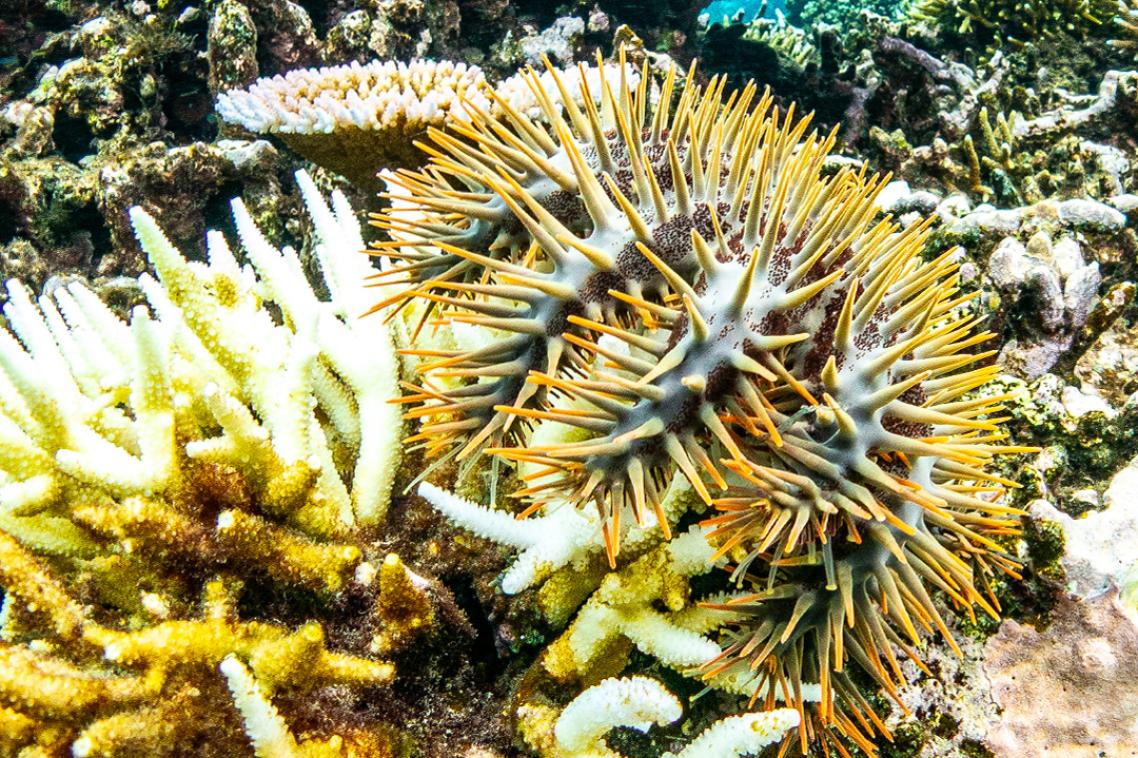
Crown-of-thorns starfish feed on coral and are considered a significant threat to the Great Barrier Reef.
(Photo credit: Professor Peter Mumby )
Work to combat coral-eating crown-of-thorns starfish across the Great Barrier Reef is working even under increasing environmental pressures, according to an assessment by University of Queensland researchers.
Dr Tina Skinner at UQ’s School of the Environment said crown-of-thorns starfish (COTS) control measures were having a substantial impact which was sustained well into the future.
“Our simulations showed that COTS control led to increased coral cover in about 85 per cent of cases, with roughly one-third of reefs experiencing more than 10 per cent growth,” Dr Skinner said.
“This is a positive story about reef resilience and the benefits of proactive intervention.
“As well as substantial improvement in coral cover, we found the benefits of programs to kill or remove the predatory starfish grew over time despite increasing climate change pressures.
“Even with temperature increases, we saw benefits on the reefs where COTS control had taken place and that extended to nearby reefs – either by protecting their coral populations from a transfer of COTS larvae or by enhancing recovery by supplying healthy coral larvae.
“Amid rising concern over the Reef’s future, this study shows proactive and local intervention is paying off, giving managers evidence that their efforts are working and worth expanding.
“COTS control is still only one part of the solution - reducing emissions to limit climate change-driven disturbances to the Reef will be essential to protect the coral gains beyond 2040.”
The project used a spatially explicit ecosystem model – a comprehensive simulation of the 3,806 individual reefs across the Great Barrier Reef’s 2,300 km.
“We input information about past outbreaks and the current control programs managed by the Great Barrier Reef Marine Park Authority,” Dr Skinner said.
“Then we used past data to project the impact of future outbreaks along with heat stress, cyclones, and changes in water quality up to 2040 using global climate models.
“Even as temperatures increase and there are more disturbances, we were still seeing benefits on the reefs where COTS were controlled, and some benefits on adjacent reefs.
“The reefs that haven’t seen direct COTS control work or any nearby fared worse.”
Study co-author, Professor Peter Mumby, said while current COTS control was effective it was limited to less than 10 per cent of the Reef.
“This assessment will play an important role in helping to maximise the impact of starfish culling and improve the health of corals across the Great Barrier Reef,” Professor Mumby said.
“It was able to identify the key ecological and management factors that influence when and where control is most effective to help guide management decisions.”
The research has been published in Journal of Environmental Management.
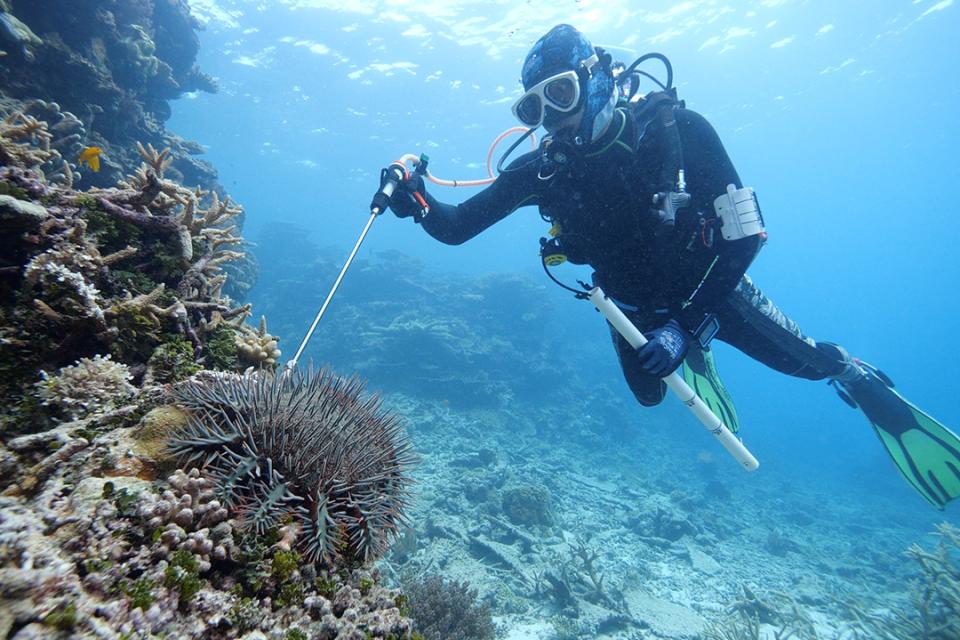
COTS control measures include injecting the starfish with vinegar which is fatal.
(Photo credit: Great Barrier Reef Marine Park Authority)
Collaboration and acknowledgements
The work is part of the COTS Control Innovation Program which is funded by the partnership between the Australian Government’s Reef Trust and the Great Barrier Reef Foundation.
Related articles

Mapping the green transition of Asia Pacific economies
