
Sub-soil secrets revealed in robot-driven farm research
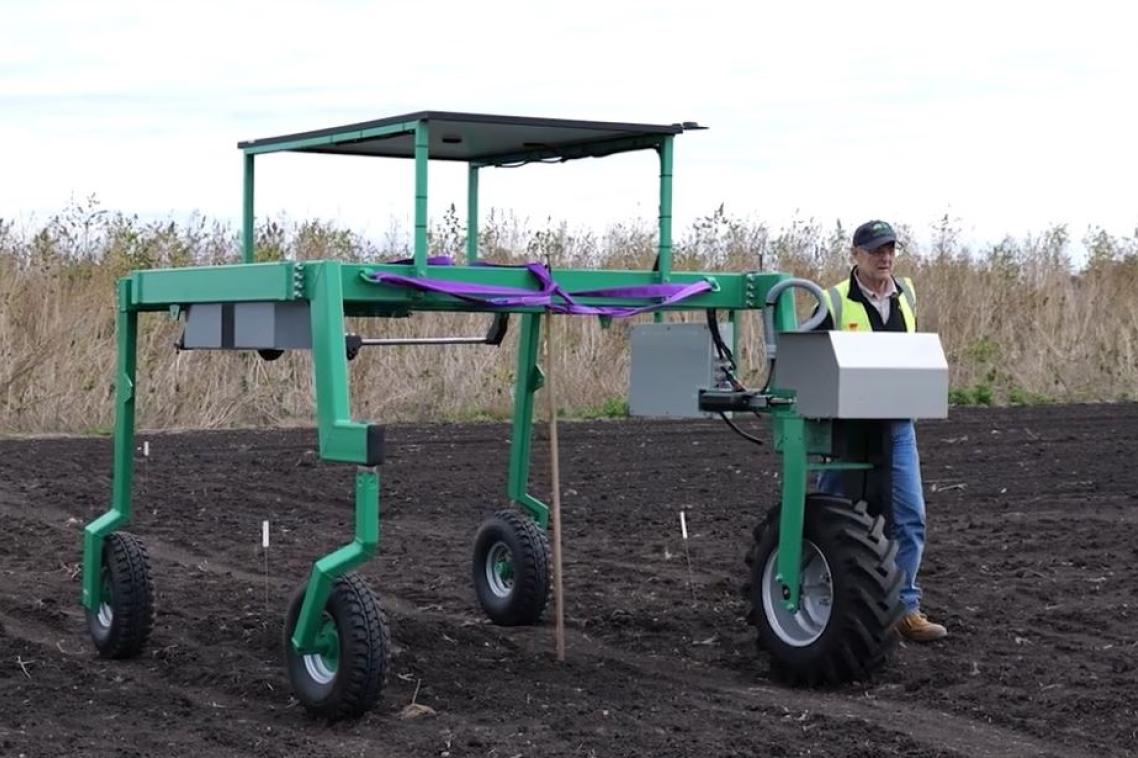
Professor Daniel Rodriguez with The RootBot.
(Photo credit: The University of Queensland )
A robotic root-sensing system developed at The University of Queensland is opening up new opportunities for more productive agricultural crops.
The root phenotyping system provides new information on the link between plant roots and yield to identify ways to boost productivity and improve drought resilience.
Dr Dongxue Zhao at the Queensland Alliance for Agriculture and Food Innovation said a purpose-built robot was propelling the Grains Research and Development Corporation (GRDC) invested phenotyping project into the future
“Given the critical role of the root system to access water and nutrient resources, it is perplexing how little we know about the genotypic diversity of root traits and their effect on crop yield and yield stability,” Dr Zhao said.
“Most root phenotyping methods focus on 2D and 3D visualisations of root architecture traits, usually on young plants grown under controlled conditions in pots or root chambers.
“But because of environmental variables and how plants adapt and respond to them, such studies can’t untangle the whole relationship between root architecture, root function and yield.
“On the other hand, root studies in the field mostly rely on expensive, time-consuming and laborious excavations of the root system.
“Our approach doesn’t disturb the crop, and its measurements are non-invasive and rapid.
“Now, we can cheaply phenotype a 5-metre-long plot every 8 seconds, meaning that we can assess about 250 field plots per hour.
“The system senses the entire root system within the soil profile, reducing error and maximising our capacity to identify differences between genotypes or agronomic treatments.”
The system involves a range of technologies including an autonomous high-clearance robot called The RootBot, co-designed with AntRobotics in Germany.
It carries an electromagnetic induction (EMI) instrument and sensors for canopy and root phenotyping.
A data pipeline was developed in collaboration with a service provider of digital agriculture products, streamlining the translation of the technology to industry.
“The technology will allow researchers and providers of digital agriculture services to screen large numbers of genotypes for root traits which likely drive drought tolerance and yield stability,” Dr Zhao said.
“Agronomists could use it to map maximum crop rooting depth and plant available water across paddocks to inform precision agriculture practices.”
Research team member Dr Raul Gimenez said the possibilities of the system are enormous.
“This technology has the potential to be used not only in root phenotyping, but in combining information from above-ground traits as well to give us a better understanding of what is happening with our crops and how to improve them,” Dr Gimenez said.
“We’re in an era where machine learning and big data are very useful tools, but we need to feed them with information – this robot provides us the means to feed these very powerful models with the information that they need.”
The research was published in Plant and Soil.
Collaboration and acknowledgements
The research program called ‘Root structure and function traits: Overcoming the root phenotyping bottleneck in cereals’ is an investment of the Grains Research and Development Corporation led by UQ in collaboration with the Western Australian Department of Primary Industries Research and Development, Agriculture Victoria, IPK Leibniz Institute, digital agricultural provider services Airborn Insight and Data Farming, and seed companies AGT, Pioneer Seeds, Long Reach Plant Success and Pacific Seeds.
The Queensland Alliance for Agriculture and Food Innovation is a research institute at The University of Queensland established with and supported by the Department of Primary Industries.
Topics
Related articles

Unpacking wheat’s water use for drought research
