Skip to menu Skip to content Skip to footer
News

Growing shade trees can cut chocolate’s environmental impact
7 August 2025
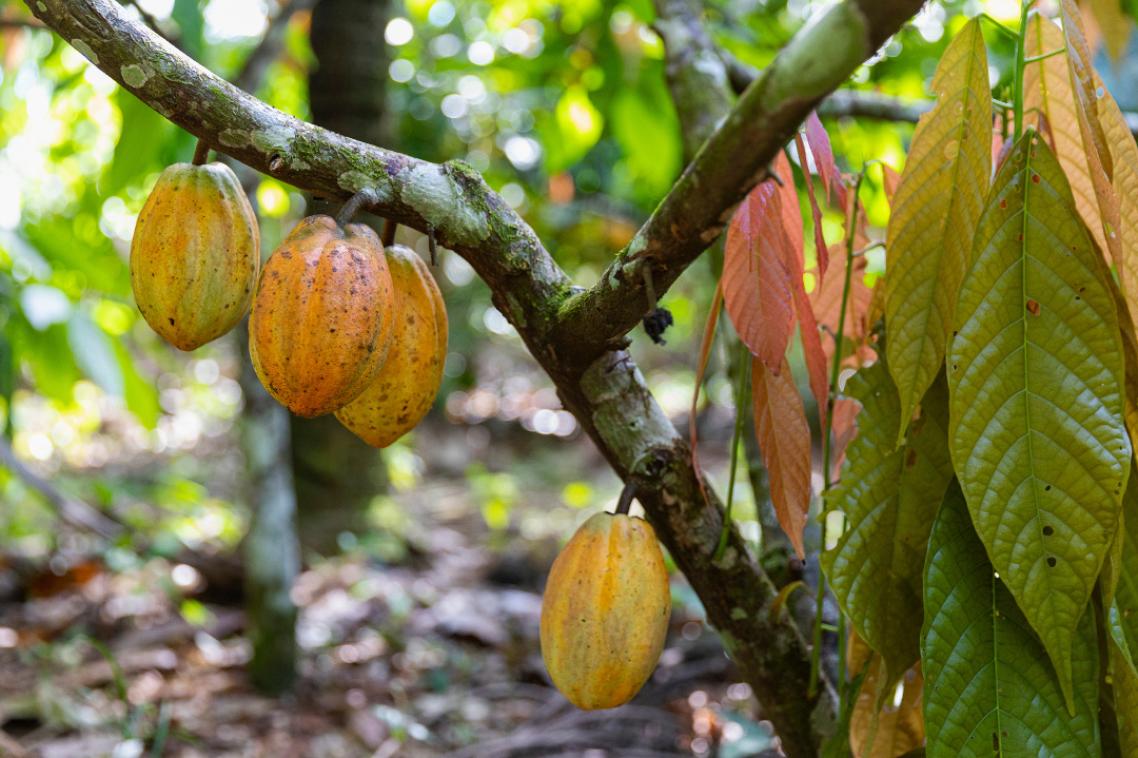
cocoa fruit on trees

(Photo credit: Adobe )

University of Queensland research shows emissions from the global chocolate industry could be reduced by growing more shade trees over farms in the region that supplies 60 per cent of the world’s cocoa.

Dr Wilma Blaser-Hart and Dr Simon Hart from UQ’s School of the Environment and Centre for Biodiversity and Conservation Science led a study which used satellite images and machine learning to examine farms in West Africa.

“Cocoa is naturally an understory tree in rainforests, but in monoculture farming systems it’s grown in the open,” Dr Blaser-Hart said.

“Shade trees growing in cocoa farms can sequester substantial amounts of carbon in both aboveground and belowground biomass.

“Our analysis found shade-tree cover in cocoa production in Ghana and Côte d’Ivoire was relatively low at around 13 per cent, well below what it could be.

“Cocoa can be grown without significant yield losses under shade levels of 30-50 per cent, so there is huge unrealised potential to increase carbon sequestration through tree planting.”

The study found increasing tree cover on cocoa farms across the 2 countries to a minimum of 30 per cent would sequester up to 10.2 million tonnes of carbon dioxide equivalent (CO₂e) each year over the next few decades. CO₂e is a standard measure used to compare emissions from different greenhouse gases based on their global warming potential.
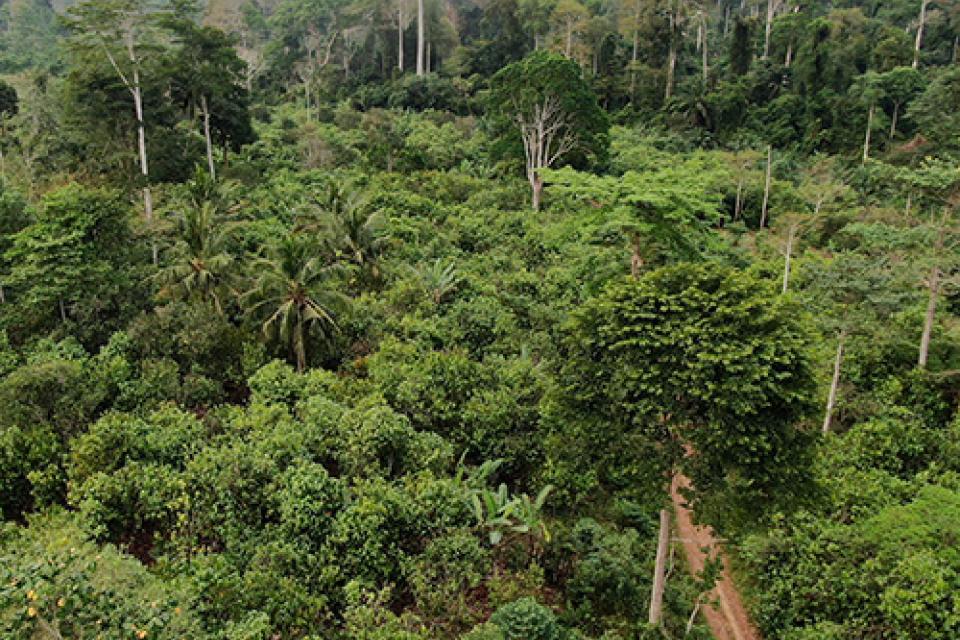
an aerial view of a forest

An aerial view of a cocoa plantation including shade trees with a rainforest in the background. 

(Photo credit: Dr Blaser-Hart)

Dr Blaser-Hart said increasing shade would bring environmental and ecosystem benefits to the regions where forests have been removed for cocoa plantations.

“The amount of carbon sequestration we have calculated is about 9 per cent of the total annual emissions and about 167 per cent of current cocoa-related emissions across both countries,” she said.

“But when emissions from past land-use change and deforestation are included, the potential offset falls to about 15 per cent of the sector’s annual greenhouse gas emissions.

“As well as carbon storage, planting a variety of trees in plantations will support biodiversity, improve soil fertility and temperature regulation, and reduce pest and disease pressure.”

While significant, the researchers noted that even widespread tree planting would only store carbon roughly equivalent to that found in the small areas of remaining intact forests in Ghana and Côte d’Ivoire.

“Agroforestry can deliver meaningful mitigation, but it is not a substitute for protecting natural forests and this must remain a priority,” Dr Blaser-Hart said.

Dr Hart said the team’s method could be applied to other cocoa producing regions in South America and South-East Asia and extended to other perennial shade-tolerant crops such as coffee.

“For cocoa, tree planting on farms is a win-win situation – a clear environmental benefit for the chocolate industry through growing a carbon sink with no loss of crop production,” he said.

The research has been published in Nature Sustainability.

Collaboration and acknowledgements

The project was supported by the Lindt Cocoa Foundation, the Joint Cocoa Research Fund of CAOBISCO and ECA, the BiodivClim ERA-Net COFUND programme, and the Queensland Government Women’s Research Assistance Program.

Related articles

Three researchers wearing blue protective lab gowns stand among rows of potted chickpea plants inside a controlled-environment plant research facility.

Turning up the heat on chickpea yield

A University of Queensland study has outlined a practical pathway for accelerating the development of heat adapted chickpeas using data from new ‘omic’ technologies. PhD candidate Callum Jamie said the suite of technologies offered tremendous opportunities to understand how a complex trait like heat tolerance works. “The narrow genetic diversity in the elite chickpea gene pool has limited conventional breeding’s effectiveness for stress tolerance,” Mr Jamie said. “These technologies have improved our capacity to dissect trait architecture and phenotype secondary traits but their use in chickpeas has been limited.” The technologies include genomics, epigenomics, transcriptomics, proteomics, metabolomics, phenomics and enviromics, and help provide a comprehensive picture of biological systems. Epigenomics helps understand what controls gene activity; transcriptomics considers gene expression; proteomics protein production; metabolomics looks at biochemical processes; phenomics observes traits; and enviromics considers environmental factors influencing outcomes. Mr Jamie said previous studies had focused on just 1 to 2 -omic datasets, a small number of genotypes, and single tissues. This has meant it was hard to infer what results meant for trait architecture and mechanisms and the ability to extrapolate the information to breeding populations was limited. There have also been challenges around cost, scalability and integrating very different types of data to make the technologies useful. To overcome the hurdles, Mr Jamie’s research at the Queensland Alliance for Agriculture and Food Innovation has resulted in a proposed staged approach. It would start with genomic prediction and phenotyping, before adding -omic layers as costs fall and unknowns were resolved. “These technologies are novel and we still don’t know which information provides added value and how best to integrate all of this data to achieve an outcome,” Mr Jamie said. His PhD is supported by the Grains Research and Development Corporation (GRDC) and the International Research Training Group (IRTG) Accelerating Crop Genetic Gain and is aligned to a project which aims to fast-track the development of chickpea varieties adapted to high temperatures. Project leader Dr Millicent Smith said heat stress causes severe yield implications through flower and pod loss, reduced pollen viability and impaired grain filling. “Late sown chickpea is particularly in the firing line across most of Australia's crop in southern Queensland and northern New South Wales,” Dr Smith said. “We want to ensure that Australian growers maintain their competitive edge. “New varieties with improved genetics to cope with heat stress are essential for the future. “This work, suggesting a staged approach to utilising the new -omic technologies, is an exciting frontier.” The research was published by Food and Energy Security. Callum Jamie’s PhD is supported by the Grains Research and Development Corporation (GRDC) and the International Research Training Group (IRTG) Accelerating Crop Genetic Gain.
15 October 2026
Close-up photograph of a red-bellied black snake coiled across pale, weathered wood. The snake has glossy black scales on its back and vivid red coloration along its sides and underside. The image highlights the texture of the scales and the contrast between the dark body and the light wood background.
Analysis

Deadly fungi are harming Australia’s wild reptiles. This is how to stop the spread

With spring underway and the weather warming, reptiles are on the move in suburbs, parks and bushland across Australia. Snake catchers and wildlife carers are responding to calls for help, and reptile enthusiasts – known as “herpers” – are heading outdoors in search of their next sighting.
13 October 2026

Media contact

Subscribe to UQ News

Get the latest from our newsroom.