
Scientists read the very venomous caterpillar’s DNA
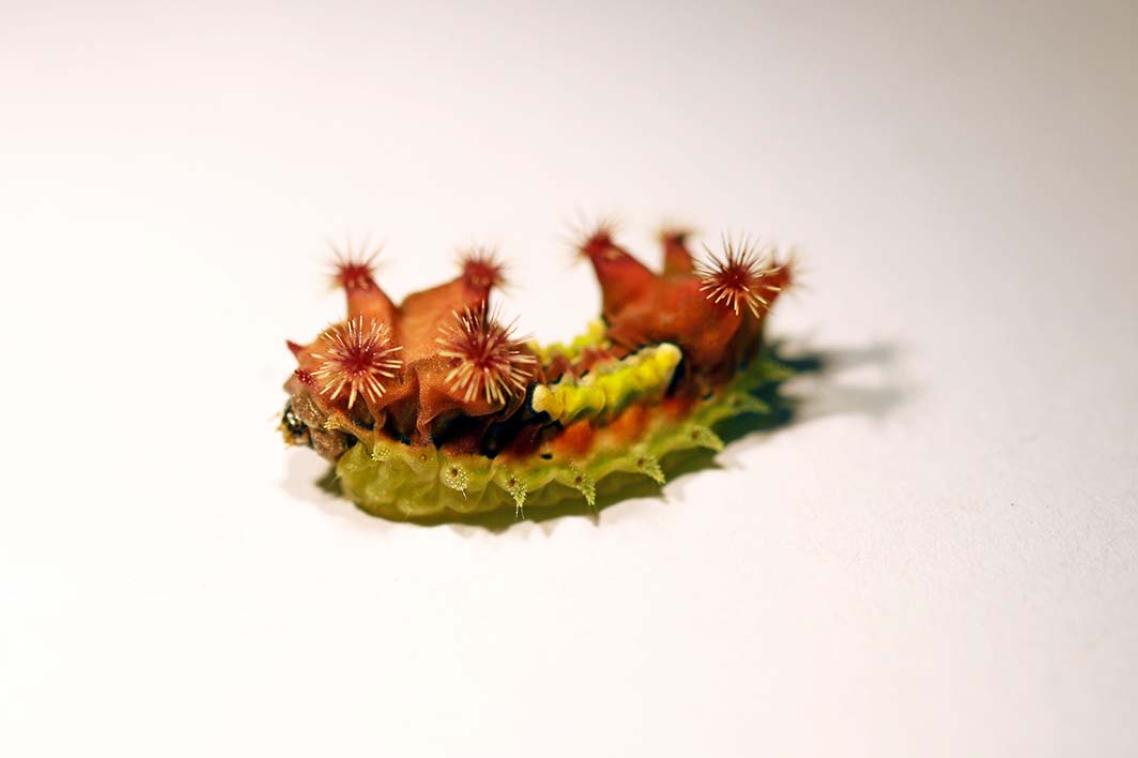
The venomous caterpillar, commonly known as the Mottled Cup Moth.
(Photo credit: Jiayi Jin. )
The genome of a venomous caterpillar has been sequenced by University of Queensland researchers, revealing how its immune system has been weaponised to be used against predators, and molecules that have potential to treat human disease.
Doratifera vulnerans, commonly known as the Mottled Cup Moth, is common to Queensland’s south-east and is routinely found in Toohey Forest Park on Brisbane’s southside.
Dr Andrew Walker from UQ’s Institute for Molecular Bioscience has been researching the striking looking caterpillars — each about the size of a 20-cent coin – since 2017.
“This pocket rocket has venom toxins with a molecular structure similar to those produced by spiders, wasps, bees and ants, and some of these toxins may turn out to be useful to develop drug treatments,” Dr Walker said.
“The unique looking creature’s venom, which is delivered through tiny needle-like spines, is made up of 151 different protein-based toxins, some with the ability to kill bacteria and parasites.
“Our latest research provides a fascinating insight into how the caterpillar’s immune system has evolved to produce painful toxins to protect itself from predators.”
The Institute for Molecular Bioscience has the largest invertebrate venom library in the world, and a proportion of the library’s freezers are filled with caterpillar venoms.
Dr Walker’s research explores how venom evolved in caterpillars.
“There are more than 150,000 species of moths and butterflies, and that includes several different groups that have independently evolved venoms with different compositions,” Dr Walker said.
“Some of the venom molecules have insecticidal properties, so we are looking at them for use as pesticides, while others can activate receptors in the human body, so could potentially be used in medicine to treat epilepsy, stroke, or cancer.
“Currently, the scientific world’s understanding of the genomic basis of venom production depends on a handful of species, most of which are snakes, so this is a significant step forward in our knowledge of animal venom.”
The research is published in Proceedings of the National Academy of Sciences (PNAS).
Collaboration and acknowledgements
The research was a collaboration with MedGenome and was funded by the Australian Research Council including its Centre of Excellence for Innovations in Protein and Peptide Science, the National Health and Medical Research Council, and was supported by the US Department of Defense and The Wellcome Trust through The Community for Antimicrobial Drug Discovery (CO-ADD).
Topics
Related articles

1 in 4 Australians physically abused by parents: study
