
UQ researchers send an unblockable message using gravity

Professor Matthew Davis, Dr Charles Woffiden and Professor Andrew White inside the elevator they used to send a message.
(Photo credit: The University of Queensland. )
University of Queensland researchers have used gravity to transmit a message through a brick wall using an elevator and a sensitive gravimeter.
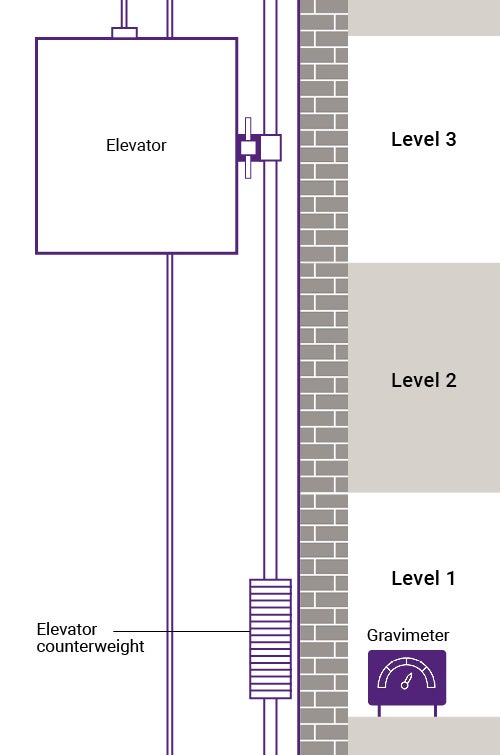
The unusual experiment took place in UQ’s Parnell Building, where the team of physicists sent the elevator back and forth between 2 levels, moving its 1.8-tonne counterweight between positions representing binary 0 and 1.
A gravimeter in an adjacent bathroom detected the changes in the gravitational field and translated the message into a single word, ‘Gravity’.
Dr Charles Woffinden from the School of Mathematics and Physics said gravitational communication had an intriguing advantage.
“Unlike the electromagnetic signals used in modern wireless communication, a gravitational signal cannot simply be screened out by placing ordinary material in its path,” Dr Woffinden said.
“Anyone who has lost phone reception in a tunnel or struggled with Wi-Fi through a solid wall will understand the appeal.
“While the present system is far from practical, it demonstrates the possibility of communicating using a method that ordinary physical barriers cannot block.”
Dr Andrew Groszek said the idea came from a project to develop a contactless weighbridge.
“We were aiming to determine the mass of trucks and other large vehicles by measuring their tiny gravitational pull,” Dr Groszek said.
“Once we had shown that the idea worked, we realised the same physics could be used to encode and transmit information.”
Professor Andrew White said the biggest limitation to future gravity-based communication was its slow speed.
“Our lift was snail-paced – it’s from the 1950s – so our experiment transmitted just 1 bit per minute, meaning it took an hour to send a single word,” Professor White said.
“The speed of gravity communication would come down to how big the mass is, how fast you can move it and the sensitivity of the detector.
“It took more than 100 years to go from the first telegraph system to the mobile phone, so while gravity communication is not practical today, it could be in the future.”

A gravimeter in an adjacent bathroom detected the changes in the gravitational field from the elevator's movement and translated the message.
(Photo credit: The University of Queensland.)
Professor Matthew Davis said the UQ team had established an important underlying principle.
“It’s not often that you get to demonstrate an entirely new way of communicating,” Professor Davis said.
“We have shown experimentally that information can be encoded in the gravitational field and recovered at the other end.
“Our experiment used a classical gravity sensor, but our modelling indicates that quantum sensors could, with rather ambitious assumptions, support ranges of up to about 500 metres and data rates of around 15 bits per minute.”
Such sensors could eventually support communication in environments where radio waves, light and other conventional signals cannot penetrate.
Read the research published in Science Advances.
Related articles

Predicting hail damage on researchers' radar
