
Dusky moorhen chicks find shelter in downpour
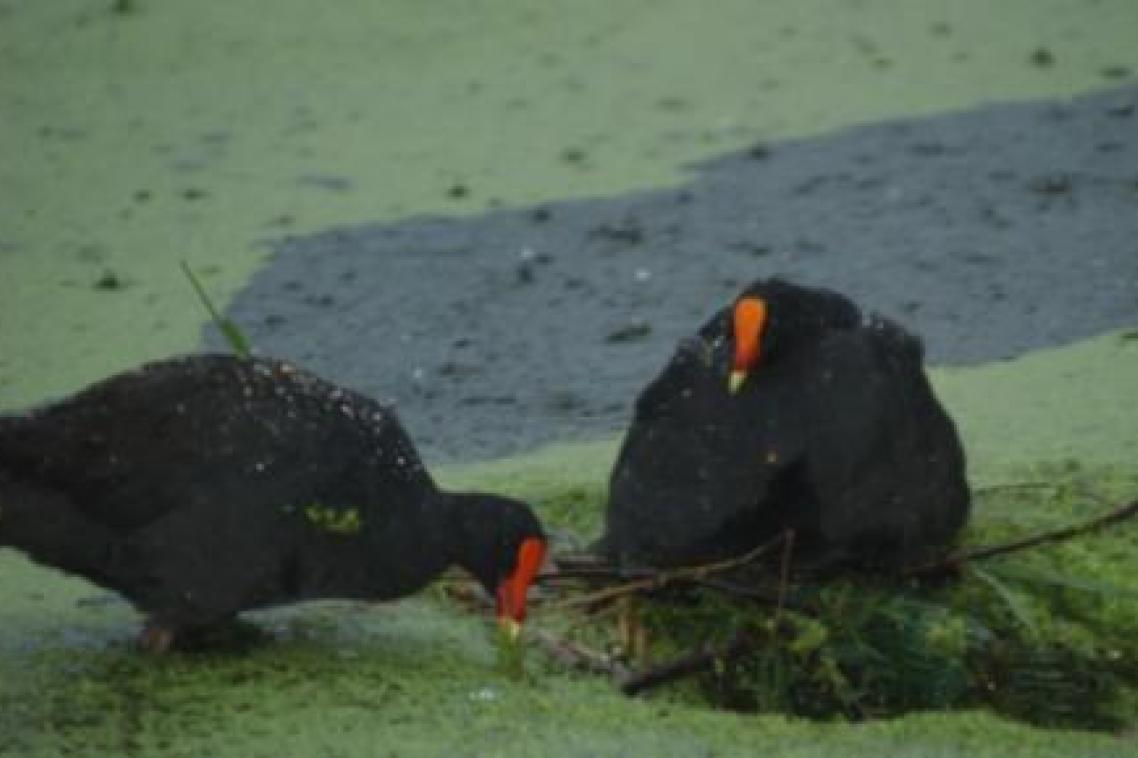
Raising a brood is a challenge at the best of times, but for a pair of dusky moorhens at The University of Queensland’s (UQ) St Lucia campus, the recent rains are making child rearing even more testing.
The pair was spotted last week sheltering their two chicks from the rain as the water level rose up to their nest, which was precariously balanced on an aeration grid on one of the smaller UQ Lakes.
Unfortunately their nest was swamped and the family had to move to higher ground on the lake’s edge and hide amongst the reeds.
The dusky moorhen (Gallinula tenebrosa) is a common water bird seen around the UQ Lakes. It has a red bill with yellow tip and grey-black feathers and is commonly found at freshwater wetlands, lakes and rivers in eastern and south-western Australia.
All the dusky moorhens in the group, even juveniles, will help care for the chicks for about 28 days until they fledge.
They feed on algae, water plants and grasses, but also eat seeds, fruits and invertebrates.
Another common rail species seen around UQ Lakes is the purple swamphen, which is a voracious carnivore known to eat the dusky moorhen chicks.
Director of The Ecology Centre at UQ, Professor Hugh Possingham, said a few of the wetland birds seen commonly around Brisbane were heading west to exploit the floods in inland Australia.
“Waterbirds will breed when there are good conditions and food available almost any time of the year,” he said.
Professor Possingham and friends will produce a bird guide to the UQ campus similar to the one produced for Oxley Creek Common, which has been very popular and resulted in increased numbers of people visiting the common to bird watch.
“Over the years more than 150 species have been recorded in and around the University of Queensland campus,” Professor Possingham said.
“On a one or two hour stroll around the lake and along the river you should be able to find more than 40 species.”
Media: Kathy Grube, UQ Communications, (07 3346 0561).
Topics
Related articles

UQ’s QARC wins at Engagement Australia Awards
