
Few friends for shy kangaroos
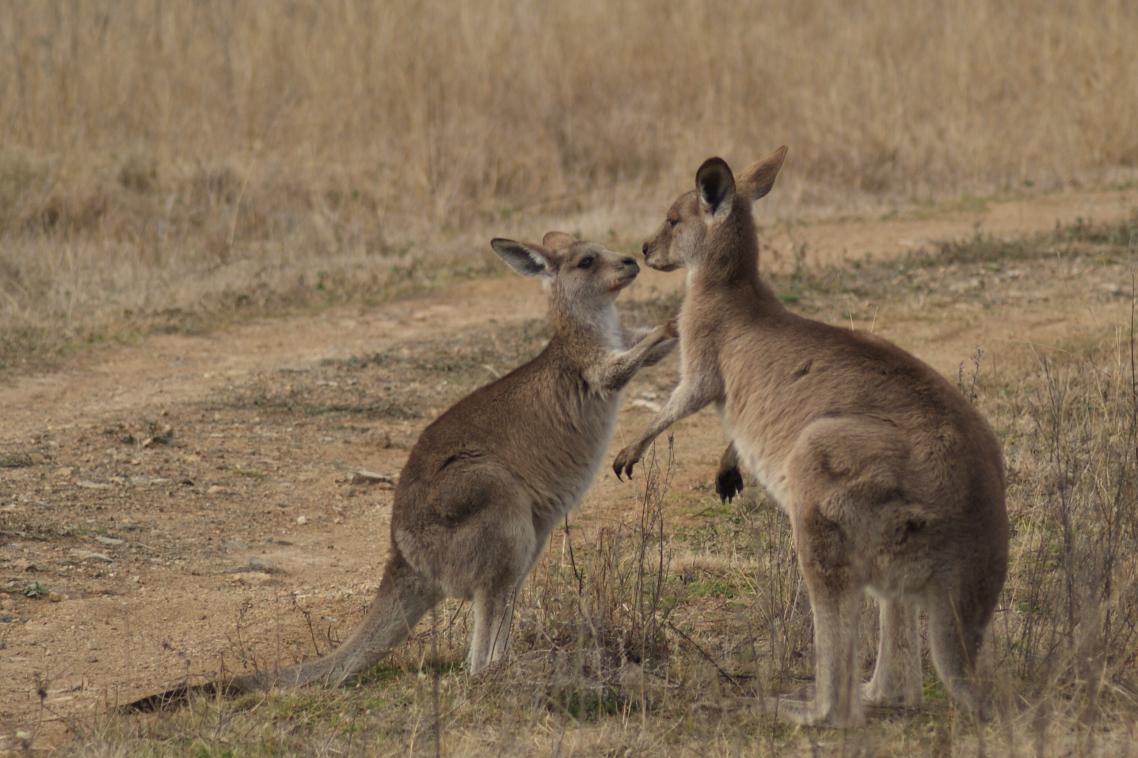
Kangaroo social networks could provide insight into the evolution of human personality differences.
Researchers from The University of Queensland studied the friendships of female kangaroos over 18 months to understand why personalities differ and how differences could affect behaviour.
School of Biological Sciences researcher Dr Emily Best said that risk-averse or ‘shy’ female kangaroos spent time in larger groups, but they had fewer friends.
“Individual female kangaroos differ consistently in both the sizes of groups in which they feed and in how shy or bold they are,” Dr Best said.
“Bolder females seem more comfortable in smaller groups and will seek out their ‘friends’, while shyer females opt to remain in larger groups where there is less risk of predation.
“Similar findings have been made for fish in captivity and domestic mammals, but never for mammals in the wild.
“These results increase our understanding of how aspects of personality affect each other, which will lead to better understanding of why such personality differences have evolved.”
Personality involves consistent differences in behaviour among individual animals and is thought to be at least partially genetically determined.
“Humans show the same sorts of individual differences which are partly determined by genetics,” Dr Best said.
“It is likely that personality evolved in similar ways in our ancestors as in animals, so studying personality in kangaroos will give us insight into humans.”
The researchers observed 171 wild female eastern grey kangaroos over 18 months, identifying friendships through analysis of which other females each kangaroo went out of her way to feed with.
Risk-taking propensity or ‘boldness’ was calculated by having someone the kangaroos didn’t know walk toward an animal at a consistent speed, measuring the distance at which the animal fled.
Bolder kangaroos allowed unknown humans to approach more closely and had more female associates or ‘friends’.
Associate Professor Anne Goldizen from UQ’s School of Biological Sciences said it was likely that shyer, more risk-averse females were unwilling to leave the foraging group in search of friends as it increased their risk of predation.
“Therefore their associations, or friendships, are weaker than those of individuals who go out of their way to be sociable,” she said.
“This work is part of a long-term study which will increase our understanding of why animals form social bonds.”
The research is published in Behavioral Ecology.
Media: Dr Anne Goldizen, 0409 694 096, bowerbirds@uq.edu.au.
Related articles

Supercharged 'molecule highway' could transform industrial processing
