Skip to menu Skip to content Skip to footer
News

UQ projects win Healthy Waterways awards
23 June 2015
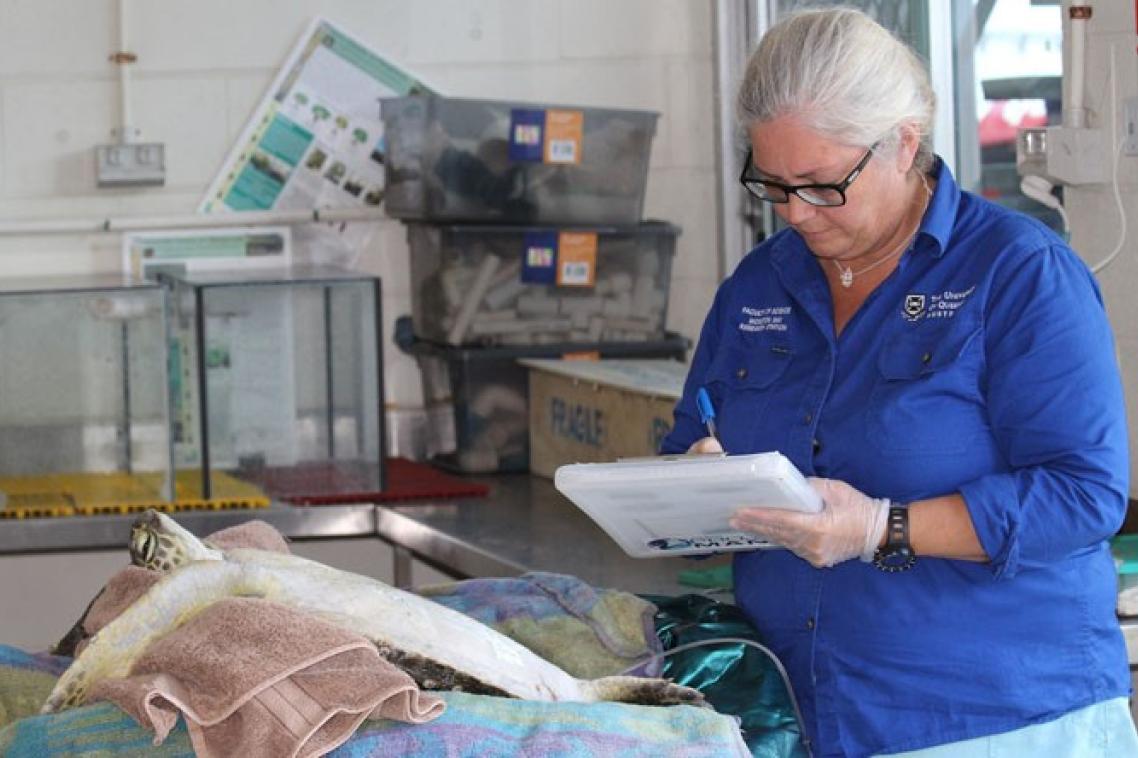
Dr Kathy Townsend studies a turtle victim of marine debris.

University of Queensland research highlighting the devastating impact of marine rubbish on wildlife has taken out the 2015 Healthy Waterways Research Award at the weekend.

The study, by researchers at UQ’s North Stradbroke Island Moreton Bay Research Station, sought to understand the impact of ingested marine debris on marine animals in Moreton Bay.

UQ’s UniDive won the Waterway Stewardship Award and the 2015 People’s Choice award for a project entitled: Caring for our local reefs. 

Dr Kathy Townsend said the marine rubbish project used endangered sea turtles as an indicator species.

“Our studies found more than 30 per cent of stranded turtles die due to eating marine debris, with another six per cent due to entanglement,” she said.

“Marine rubbish is having a significant impact on marine life.

“These impacts include ingestion of plastic debris and entanglement in packaging bands, synthetic ropes and lines or drift nets, both of which can lead to the death of turtles, birds and marine mammals.

“Our observations indicate that size, shape and composition of the rubbish and the age of the turtle all play an important role in whether the turtles will eat the debris and  if the gut becomes impacted.”

Dr Townsend said turtles often mistook plastic bags for jellyfish, one of their food sources. 

Ingesting marine debris can lead to floating syndrome, which occurs when a turtle’s gut became paralysed, preventing it from being able to digest food.

The food decomposes, releasing gases that get caught in the body cavity and cause the animal to float.

“The condition occurs either from a parasite infection or from swallowing marine debris like plastic bags or balloons,” Dr Townsend said.

“Turtles with floating syndrome can’t absorb water so they quickly dehydrate and, because they can’t dive underwater, they’re often attacked by other animals, hit by boats or severely sunburnt.”

The Australian Research Council Linkage grant research involved Professor Justin Marshall from UQ’s Queensland Brain Institute and the School of Biomedical Sciences, UQ postgraduate students Qamar Schuyler and Melody Puckridge, and the CSIRO.

UniDive’s Caring for our local reefs project involved more than 100 volunteer divers in an ecological assessment of dive sites at Point Lookout, North Stradbroke Island.

The project advanced the skills of local divers and involved the broader community through reports, videos, presentations and media.

Media: Dr Kathy Townsend 0428 388 959, kathy.townsend@uq.edu.au.

Related articles

Three researchers wearing blue protective lab gowns stand among rows of potted chickpea plants inside a controlled-environment plant research facility.

Turning up the heat on chickpea yield

A University of Queensland study has outlined a practical pathway for accelerating the development of heat adapted chickpeas using data from new ‘omic’ technologies. PhD candidate Callum Jamie said the suite of technologies offered tremendous opportunities to understand how a complex trait like heat tolerance works. “The narrow genetic diversity in the elite chickpea gene pool has limited conventional breeding’s effectiveness for stress tolerance,” Mr Jamie said. “These technologies have improved our capacity to dissect trait architecture and phenotype secondary traits but their use in chickpeas has been limited.” The technologies include genomics, epigenomics, transcriptomics, proteomics, metabolomics, phenomics and enviromics, and help provide a comprehensive picture of biological systems. Epigenomics helps understand what controls gene activity; transcriptomics considers gene expression; proteomics protein production; metabolomics looks at biochemical processes; phenomics observes traits; and enviromics considers environmental factors influencing outcomes. Mr Jamie said previous studies had focused on just 1 to 2 -omic datasets, a small number of genotypes, and single tissues. This has meant it was hard to infer what results meant for trait architecture and mechanisms and the ability to extrapolate the information to breeding populations was limited. There have also been challenges around cost, scalability and integrating very different types of data to make the technologies useful. To overcome the hurdles, Mr Jamie’s research at the Queensland Alliance for Agriculture and Food Innovation has resulted in a proposed staged approach. It would start with genomic prediction and phenotyping, before adding -omic layers as costs fall and unknowns were resolved. “These technologies are novel and we still don’t know which information provides added value and how best to integrate all of this data to achieve an outcome,” Mr Jamie said. His PhD is supported by the Grains Research and Development Corporation (GRDC) and the International Research Training Group (IRTG) Accelerating Crop Genetic Gain and is aligned to a project which aims to fast-track the development of chickpea varieties adapted to high temperatures. Project leader Dr Millicent Smith said heat stress causes severe yield implications through flower and pod loss, reduced pollen viability and impaired grain filling. “Late sown chickpea is particularly in the firing line across most of Australia's crop in southern Queensland and northern New South Wales,” Dr Smith said. “We want to ensure that Australian growers maintain their competitive edge. “New varieties with improved genetics to cope with heat stress are essential for the future. “This work, suggesting a staged approach to utilising the new -omic technologies, is an exciting frontier.” The research was published by Food and Energy Security. Callum Jamie’s PhD is supported by the Grains Research and Development Corporation (GRDC) and the International Research Training Group (IRTG) Accelerating Crop Genetic Gain.
15 October 2026
Close-up photograph of a red-bellied black snake coiled across pale, weathered wood. The snake has glossy black scales on its back and vivid red coloration along its sides and underside. The image highlights the texture of the scales and the contrast between the dark body and the light wood background.
Analysis

Deadly fungi are harming Australia’s wild reptiles. This is how to stop the spread

With spring underway and the weather warming, reptiles are on the move in suburbs, parks and bushland across Australia. Snake catchers and wildlife carers are responding to calls for help, and reptile enthusiasts – known as “herpers” – are heading outdoors in search of their next sighting.
13 October 2026

Media contact

Subscribe to UQ News

Get the latest from our newsroom.