Skip to menu Skip to content Skip to footer
News

Breeding study could save endangered long-beaked echidna
23 September 2015
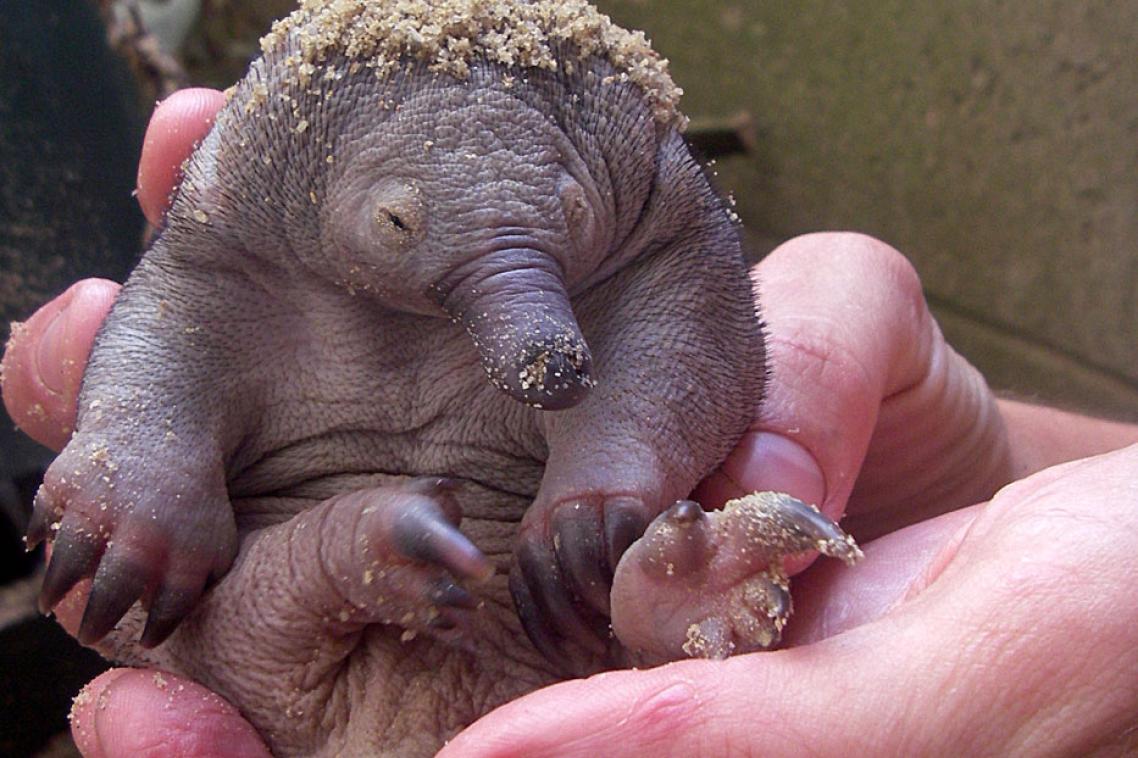
Picture: an echidna puggle at Currumbin Wildlife Sanctuary
An echidna puggle at Currumbin Wildlife Sanctuary

An echidna-breeding partnership between The University of Queensland and the Currumbin Wildlife Sanctuary has proved so successful that researchers hope their model could help save endangered echidna species. 

UQ School of Agriculture and Food Sciences reproductive zoologist Associate Professor Stephen Johnston said the program had produced 14 short-beaked echidna puggles (babies) in the past five years, more than any other zoo in the world.

“Up to a few years ago it was thought almost impossible to breed echidnas in captivity, and most births were somewhat accidental and unplanned,” Dr Johnston said.

“Now we can pretty much predict that, if we put A and B together and provide the right environmental conditions, a mating is likely to be successful.

“This breeding season our echidnas have already produced five eggs.

“We now have a better understanding of the echidna’s temperature regulation requirements and we are seeking to identify what hormones are involved at different stages of the females' breeding cycle.”  

Dr Johnston said short-beaked echidnas like those born at Currumbin were relatively common in the wild in Australia, but time was running out for their larger cousins, the long-beaked echidnas.

Short-beaked echidnas are found in Australia and north-east New Guinea.

Their endangered long-beaked cousins are found in New Guinea and Indonesia, where they are hunted for food and prone to habitat fragmentation.

Captive Breeding to Help Cousins from The University of Queensland on Vimeo.

UQ and the Currumbin Wildlife Sanctuary plan to establish a research centre to increase knowledge of monotreme reproduction and biology.

Dr Johnston said echidnas had a “bizarre” method of reproduction.

“The male has a four-headed penis, and uses two of those heads at a time to ejaculate sperm,” he said. 

A female echidna typically has a 20-day gestation period before laying an egg directly into her temporary pouch that develops when she  is pregnant and regresses when her baby no longer needs it. 

The puggles hatch about 10 days after the egg is laid, and stay in the pouch for two to three months.

Dr Johnston said the research program aimed to perfect short-beaked echidna breeding and husbandry and understand the animals’ physiology, behavior and relationships to reptiles and other mammals.

Currumbin Wildlife Sanctuary’s general manager of life sciences, Michael Pyne, said the research was an exciting journey.

“It's so important now we use what we have learnt to make a real difference to conservation and the plight of the long-beaked echidna from Papua New Guinea,” he said.

"Currumbin Wildlife Sanctuary is committed to conservation and research of our native wildlife and is proud to work closely with UQ in world-leading research such as this echidna project."

Media: Associate Professor Johnston, 0408 280 963, s.johnston1@uq.edu.au; Michael Pyne, mpyne@cws.org.au, +61 7 5534 0833.

Related articles

Three researchers wearing blue protective lab gowns stand among rows of potted chickpea plants inside a controlled-environment plant research facility.

Turning up the heat on chickpea yield

A University of Queensland study has outlined a practical pathway for accelerating the development of heat adapted chickpeas using data from new ‘omic’ technologies. PhD candidate Callum Jamie said the suite of technologies offered tremendous opportunities to understand how a complex trait like heat tolerance works. “The narrow genetic diversity in the elite chickpea gene pool has limited conventional breeding’s effectiveness for stress tolerance,” Mr Jamie said. “These technologies have improved our capacity to dissect trait architecture and phenotype secondary traits but their use in chickpeas has been limited.” The technologies include genomics, epigenomics, transcriptomics, proteomics, metabolomics, phenomics and enviromics, and help provide a comprehensive picture of biological systems. Epigenomics helps understand what controls gene activity; transcriptomics considers gene expression; proteomics protein production; metabolomics looks at biochemical processes; phenomics observes traits; and enviromics considers environmental factors influencing outcomes. Mr Jamie said previous studies had focused on just 1 to 2 -omic datasets, a small number of genotypes, and single tissues. This has meant it was hard to infer what results meant for trait architecture and mechanisms and the ability to extrapolate the information to breeding populations was limited. There have also been challenges around cost, scalability and integrating very different types of data to make the technologies useful. To overcome the hurdles, Mr Jamie’s research at the Queensland Alliance for Agriculture and Food Innovation has resulted in a proposed staged approach. It would start with genomic prediction and phenotyping, before adding -omic layers as costs fall and unknowns were resolved. “These technologies are novel and we still don’t know which information provides added value and how best to integrate all of this data to achieve an outcome,” Mr Jamie said. His PhD is supported by the Grains Research and Development Corporation (GRDC) and the International Research Training Group (IRTG) Accelerating Crop Genetic Gain and is aligned to a project which aims to fast-track the development of chickpea varieties adapted to high temperatures. Project leader Dr Millicent Smith said heat stress causes severe yield implications through flower and pod loss, reduced pollen viability and impaired grain filling. “Late sown chickpea is particularly in the firing line across most of Australia's crop in southern Queensland and northern New South Wales,” Dr Smith said. “We want to ensure that Australian growers maintain their competitive edge. “New varieties with improved genetics to cope with heat stress are essential for the future. “This work, suggesting a staged approach to utilising the new -omic technologies, is an exciting frontier.” The research was published by Food and Energy Security. Callum Jamie’s PhD is supported by the Grains Research and Development Corporation (GRDC) and the International Research Training Group (IRTG) Accelerating Crop Genetic Gain.
15 October 2026
Close-up photograph of a red-bellied black snake coiled across pale, weathered wood. The snake has glossy black scales on its back and vivid red coloration along its sides and underside. The image highlights the texture of the scales and the contrast between the dark body and the light wood background.
Analysis

Deadly fungi are harming Australia’s wild reptiles. This is how to stop the spread

With spring underway and the weather warming, reptiles are on the move in suburbs, parks and bushland across Australia. Snake catchers and wildlife carers are responding to calls for help, and reptile enthusiasts – known as “herpers” – are heading outdoors in search of their next sighting.
13 October 2026

Media contact

Subscribe to UQ News

Get the latest from our newsroom.