Skip to menu Skip to content Skip to footer
News

The (fish) eyes have it
24 November 2015
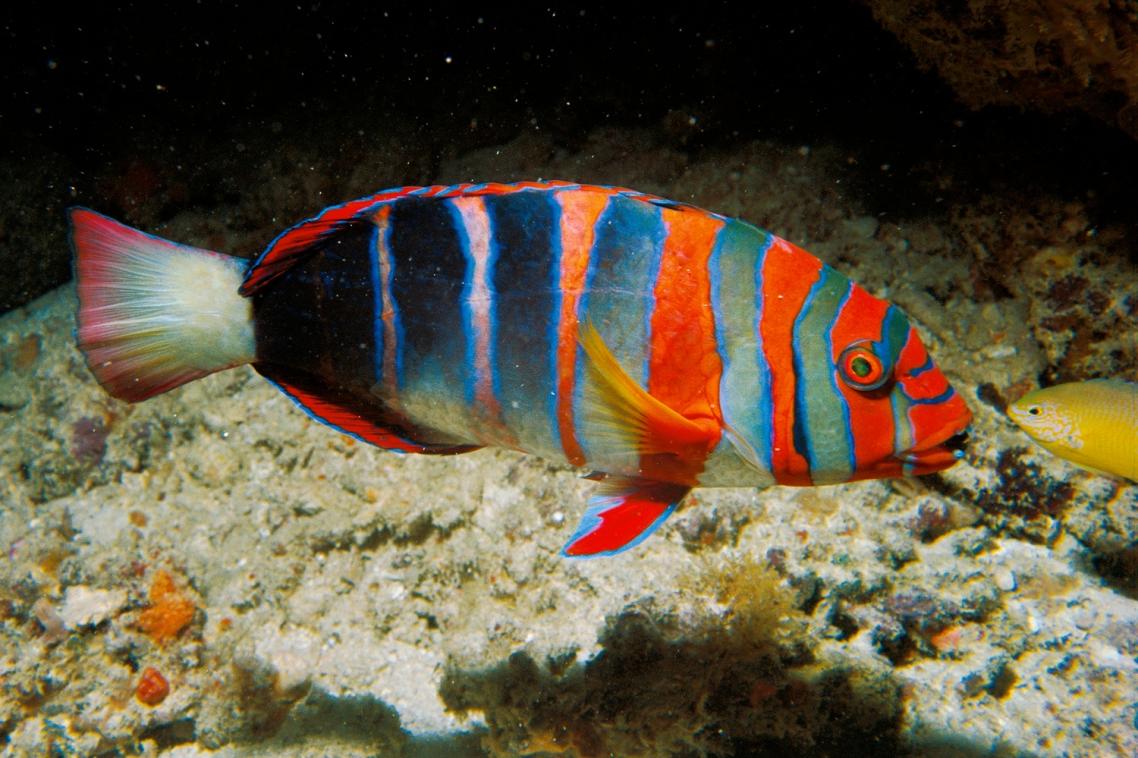
The harlequin tuskfish is a predatory wrasse found on the Great Barrier Reef. It was found to express four classes of opsins, including the UV-sensitive SWS1 opsin, despite having UV-blocking ocular media. Photo: Steve Parish.

Understanding how fish “see” is helping a team of international scientists increase their knowledge of the Great Barrier Reef’s biodiversity.

PhD student Genevieve Phillips at The University of Queensland's Queensland Brain Institute said the reef was one of the planet’s most visually diverse environments in terms of light availability and the colours and patterns on the animals living there.

“We studied the visual systems of the labrids, a large family of fish that includes wrasses – which are mainly predatory – and parrotfish – which tend to eat coral and algae,” she said.

“Many animals have visual systems that are tuned to the specific wavelengths of light that availablein their environment, so fish that live in rivers ‘see’ differently from fish living at the bottom of the ocean.”

Ms Phillips said the team, which includes scientists from The University of Maryland, studied the different types of opsins in fishes’ eyes.

“Opsins are light-sensitive proteins in the photoreceptors that absorb light at specific wavelengths,” she said.

This absorption was the first step in the process of “seeing” an image.

Watch Colourful coral reef fish see red on YouTube.


Researchers could learn which colours an animal could potentially see by studying the different classes and quantities of opsins in its eyes.

“Many labrids live in the same environment with similar light availability, so you could expect that their visual systems would be fairly similar,” Ms Phillips said.

“But we found that the repertoire of opsins they express is actually very different.

“In general, most of the opsins found in the fishes’ eyes were sensitive to the green-blue region of the spectrum, which is typical of many reef fish, as it is the dominant light available to fish on coral reefs.

“However, some of the labrids appeared to have specialised in opsins sensitive to orange-red light.”

Ms Phillips said this could help these fish find prey against a predominantly red-brown background.

“The more we understand about what fish can see, and how this relates to their behaviour, the more we will understand about biodiversity on the Great Barrier Reef,” she said.

The study is published in Molecular Biology and Evolution.

Media: QBI media and communications manager Bernadette Condren, b.condren@uq.edu.au, +61 7 3346 6353; Genevieve Phillips, g.phillips2@uq.edu.au, +61 (0)424 359405.


Related articles

A blonde woman in jeans and sneakers sits on a rock in the bush smiling.

Transforming communities: 2026 UQ Alumni Award winners

A Totally Wild legend, a leading parenting expert and a pioneer in Queensland’s community sector are among The University of Queensland’s 2026 Alumni Award winners.
16 October 2026
Three researchers wearing blue protective lab gowns stand among rows of potted chickpea plants inside a controlled-environment plant research facility.

Turning up the heat on chickpea yield

A University of Queensland study has outlined a practical pathway for accelerating the development of heat adapted chickpeas using data from new ‘omic’ technologies. PhD candidate Callum Jamie said the suite of technologies offered tremendous opportunities to understand how a complex trait like heat tolerance works. “The narrow genetic diversity in the elite chickpea gene pool has limited conventional breeding’s effectiveness for stress tolerance,” Mr Jamie said. “These technologies have improved our capacity to dissect trait architecture and phenotype secondary traits but their use in chickpeas has been limited.” The technologies include genomics, epigenomics, transcriptomics, proteomics, metabolomics, phenomics and enviromics, and help provide a comprehensive picture of biological systems. Epigenomics helps understand what controls gene activity; transcriptomics considers gene expression; proteomics protein production; metabolomics looks at biochemical processes; phenomics observes traits; and enviromics considers environmental factors influencing outcomes. Mr Jamie said previous studies had focused on just 1 to 2 -omic datasets, a small number of genotypes, and single tissues. This has meant it was hard to infer what results meant for trait architecture and mechanisms and the ability to extrapolate the information to breeding populations was limited. There have also been challenges around cost, scalability and integrating very different types of data to make the technologies useful. To overcome the hurdles, Mr Jamie’s research at the Queensland Alliance for Agriculture and Food Innovation has resulted in a proposed staged approach. It would start with genomic prediction and phenotyping, before adding -omic layers as costs fall and unknowns were resolved. “These technologies are novel and we still don’t know which information provides added value and how best to integrate all of this data to achieve an outcome,” Mr Jamie said. His PhD is supported by the Grains Research and Development Corporation (GRDC) and the International Research Training Group (IRTG) Accelerating Crop Genetic Gain and is aligned to a project which aims to fast-track the development of chickpea varieties adapted to high temperatures. Project leader Dr Millicent Smith said heat stress causes severe yield implications through flower and pod loss, reduced pollen viability and impaired grain filling. “Late sown chickpea is particularly in the firing line across most of Australia's crop in southern Queensland and northern New South Wales,” Dr Smith said. “We want to ensure that Australian growers maintain their competitive edge. “New varieties with improved genetics to cope with heat stress are essential for the future. “This work, suggesting a staged approach to utilising the new -omic technologies, is an exciting frontier.” The research was published by Food and Energy Security. Callum Jamie’s PhD is supported by the Grains Research and Development Corporation (GRDC) and the International Research Training Group (IRTG) Accelerating Crop Genetic Gain.
15 October 2026

Media contact

Subscribe to UQ News

Get the latest from our newsroom.