
Could we build a Star Wars lightsaber?
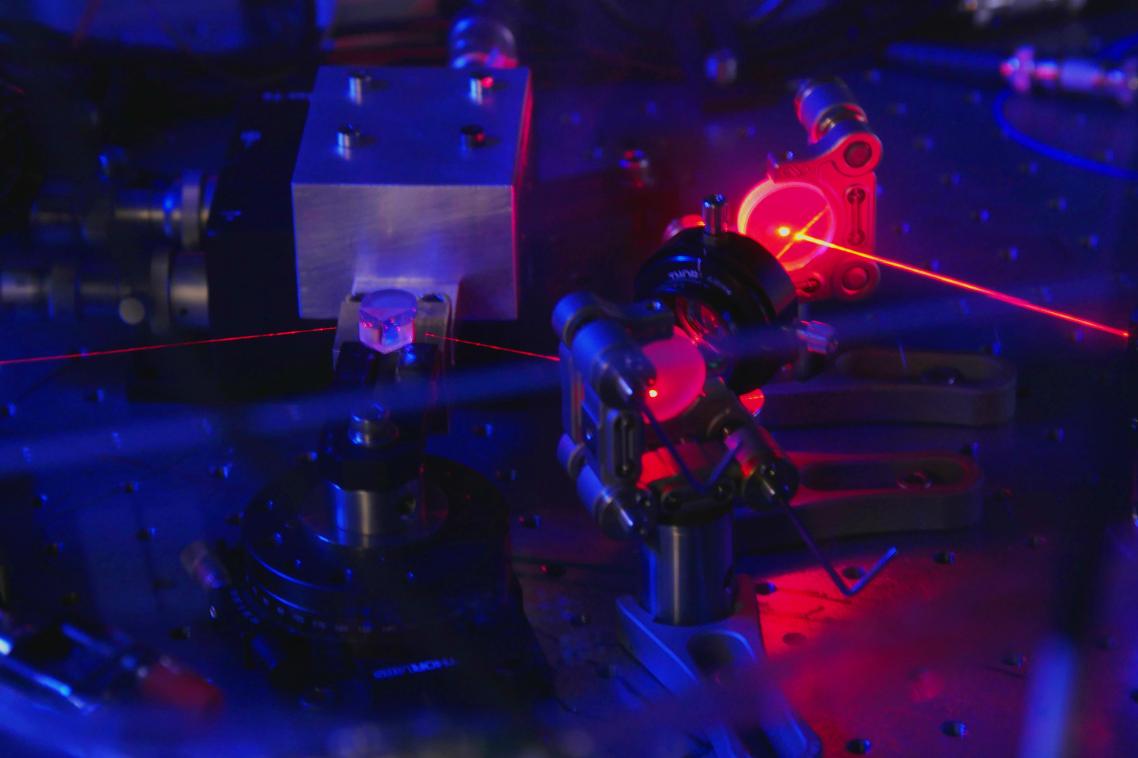
Unless you’ve been living in exile on Dagobah, you’ve probably noticed that Star Wars: Episode VII screened around Australia overnight.
Many elements of the Star Wars franchise have become icons of popular culture: none more so than the lightsaber.
While the lightsaber is a fictional weapon, it is an undeniably ingenious invention — compact and lightweight with a hypnotising beam that can effortlessly cut through steel.
But what would it take to actually build one?
UQ’s theoretical physicists from the ARC Centre of Excellence for Engineered Quantum Systems (EQuS) explain the possibilities.
According to physics researcher Martin Ringbauer, the main problem with building a lightsaber is controlling a beam of light.
“You can’t just make a laser stop without it hitting something solid or being reflected back on itself with a mirror” Mr Ringbauer says.
“Light doesn’t like to interact with itself, so two beams of light would actually pass through each other — which wouldn’t be very useful in a fight.”
Even if a beam of light could be controlled, the next problem is generating enough energy in the small hilt of a lightsaber to power a laser.
“Currently, we have very powerful industrial lasers that can cut through steel, used, for example, in car manufacturing,” Mr Ringbauer says.
“We also have laser weapons which companies like Boeing have developed to shoot down drones.
“However, these are more like the size of trucks to generate enough power to fire the laser, far from a handheld weapon.”
How we are using lasers today
Using lasers in everyday life might sound futuristic, but physics researcher James Bennett says they are actually all around us.
“These days everyone has lasers in their home for digital optical storage like DVD’s,” Mr Bennett says.
“And of course a lot of our internet is completely reliant on lasers.”
EQuS researchers are working to take lasers to the next step in fundamental research and market applications.
“We can use lasers to control atoms, how they move and what their energy is,” Mr Bennett says.
“This lets us build very sensitive machines to measure local gravity, which would let us find resources in the ground, for example.
“What I’m looking at is using light to control vibrations, so we could heat or cool objects by removing or adding vibrations.”
Media: UQ Communications, Casey Fung, c.fung@uq.edu.au, 3346 7887; EQuS, Tara Roberson, 0404 516 635, t.roberson@uq.edu.au.
Related articles

Transforming communities: 2026 UQ Alumni Award winners
