
Hot water puts crocs at risk
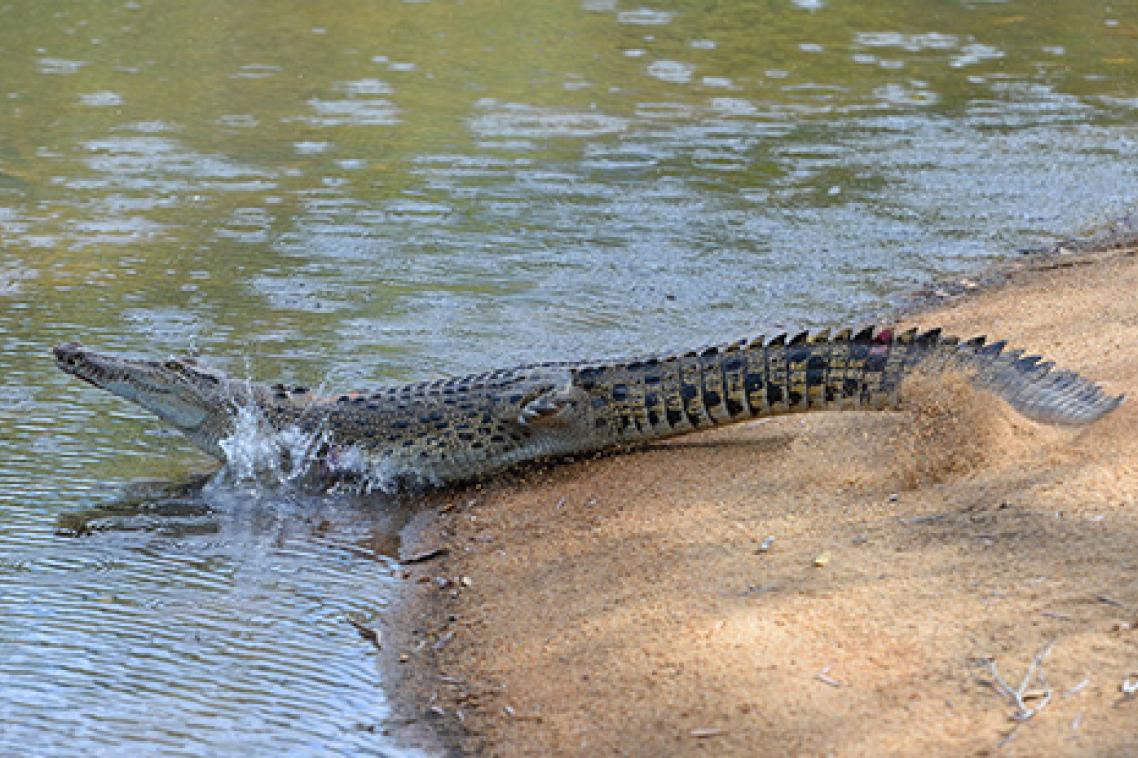
Australia’s saltwater crocodiles appear to be in hot water, with a University of Queensland study linking climate warming to shorter dives, putting the crocs’ survival at risk.
Professor Craig Franklin of the UQ School of Biological Sciences said saltwater crocodiles exposed to long-term elevated water temperature spent less time submerged once water temperature exceeded 31.5 degrees Celsius.
“We thought that crocodiles – like many animals – would adjust to temperature changes so life continues,” he said.
“However, we were surprised to find they had little capacity to compensate for water temperature changes and seemed to be hard-wired to operate at certain temperatures.
“We are not sure what this means, but it’s likely that if the water is too hot, crocodiles might move to cooler regions, or will seek refuge in deep, cool water pockets to defend their dive times.”
Lead author and PhD student Essie Rodgers said crocodiles would usually spend up to 11 hours a day submerged and their diving capacity was important to avoid predators, to forage, for sleep/recovery and for social interactions, which all occur underwater.
“Crocodiles are ectothermic animals – where environmental temperatures strongly influence their body temperatures,” she said.
Ms Rodgers said the study exposed crocodiles to three water temperatures reflecting differing climate change scenarios– current summer, 28°C; moderate climate warming, 31.5°C; and high climate warming, up to 35°C.
“Acute increases in water temperature resulted in significantly shorter crocodile dives,” she said.
“Their submergence times halved with every 3.5°C increase in water temperature.”
Ms Rodgers said the upper lethal temperature for crocodiles was in the high 30s to low 40s.
Air temperatures could easily exceed this, making water a critical refuge for crocodiles to cool down in and avoid becoming dehydrated.
Professor Franklin said further research on other crocodile performance traits that could influence the ability to survive future climate change was needed before scientists could fully understand the effects of elevated water temperatures.
The research, by Dr Franklin, Essie Rodgers and UQ Bachelor of Science (Honours) graduate Jonathan Schwartz, is published in Conservation Physiology.
Media: Essie Rodgers, essie.rodgers@uqconnect.edu.au, +61 (0) 433 787 605; Professor Craig Franklin, c.franklin@uq.edu.au, +61 7 3365 2355.
Topics
Related articles

Hay fever can strike even when grass pollen concentrations are low
