Skip to menu Skip to content Skip to footer
News

Even snakes get spinal aches
25 January 2016
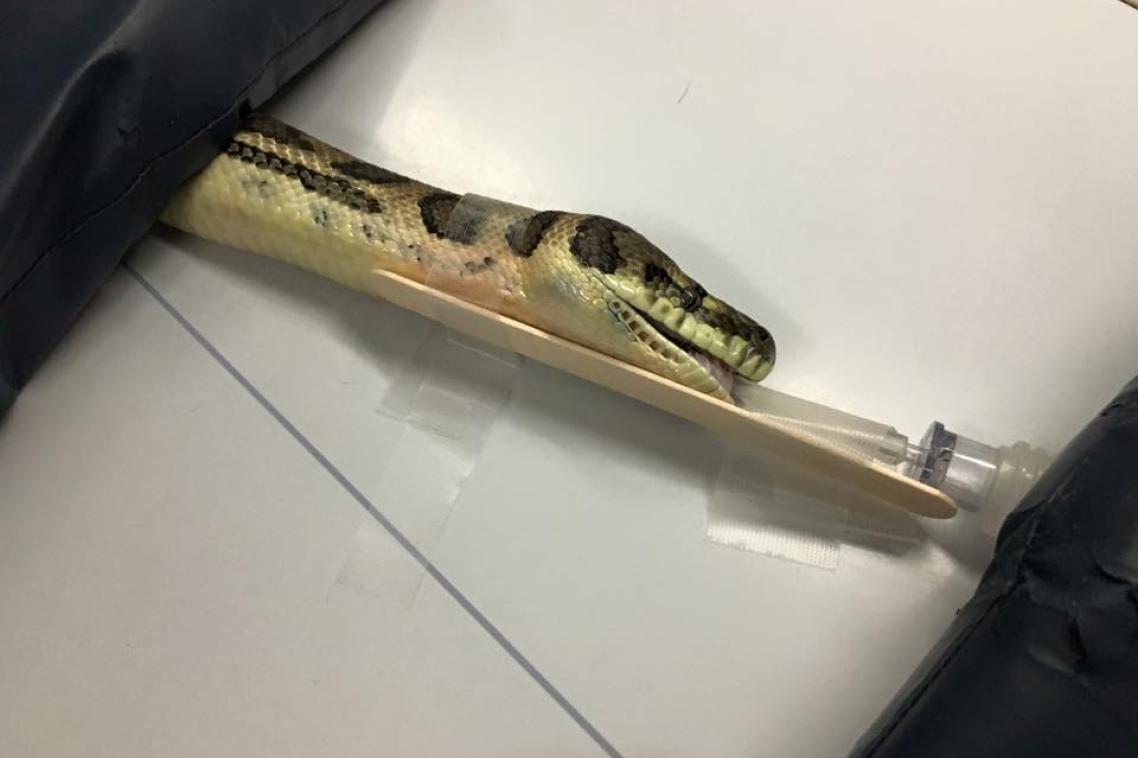
Proserpine Carpet Snake on the assessment table.

Even animals that spend all day on their front can have back problems , as the University of Queensland Small Animal Hospital avian and exotics team knows all too well.

The team, part of the School of Veterinary Science, treated an eight-foot-long Proserpine Carpet Python for spinal pain earlier this month.

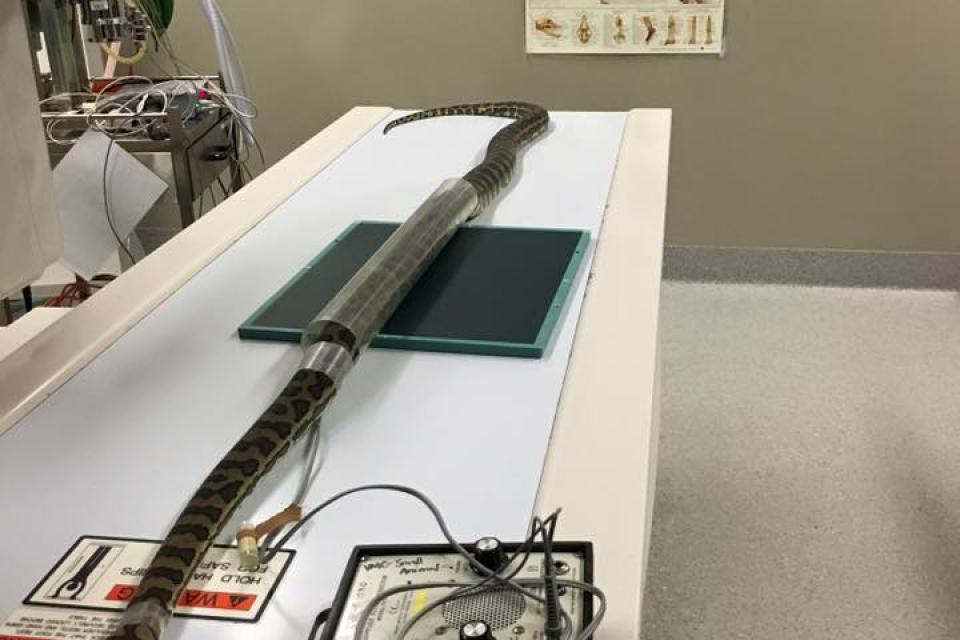
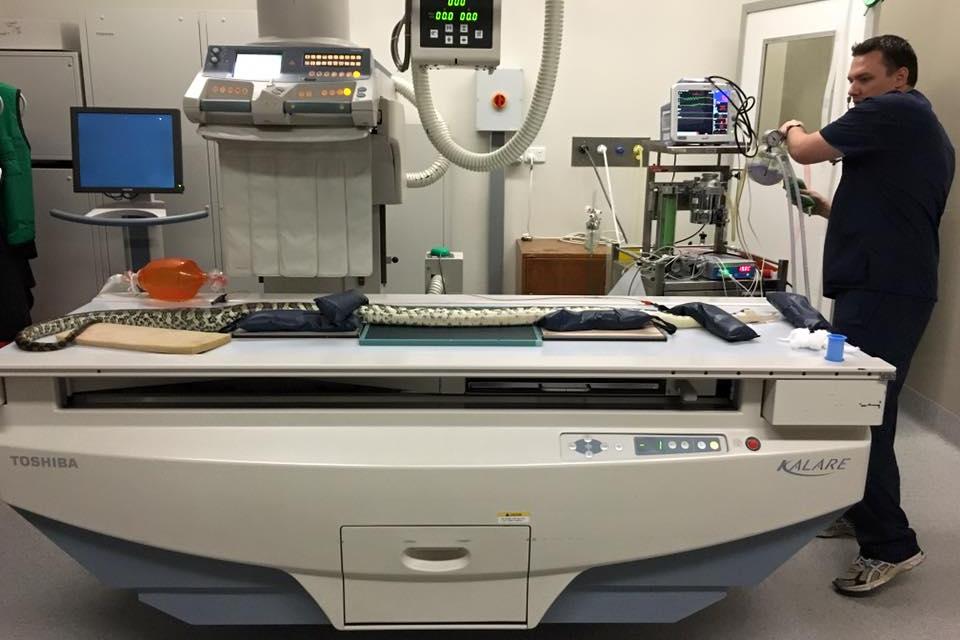
Associate Professor Dr Bob Doneley said the snake was longer than the X-ray table, and required special treatment for assessment.

“Snakes have between 300 and 400 vertebrae, each with a pair of ribs attached,” he said.
Decorative

And though non-venomous, the Proserpine snake could still wind tightly around a human and her bite could still pack a punch.

“It was a matter of anaesthetising her and then using a plastic tube to keep her back straight while we took the X-rays," Dr Doneley said.

 “One vertebrae in her spine was starting to dissolve and we haven’t ruled out an infection.”

The team put the snake on painkillers and antibiotics, and will check her progress in six months.

“Nothing happens in reptiles in a hurry,” Dr Doneley said.

Gary Fitzgerald, the clinic’s head nurse, is the owner of the snake. A keen herpetologist, Mr Fitzgerald has kept reptiles since he was a small boy and, with his training as a veterinary technician, he is alert to any signs of problems.

“He noticed this snake was becoming a bit more aggressive than usual, and also that when it was moving, it was keeping part of its back very straight,” Dr Doneley said.

“It would take an experienced reptile vet and keeper to notice this problem. So we examined the snake and pressed along its back and it reacted as if in pain.”

There’s an art to anaesthetising snakes, as the blood vessels cannot be seen through the skin and if you hit a muscle instead of a vein, the anaesthetic may not work.

“You’ve got to know where the veins are, then they take a minute or two to go to sleep and we put them on an anaesthetic machine using a ventilator.”

The clinic sees about 1000 wildlife cases a year, offering a variety of cases for UQ veterinary students to learn about treating and caring for wildlife.

“I always get a buzz when someone tells me they have released something,” Dr Doneley said.
Decorative
“This job is rewarding on so many levels. Teaching university students to look after these animals is the best part of this job.

“What they learn here, they won’t learn in a private practice where the focus is more on domestic animals.  This is a huge opportunity to learn about disease, medicine, surgery and general care of birds, reptiles, small animals and wildlife cases.

“The skills they learn now will help students to help them and similar species in future, which is particularly important if they become endangered.” 

The Veterinary School receives no government funding for wildlife care so it relies on community support through the Wildlife Emergency Care Fund.

“We are always grateful for donations to care for our native animals,” Dr Doneley said.

Click here to donate.

Caption: X-Raying an eight-foot-long Proserpine Carpet Snake.

Contact: Dr Bob Doneley, 07 54601 788 or r.doneley@uq.edu.au or UQ Communications on 07 3346 0561 or communications@uq.edu.au

Related articles

Three researchers wearing blue protective lab gowns stand among rows of potted chickpea plants inside a controlled-environment plant research facility.

Turning up the heat on chickpea yield

A University of Queensland study has outlined a practical pathway for accelerating the development of heat adapted chickpeas using data from new ‘omic’ technologies. PhD candidate Callum Jamie said the suite of technologies offered tremendous opportunities to understand how a complex trait like heat tolerance works. “The narrow genetic diversity in the elite chickpea gene pool has limited conventional breeding’s effectiveness for stress tolerance,” Mr Jamie said. “These technologies have improved our capacity to dissect trait architecture and phenotype secondary traits but their use in chickpeas has been limited.” The technologies include genomics, epigenomics, transcriptomics, proteomics, metabolomics, phenomics and enviromics, and help provide a comprehensive picture of biological systems. Epigenomics helps understand what controls gene activity; transcriptomics considers gene expression; proteomics protein production; metabolomics looks at biochemical processes; phenomics observes traits; and enviromics considers environmental factors influencing outcomes. Mr Jamie said previous studies had focused on just 1 to 2 -omic datasets, a small number of genotypes, and single tissues. This has meant it was hard to infer what results meant for trait architecture and mechanisms and the ability to extrapolate the information to breeding populations was limited. There have also been challenges around cost, scalability and integrating very different types of data to make the technologies useful. To overcome the hurdles, Mr Jamie’s research at the Queensland Alliance for Agriculture and Food Innovation has resulted in a proposed staged approach. It would start with genomic prediction and phenotyping, before adding -omic layers as costs fall and unknowns were resolved. “These technologies are novel and we still don’t know which information provides added value and how best to integrate all of this data to achieve an outcome,” Mr Jamie said. His PhD is supported by the Grains Research and Development Corporation (GRDC) and the International Research Training Group (IRTG) Accelerating Crop Genetic Gain and is aligned to a project which aims to fast-track the development of chickpea varieties adapted to high temperatures. Project leader Dr Millicent Smith said heat stress causes severe yield implications through flower and pod loss, reduced pollen viability and impaired grain filling. “Late sown chickpea is particularly in the firing line across most of Australia's crop in southern Queensland and northern New South Wales,” Dr Smith said. “We want to ensure that Australian growers maintain their competitive edge. “New varieties with improved genetics to cope with heat stress are essential for the future. “This work, suggesting a staged approach to utilising the new -omic technologies, is an exciting frontier.” The research was published by Food and Energy Security. Callum Jamie’s PhD is supported by the Grains Research and Development Corporation (GRDC) and the International Research Training Group (IRTG) Accelerating Crop Genetic Gain.
15 October 2026
Close-up photograph of a red-bellied black snake coiled across pale, weathered wood. The snake has glossy black scales on its back and vivid red coloration along its sides and underside. The image highlights the texture of the scales and the contrast between the dark body and the light wood background.
Analysis

Deadly fungi are harming Australia’s wild reptiles. This is how to stop the spread

With spring underway and the weather warming, reptiles are on the move in suburbs, parks and bushland across Australia. Snake catchers and wildlife carers are responding to calls for help, and reptile enthusiasts – known as “herpers” – are heading outdoors in search of their next sighting.
13 October 2026

Media contact

Subscribe to UQ News

Get the latest from our newsroom.