
Tiny worm opens big discovery on nerve degeneration
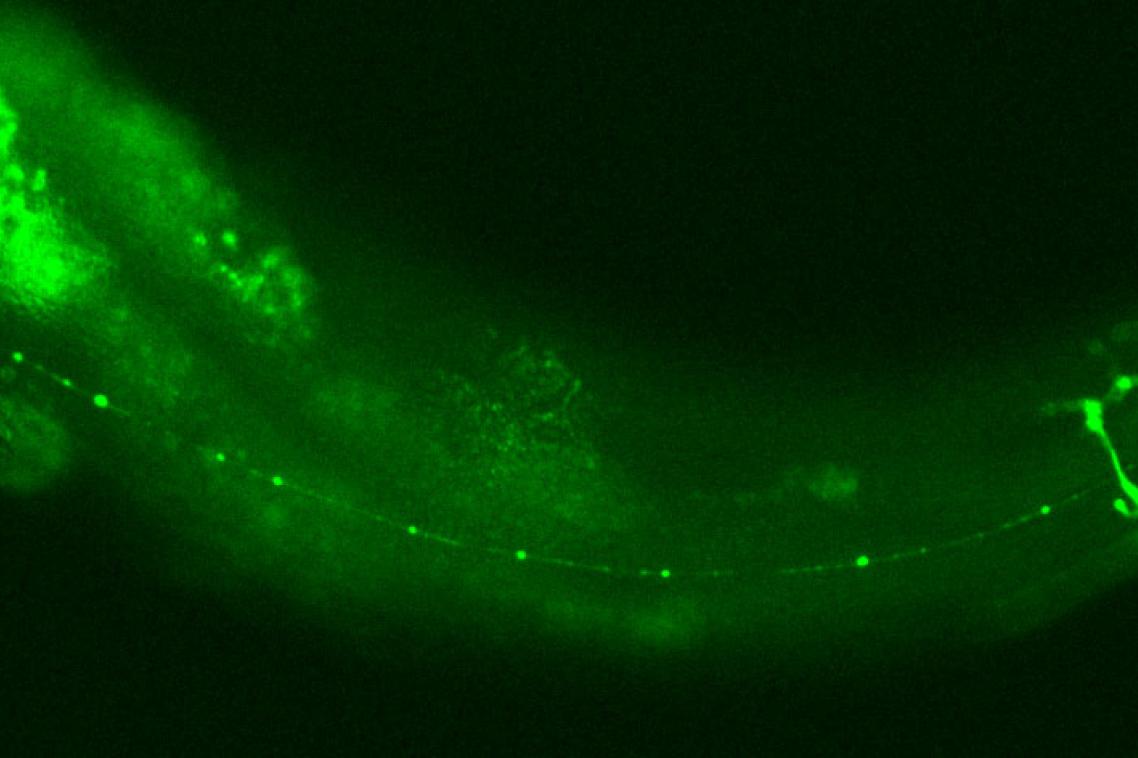
A discovery in a transparent roundworm has brought scientists one step closer to understanding nerve degeneration.
University of Queensland researchers have discovered the worm contains two proteins that play a role in the degeneration of axons in nerve cells.
Project leader Associate Professor Massimo Hilliard, from the Queensland Brain Institute, said axons – long, thread-like nerve cell sections that transmit information – were one of the first parts destroyed in neurodegenerative disease.
“By understanding the molecules involved in axonal degeneration, we can find better ways to protect neurons,” Dr Hilliard said.
“Axons are often hit and damaged by external trauma or internal injury.”

The researchers discovered the new proteins by using a laser to cut axons in the roundworm Caenorhabditis elegans (C. elegans), a small model system with only 302 neurons.
Monash University collaborator Dr Brent Neumann, previously of QBI, said C. elegans was an ideal research model.
“This tiny worm – about 1mm long – allows us to understand what happens in axonal degeneration on a molecular and genetic level,” Dr Neumann said.
“We found there is cross-talk between the dying neuron and the surrounding tissue, where the neuron sends a signal that it needs to be cleaned up.”
The study’s co-lead author, Ms Annika Nichols, said the discovery created new avenues for researchers seeking to limit the degenerative process.
“The aim would be to allow neurons to be better preserved,” she said.
The proteins identified seem to alter the membrane of dying neurons.
“The molecular components we discovered are conserved across evolution, meaning that the same proteins exist in the C. elegans worm as in flies, mice and humans,” Ms Nichols said.
Collaborators on the project included Professor Ding Xue from the University of Colorado, Boulder, and Professor David Hall from the Albert Einstein College of Medicine New York.
The National Health and Medical Research Council, the Australian Research Council, and the National Institutes of Health funded the study, which is published in Cell Reports.
Contact: Donna Lu, +61 7 3346 6419, d.lu@uq.edu.au; Associate Professor Massimo Hilliard, +61 404 784 264, m.hilliard@uq.edu.au.
Watch a video on the team's work here
Topics
Related articles

Sick of being told to ‘just lose weight’? Health promotion shouldn’t come with weight stigma
