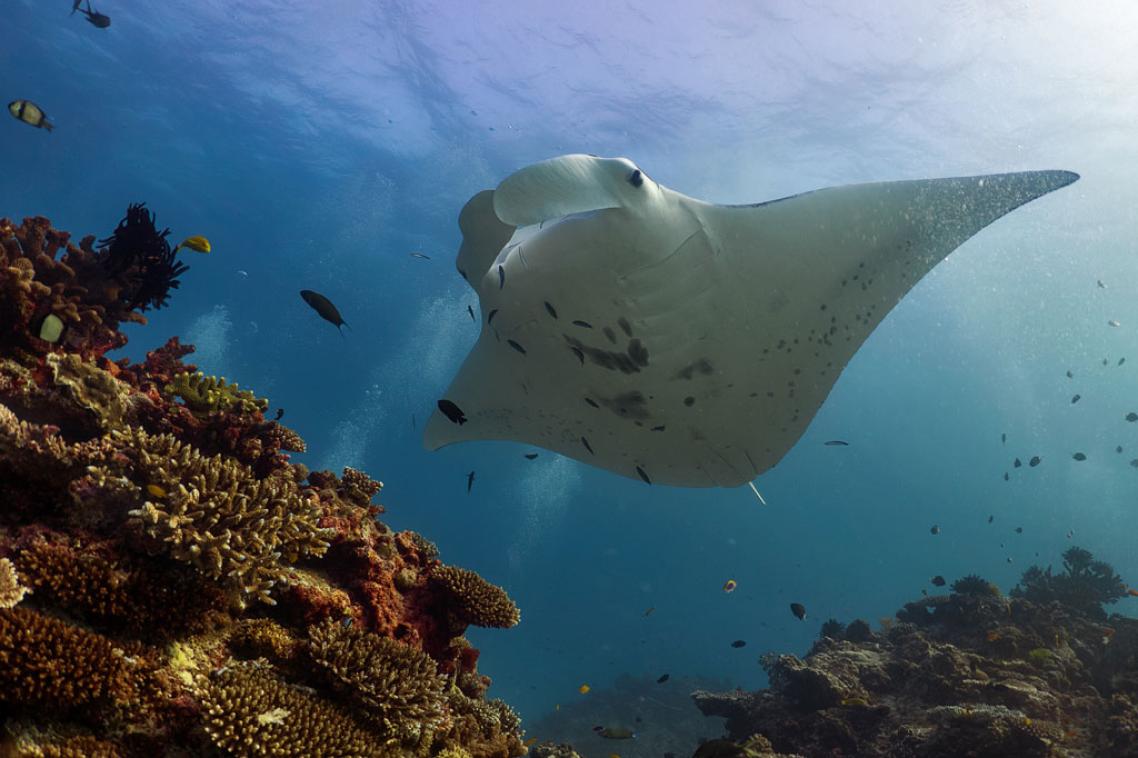
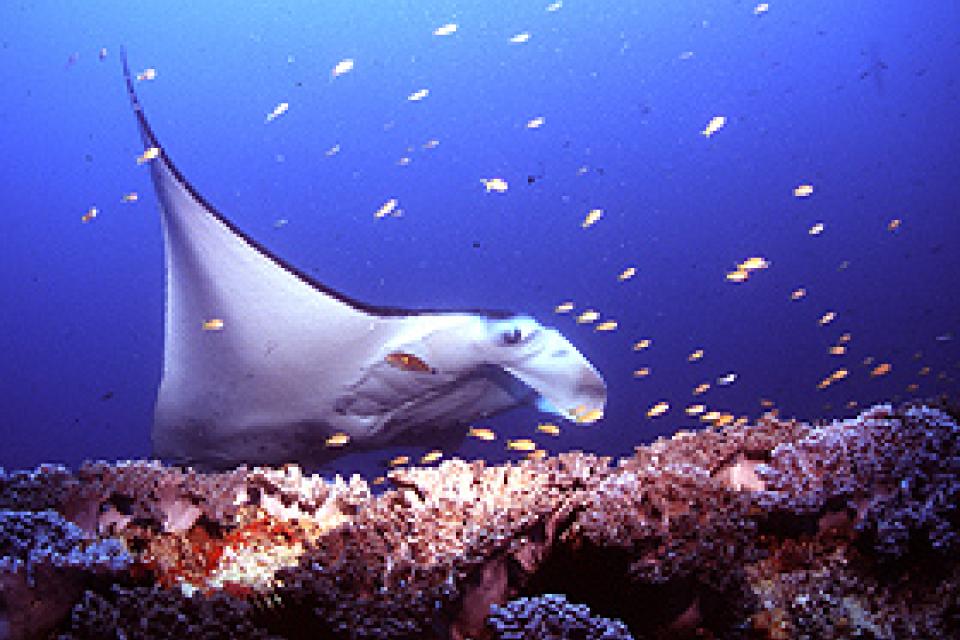
A reef manta ray at Lady Elliot Island. Photo: Amelia Armstrong.
A team of international scientists has unlocked the foraging secrets of manta rays at Lady Elliot Island, which could help conservation efforts for the vulnerable species.
Led by The University of Queensland, the team found manta rays only feed when the biomass of their food source — tiny creatures known as zooplankton — passes a critical threshold, which happens two hours before high tide.
“This is the first study of the feeding and prey availability at any site where reef manta rays are known to aggregate,” said paper co-author Professor Anthony Richardson of UQ’s School of Mathematics and Physics, and CSIRO Oceans and Atmosphere.
Lady Elliot Island is a well-known gathering site for the mysterious reef manta rays (Manta alfredi) in the southern Great Barrier Reef.
“Despite the popular interest worldwide for manta rays, very little is known about their biology and ecology,” Professor Richardson said.
“However, further knowledge is essential for conservation.”
The researchers visited three sites near Lady Elliott Island to collect samples of prey, and combined this with long-term sighting records for manta rays in the area.
They performed laboratory and complex statistical analyses, factoring in oceanographic influences, to reach their conclusions.
“Over the past decade, there has been considerable research effort to understand the basic ecology and biology of these animals,” she said.
“A remaining gap, however, has been an understanding of their movement ecology in relation to foraging.
“Conserving highly mobile species can be particularly challenging. However analysis of species critical habitats and drivers for their migrations can help inform conservation planning.”
The study also involved researchers from the Manta Ray and Whale Shark Research Centre, Mozambique, and Aix-Marseille Universite, France, and Lady Elliot Island Eco Resort.
An open-source software tool to help find a sweet spot between competing environmental and development demands has been launched by University of Queensland researchers.
The University of Queensland’s advanced engineering expertise will assist a Queensland Government-funded consortium to develop a mobile launch capability for high-speed flight research, development and testing in the state.