
Purple bacteria shine path to super-efficient light harvesting

In its billions of years on earth, plant life has become super-efficient at using light – and now it’s showing how it does it.
A quantum – minuscule – examination of chlorophyll within certain purple bacteria shows an exceptionally efficient geometric arrangement for light harvesting, say scientists from The University of Queensland and Iran’s Institute for Research in Fundamental Sciences.
UQ School of Mathematics and Physics’s Dr Ivan Kassal, also a researcher at the ARC Centre of Excellence for Engineered Quantum Systems, said the bacteria used “quantum coherence” – particles’ wave-like properties – to harvest light during photosynthesis.
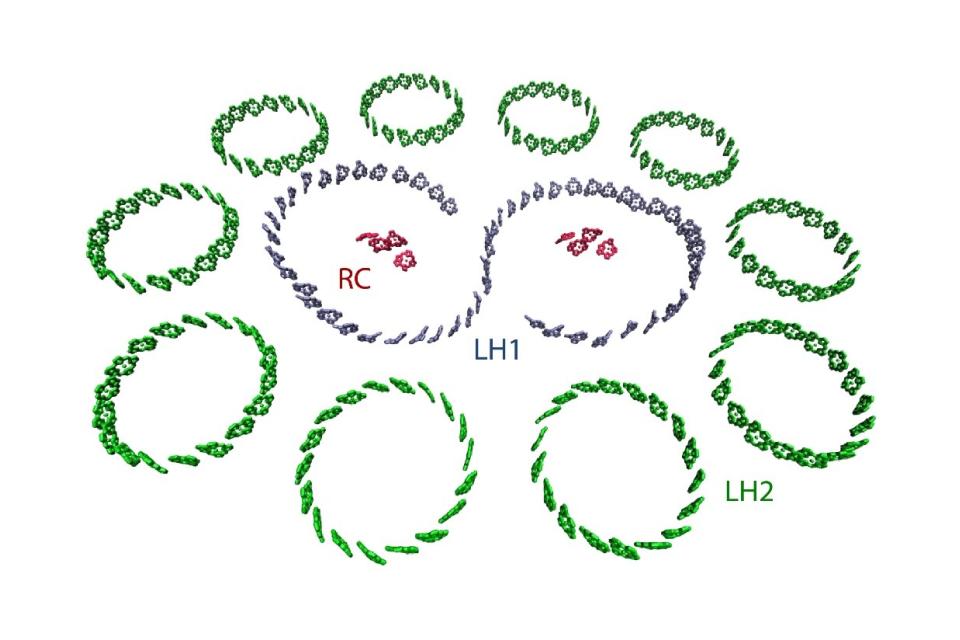
“Inside, the bacteria’s chlorophyll molecules – which collect energy from light – are arranged in symmetrical rings,” Dr Kassal said.
“This geometric organisation is exceptionally good for light harvesting.
“By Understanding how the purple bacteria harvest light, we may be able to use these lessons to improve how we do artificial light harvesting.”
Dr Kassal said previous research had proposed the theory that quantum coherence played a role in how the purple bacteria harvested light.
“We found that the geometry adopted by the purple bacteria allows for quantum coherence,” he said.
“There has been debate in the field about whether coherent effects are possible in photosynthetic systems at all.”
“The research was significant also because it provided evidence of quantum effects in a biological setting,” Dr Kassal said.
“We know now that quantum effects cannot be neglected in studies on biological light harvesting,” he said.
“The study also opens avenues for research into whether quantum coherence already occurs in organic solar cells, and whether humans can deliberately engineer that coherence to make them more efficient.”
Dr Kassal said he hoped to apply the findings to investigations of other species, including plants.
The paper appeared in the Journal of Physical Chemistry Letters.
Media: Dr Ivan Kassal, i.kassal@uq.edu.au, +61 7 3365 7415; Tara Roberson, EQuS Communications, t.roberson@uq.edu.au, +61 7 3346 7429
Topics
Related articles

Hay fever can strike even when grass pollen concentrations are low
