
Size matters when innovating dairy products
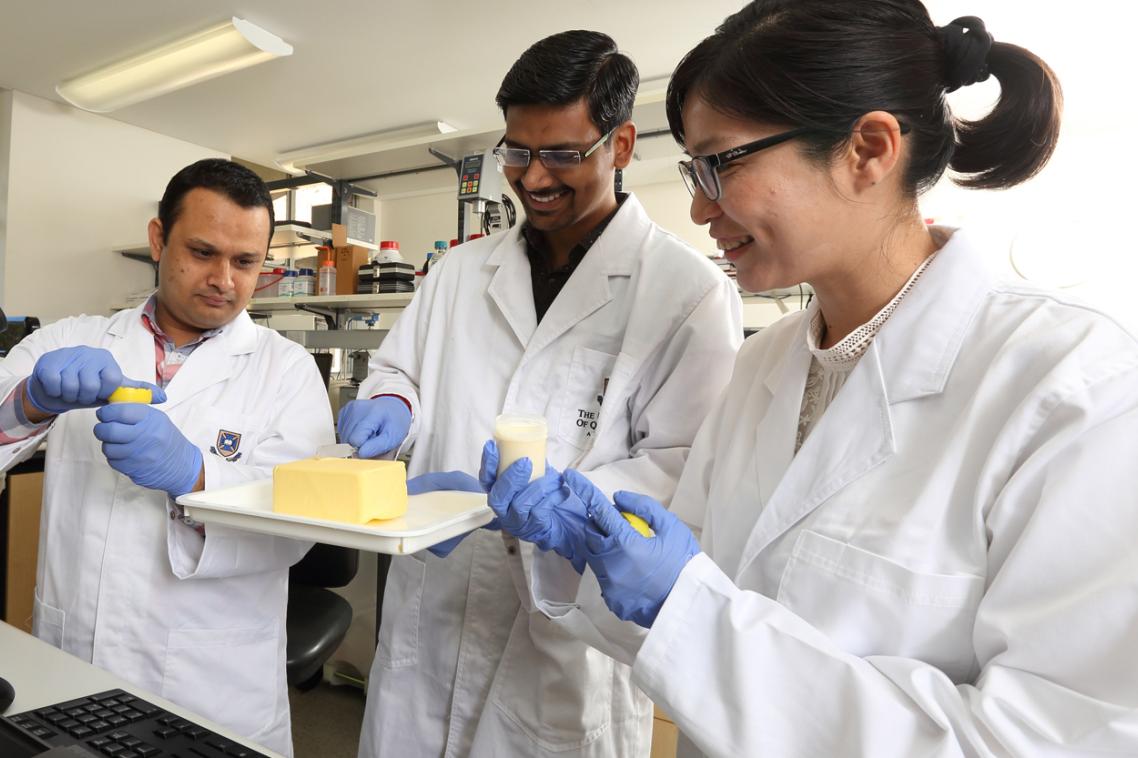
Imagine low-fat cream that’s easier to whip, cold butter that’s more spreadable, and dairy cream powders that can be tailored for a range of products from milk to cheese to yoghurts.
The solution is all in the fat globule sizes, according to a research team led by Professor Bhesh Bhandari of the The University of Queensland’s School of Agriculture and Food Sciences.
Professor Bhandari, also of the Australian Research Council (ARC) Dairy Innovation Hub, is pioneering techniques to create innovative dairy products with relatively small capital investment.
“Fat globules in milk came in various sizes, with each size class able to be used to improve specific dairy products,” Professor Bhandari said.
“Our latest findings reveal that small fat globules impart an amazing stability to cream and give cold butter softer texture and improved spreadability.”
Professor Bhandari and his team are exploiting technologies such as nanoemulsions (emulsified oil and water systems with droplets ranging in the billionths of a metre), which are gaining popularity in the pharmaceutical industry.
- ARC Dairy Innovation Hub PhD student Pramesh Dhungana said the team at UQ had developed procedures using a modified commercial cream separator to separate native milk fat globules into various size ranges without damaging the droplet integrity.
“The benefit of using the existing dairy equipment is that it can be readily applied to the dairy industry with some modifications,” he said
“We expect this innovative approach can be used to increase the whippability of low fat cream and to manufacture functional cream powder for use in recombined liquid milk, cheese, yoghurt and butter making.”
- ARC Dairy Innovation Hub PhD student Bhavesh Panchal is downsizing creams into nanometric size ranges and using the resultant nano-sized creams in butter making at UQ.
“This will help in introducing further desirable properties in low fat butter or fat spreads,” he said.
“We can’t wait to learn about consumer responses to the taste and flavour of nano-sized butter in the later stages of the project.”
ARC Dairy Innovation Hub director Associate Professor Sally Gras said the capabilities developed by the nanoemulsions team had the potential to allow production of innovative dairy ingredients, providing the Australian industry with a competitive advantage.
“This is a great outcome for the dairy industry, as these innovations could boost the sale of dairy fat products, potentially increasing the return on investment to dairy manufacturers,” she said.
The Nanoemulsion team at UQ includes Professor Bhandari, Dr Nidhi Bansal, Dr Sangeeta Prakash, Dr Tuyen Truong, Mr Dhungana and Mr Panchal, in partnership with The University of Melbourne researchers and dairy manufacturing companies.
The studies are published in the Innovative Food Science and Emerging Technologies (https://doi.org/10.1016/j.ifset.2017.03.011) and Food Research International (https://doi.org/10.1016/j.foodres.2017.05.027) Journals.
The work extends on a previous UQ project funded by Dairy Innovation Australia Limited (DIAL), where dairy nanoemulsions were revealed to have unique physical characteristics.
Media: Bhesh Bhandari, b.bhandari@uq.edu.au, +61 7 3346 9192.
Related articles

Shaping the future of medicine: UQ Medical School turns 90
