Skip to menu Skip to content Skip to footer
News

Nanango takes out back-to-back sunflower awards
17 May 2018
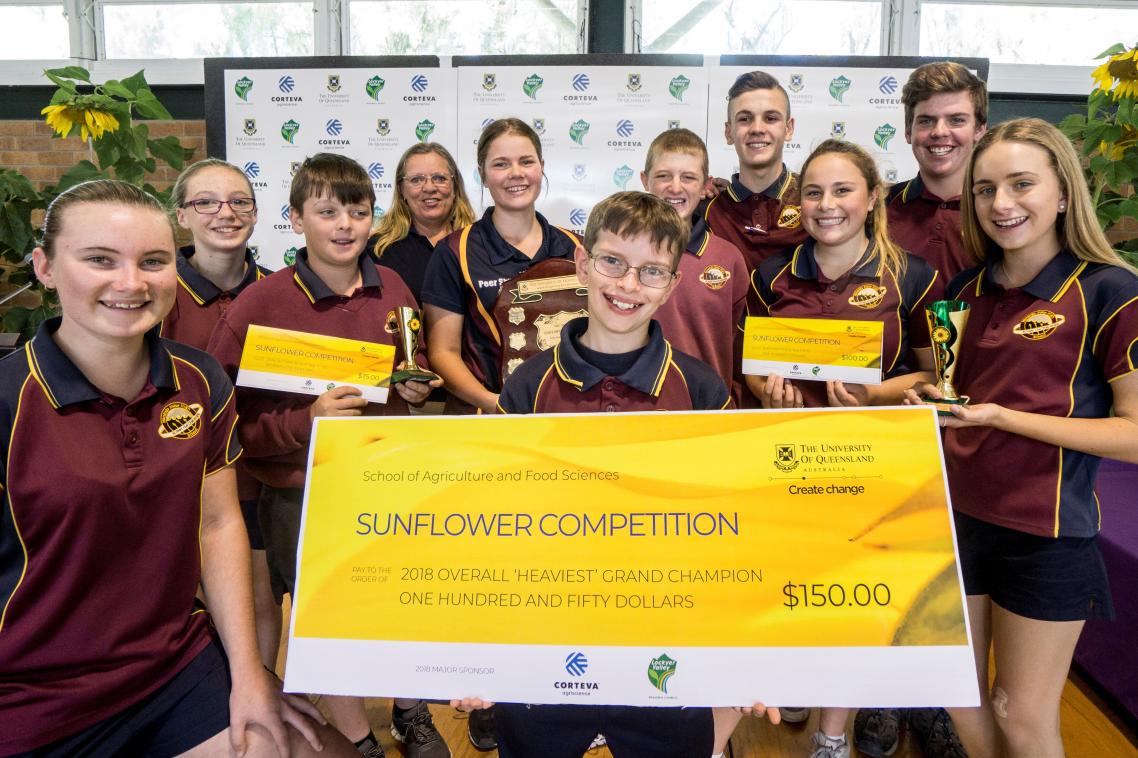
The winners are... Nanango State High School

Budding plant scientists from Nanango State High School have won the Overall Grand Champion prize at The University of Queensland Sunflower Competition for the second year in a row.

Building on last year’s formula for success, the small South Burnett school grew a giant sunflower weighing 2.97kg, which topped the competition at UQ Gatton campus.

More than 4000 students from 103 high schools across Australia participated in this year’s competition.

UQ School of Agriculture and Food Sciences head Professor Neal Menzies said the University worked hard with schools to make it a fair competition, given the different growing conditions across the country – from soil varieties to extreme weather events.

“All schools work with the same genetic source material – the same seed variety – and must use a specified pot size, but they are encouraged to be as creative as they can within the rules to get the prize,” Professor Menzies said.

Thirteen schools attended the competition weigh-in day at Gatton, while others submitted videos.

The students grew their sunflowers over a 12-week period, aiming to beat the all-time record weight of 4.455kg set by Mueller College in 2014.

“Since the initial planting date in February, students have tended their potted sunflowers at school, experimenting with different soils, light regimes, water applications and fertilisers,” Professor Menzies said.

“They have had to learn about and consider environmental factors such as weather, growing conditions in their regions, and how this affects sunflower growth.”

The budding agriculturalists also toured the Gatton campus, had lunch, heard from industry representatives and participated in science activities.

The competition, now in its 19th year, promotes the science behind agronomy and horticulture.

Watch the presentations on Facebook.

2018 results:

Overall ‘Heaviest’ Grand Champion

Nanango State High School Years 11-12, weight 2.97 kg


Tallest Sunflower Prize: Year 10, Glasshouse Christian College, 3.1m      

Most Ornamental Sunflower Prize: Wilsonton State High Year School, Toowoomba, Year 11

Encouragement Award 1: Ferny Grove State High School Year 10B

Encouragement Award 2: Fairholme College Toowoomba Year 11


Heaviest yields in the regions Year 7-10

1st Harristown State High School, Toowoomba Agriculture Science class 941g

2nd Atherton State High School 561g

3rd Redlands College 535g


Heaviest yields in the regions Years 11-12

1st St Stephen’s College, Mareeba, 159g
 

Heaviest yield Gatton weigh-in day Years 7 to 10

1st Brisbane Adventist College 806g

2nd Nanango State High School 803g

3rd Brisbane Adventist College 673g
 

Heaviest yield Gatton weigh-in day Years 11-12

1st Nanango State High School 925g

2nd Glasshouse Christian College 871g

3rd Marymount College 851g

Media: Neil Donnelly, n.donnelly@uq.edu.au , +61 7 5460 1229, 0409 265 587.

Related articles

Three researchers wearing blue protective lab gowns stand among rows of potted chickpea plants inside a controlled-environment plant research facility.

Turning up the heat on chickpea yield

A University of Queensland study has outlined a practical pathway for accelerating the development of heat adapted chickpeas using data from new ‘omic’ technologies. PhD candidate Callum Jamie said the suite of technologies offered tremendous opportunities to understand how a complex trait like heat tolerance works. “The narrow genetic diversity in the elite chickpea gene pool has limited conventional breeding’s effectiveness for stress tolerance,” Mr Jamie said. “These technologies have improved our capacity to dissect trait architecture and phenotype secondary traits but their use in chickpeas has been limited.” The technologies include genomics, epigenomics, transcriptomics, proteomics, metabolomics, phenomics and enviromics, and help provide a comprehensive picture of biological systems. Epigenomics helps understand what controls gene activity; transcriptomics considers gene expression; proteomics protein production; metabolomics looks at biochemical processes; phenomics observes traits; and enviromics considers environmental factors influencing outcomes. Mr Jamie said previous studies had focused on just 1 to 2 -omic datasets, a small number of genotypes, and single tissues. This has meant it was hard to infer what results meant for trait architecture and mechanisms and the ability to extrapolate the information to breeding populations was limited. There have also been challenges around cost, scalability and integrating very different types of data to make the technologies useful. To overcome the hurdles, Mr Jamie’s research at the Queensland Alliance for Agriculture and Food Innovation has resulted in a proposed staged approach. It would start with genomic prediction and phenotyping, before adding -omic layers as costs fall and unknowns were resolved. “These technologies are novel and we still don’t know which information provides added value and how best to integrate all of this data to achieve an outcome,” Mr Jamie said. His PhD is supported by the Grains Research and Development Corporation (GRDC) and the International Research Training Group (IRTG) Accelerating Crop Genetic Gain and is aligned to a project which aims to fast-track the development of chickpea varieties adapted to high temperatures. Project leader Dr Millicent Smith said heat stress causes severe yield implications through flower and pod loss, reduced pollen viability and impaired grain filling. “Late sown chickpea is particularly in the firing line across most of Australia's crop in southern Queensland and northern New South Wales,” Dr Smith said. “We want to ensure that Australian growers maintain their competitive edge. “New varieties with improved genetics to cope with heat stress are essential for the future. “This work, suggesting a staged approach to utilising the new -omic technologies, is an exciting frontier.” The research was published by Food and Energy Security. Callum Jamie’s PhD is supported by the Grains Research and Development Corporation (GRDC) and the International Research Training Group (IRTG) Accelerating Crop Genetic Gain.
15 October 2026
Man sits amongst grass and flowers while blowing his nose

Hay fever can strike even when grass pollen concentrations are low

A low pollen count does not always mean a symptom-free day for those with asthma or hay fever, with new research showing some people still experience symptoms even when grass pollen levels are classified as low.
6 October 2026

Media contact

Subscribe to UQ News

Get the latest from our newsroom.