
Winning Wiener wows judges

A supercomputer named Wiener has won a gold Australian Computer Society Digital Disruptors Award at a gala event in Melbourne.
Wiener is a high-performance computer developed at The University of Queensland, which is able to process large volumes of imaging data.
UQ Research Computing Centre Director Professor David Abramson and Associate Director of Institutes Research Computing Jake Carroll were on hand to accept the prize.
“We are delighted with the result, and we believe Wiener is a worthy winner,” Professor Abramson said.
“We’ve used several disruptive technologies in Wiener and delivered stunning performance on key problems.”
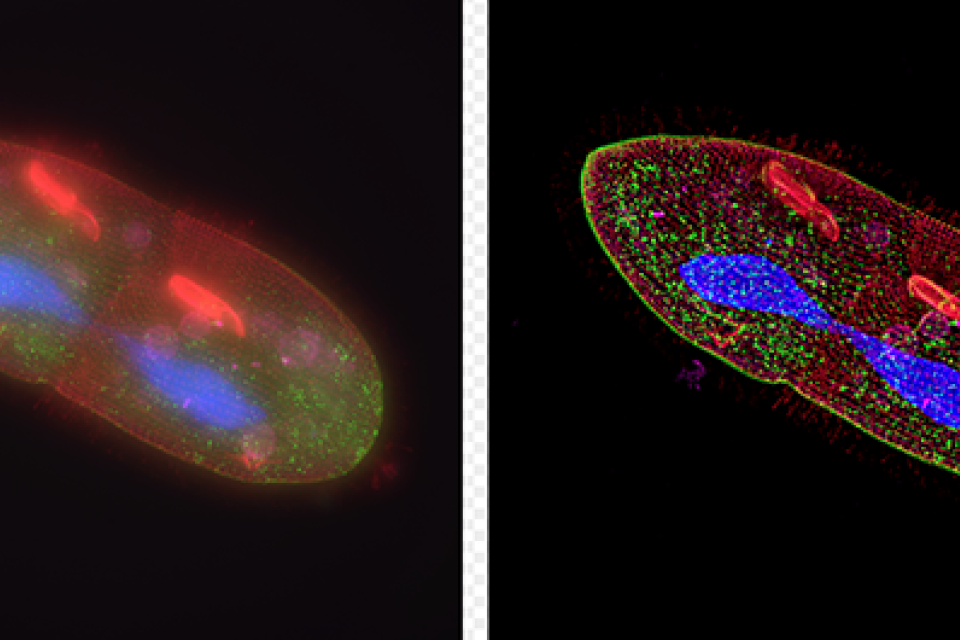
Wiener provides significant computing capability for enhancing images from UQ’s advanced microscopes, in particular the Lattice Light Sheet Microscope, which can generate up to seven terabytes of imaging data per day.
Microscopy images analysed much faster and clearer with Wiener will enable researchers to make exciting, new discoveries in the fields of health and medicine.
Initial imaging research using Wiener focuses on cancer biology, inflammation, infection and brain analysis.
Other applications include a new approach for treating Alzheimer’s disease; automating the analysis of histology slides of skin cancer biopsies; and simulating the dynamics of protein folding.
Wiener was built with funding from a UQ Research Facility Infrastructure Grant, with investment from a consortium of the university’s microscopy facilities within the Centre for Microscopy and Microanalysis, Institute for Molecular Bioscience, and Queensland Brain Institute.
The supercomputer became fully operational in February this year.
The award is the second for UQ in consecutive years.
Last year, UQ won the top prize in its category for its Metropolitan Data Caching Infrastructure (MeDiCI), which enables a range of techniques for national and international research data sharing.
Image above left: UQ's Wiener supercomputer adds sharp detail to microscopic imagery (image courtesy of Leica Microsystems GmbH).
Media: Professor David Abramson, david.abramson@uq.edu.au, +61 417 375 635, Shannon Lindsay, s.lindsay@uq.edu.au, +61 420 524 392.
Topics
Related articles

Shaping the future of medicine: UQ Medical School turns 90
