
Researchers develop sharp solution for waste glass
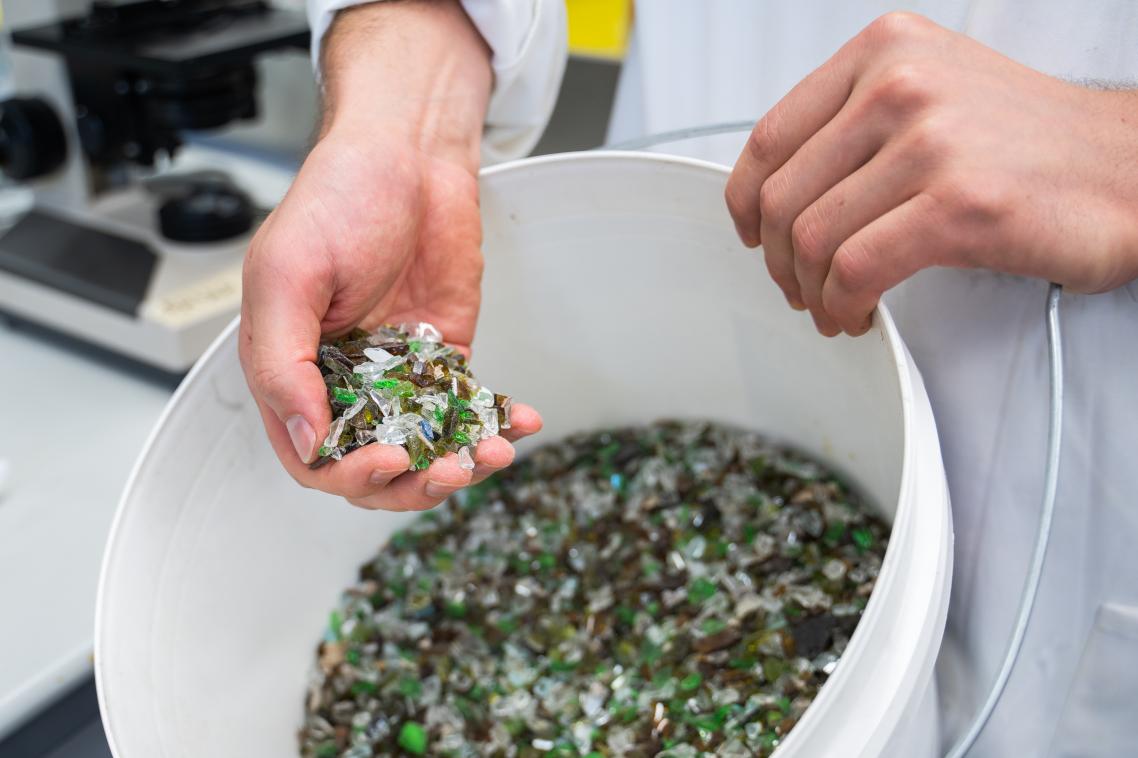
A new process turning waste glass into every day products could save tens of millions of tonnes of glass from going to landfill every year.
University of Queensland PhD candidate Rhys Pirie and Professor Damien Batstone have developed a method to extract liquid silicate from waste glass, and it can be used to make thousands of products, from concrete sealers and fertilisers to detergents and toothpaste.
“We estimate the process is more than 50 per cent cheaper than conventional ways of producing silicate,” Mr Pirie said.
“It requires less energy, raw materials and capital, and that’s before you consider the reduced social and economic costs compared to landfilling material.”
UQ’s method also leaves behind little waste, with nearly all of the glass being turned into saleable products.
Sharp solution for waste glass from The University of Queensland on Vimeo.
Mr Pirie started to look into the possibilities of glass recycling after talking to Professor Batstone from UQ’s Advanced Water Management Centre, who specialises in converting waste into high-value products.
The pair drew inspiration from ABC’s War on Waste series.
“The transition towards circular economies is a movement which is gaining momentum and something I’ve always been interested in,” he said.
“My PhD has highlighted how we need to make use of both the raw materials in ‘waste’ streams and the energy embodied in them during manufacture.
“That’s what this process does and we’re pretty confident that it will create positive, far-reaching and virtuous economic cycles.”
UniQuest, UQ’s commercialisation company, has filed a patent covering the process and is now seeking commercial partners.
For the remainder of his PhD, Mr Pirie is looking at ways in which waste glass could also be used to create a low-cost silicon-based additive to increase fertiliser efficiency.
Mr Pirie works between the School of Chemical Engineering and the School of Agriculture and Food Sciences.
He was awarded the Warwick and Nancy Olsen PhD Scholarship for his work.
The research was co-funded by the Cotton Research and Development Corporation and Department of Agriculture and Water Resources.
Media outlets: Please find images, Video News Release and transcript here.
Media: PhD candidate Rhys Pirie, r.pirie@uq.edu.au; 0421 118 284; EAIT Communications, Paige Ashby, p.ashby@uq.edu.au, 0430 511 615.
Related articles

A new way to navigate tough land and water use decisions
