Skip to menu Skip to content Skip to footer
News

Australian plants extracting high-value metals from mining wastes
16 July 2019
Decorative

Increasingly scarce metals are being recovered from mining waste by University of Queensland researchers, who are making the most of native plants’ metal-absorbing nature.

Phytomining involves harvesting metals from the living tissue of a group of plants known as hyperaccumulators, which retain metals in high concentrations after absorbing them through their roots.

UQ’s Sustainable Minerals Institute (SMI) researcher Dr Philip Nkrumah has been developing the phytomining technology at the Centre for Mined Land Rehabilitation.

“Australia is one of the world's leading mineral resources nations with a number of mines around the country generating large quantities of processed mining wastes,” he said.

“These wastes, often stored in tailings facilities, contain valuable metals including cobalt, and represent some of the largest untapped resources globally.”

Tapping into this waste through phytomining not only creates additional revenue streams, it offers a sustainable solution to supply-side issues the industry is going to face.

“Cobalt consumption is projected to rise by between eight and ten per cent annually but supplies are likely to be limited by 2050, so the industry needs to identify additional sources,” Dr Nkrumah said.

“Phytomining is an innovative solution because it complements the global supply chain for critical minerals like cobalt while promoting the circular economy by utilising mining waste.

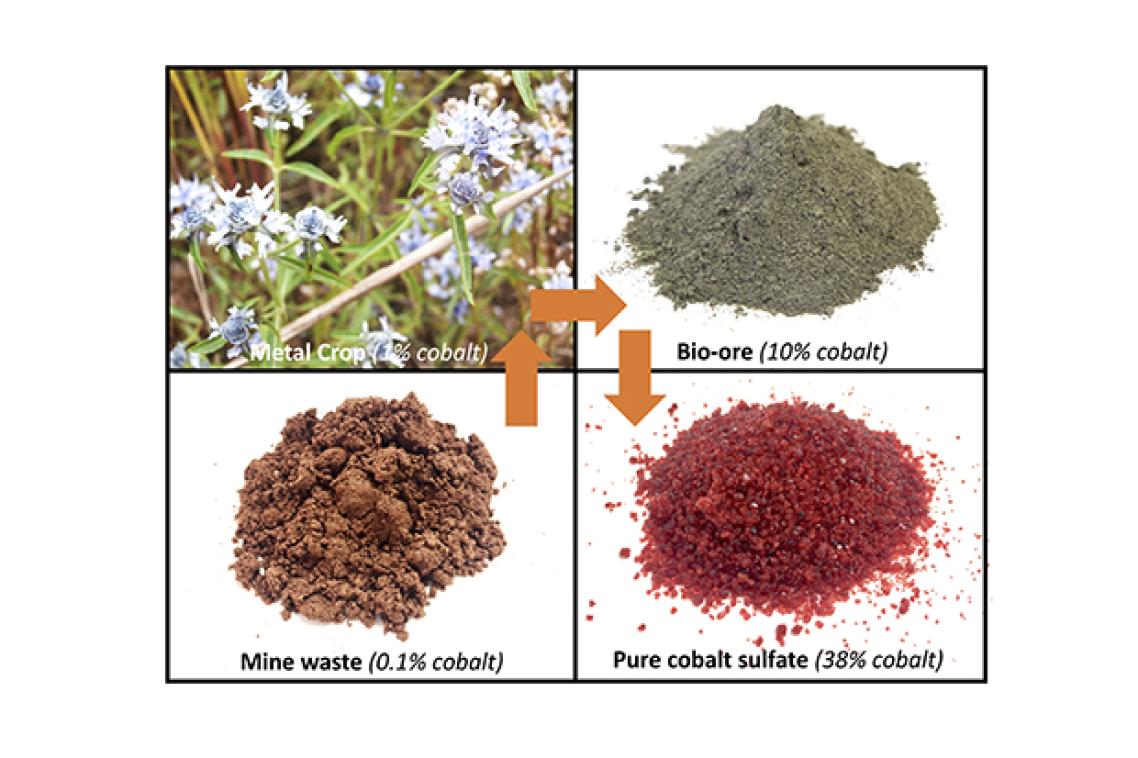
“Some species of plants can contain up to one per cent of cobalt or four per cent of nickel in their shoots, translating to more than 25 per cent metal in their ash which is dubbed ‘bio-ore'.

“The high purity of bio-sourced metals makes them especially suited for applications in the electrochemical industry, like producing rechargeable batteries.”

Intensive screening efforts in global herbaria had led to the discovery of more than 100 hyperaccumulator plants new to science.

Fieldwork at the Queensland’s MMG Dugald River Mine discovered zinc hyperaccumulation in the native legume Crotalaria novae-hollandiae, which opens up the possibility of zinc phytomining.

Media: Philip Nkrumah, p.nkrumah@uq.edu.au, +61 7 3346 4018; Connor Pound, c.pound@uq.edu.au, +61 7 3346 3258.

Related articles

Three researchers wearing blue protective lab gowns stand among rows of potted chickpea plants inside a controlled-environment plant research facility.

Turning up the heat on chickpea yield

A University of Queensland study has outlined a practical pathway for accelerating the development of heat adapted chickpeas using data from new ‘omic’ technologies. PhD candidate Callum Jamie said the suite of technologies offered tremendous opportunities to understand how a complex trait like heat tolerance works. “The narrow genetic diversity in the elite chickpea gene pool has limited conventional breeding’s effectiveness for stress tolerance,” Mr Jamie said. “These technologies have improved our capacity to dissect trait architecture and phenotype secondary traits but their use in chickpeas has been limited.” The technologies include genomics, epigenomics, transcriptomics, proteomics, metabolomics, phenomics and enviromics, and help provide a comprehensive picture of biological systems. Epigenomics helps understand what controls gene activity; transcriptomics considers gene expression; proteomics protein production; metabolomics looks at biochemical processes; phenomics observes traits; and enviromics considers environmental factors influencing outcomes. Mr Jamie said previous studies had focused on just 1 to 2 -omic datasets, a small number of genotypes, and single tissues. This has meant it was hard to infer what results meant for trait architecture and mechanisms and the ability to extrapolate the information to breeding populations was limited. There have also been challenges around cost, scalability and integrating very different types of data to make the technologies useful. To overcome the hurdles, Mr Jamie’s research at the Queensland Alliance for Agriculture and Food Innovation has resulted in a proposed staged approach. It would start with genomic prediction and phenotyping, before adding -omic layers as costs fall and unknowns were resolved. “These technologies are novel and we still don’t know which information provides added value and how best to integrate all of this data to achieve an outcome,” Mr Jamie said. His PhD is supported by the Grains Research and Development Corporation (GRDC) and the International Research Training Group (IRTG) Accelerating Crop Genetic Gain and is aligned to a project which aims to fast-track the development of chickpea varieties adapted to high temperatures. Project leader Dr Millicent Smith said heat stress causes severe yield implications through flower and pod loss, reduced pollen viability and impaired grain filling. “Late sown chickpea is particularly in the firing line across most of Australia's crop in southern Queensland and northern New South Wales,” Dr Smith said. “We want to ensure that Australian growers maintain their competitive edge. “New varieties with improved genetics to cope with heat stress are essential for the future. “This work, suggesting a staged approach to utilising the new -omic technologies, is an exciting frontier.” The research was published by Food and Energy Security. Callum Jamie’s PhD is supported by the Grains Research and Development Corporation (GRDC) and the International Research Training Group (IRTG) Accelerating Crop Genetic Gain.
15 October 2026
Close-up photograph of a red-bellied black snake coiled across pale, weathered wood. The snake has glossy black scales on its back and vivid red coloration along its sides and underside. The image highlights the texture of the scales and the contrast between the dark body and the light wood background.
Analysis

Deadly fungi are harming Australia’s wild reptiles. This is how to stop the spread

With spring underway and the weather warming, reptiles are on the move in suburbs, parks and bushland across Australia. Snake catchers and wildlife carers are responding to calls for help, and reptile enthusiasts – known as “herpers” – are heading outdoors in search of their next sighting.
13 October 2026

Media contact

Subscribe to UQ News

Get the latest from our newsroom.