Skip to menu Skip to content Skip to footer
News

Fish farming solution is in the cloud
22 October 2019
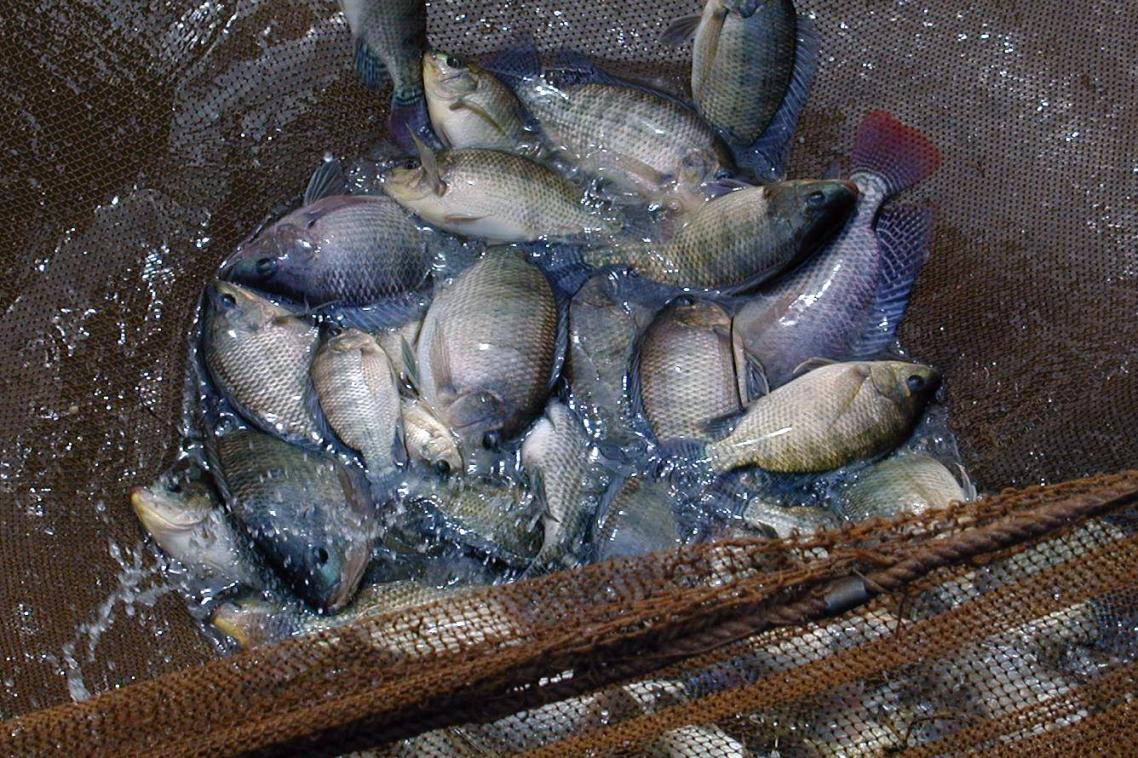
Farmed tilapia, photo WorldFish.

A quick, cost-effective, cloud-based platform, which could solve one of fish farming’s biggest challenges, has received a US$100,000 grant for concept development and testing.

The University of Queensland’s Dr Andrew Barnes is helping bring together years of fish pathogen data, combining it with new pathogen DNA sequences from infected fish, aiming to build a cloud-based service that accurately diagnoses a range of fish diseases.

“Aquaculture is one of the fastest-growing food production sectors in the world,” he said.

“It’ll be essential to meeting the 40 per cent increase in demand for food fish expected by 2030, according to the United Nations Food and Agriculture Organization, and is already providing incomes and new jobs for women and men of all ages, particularly in Africa.

“But a key challenge to aquaculture is outbreaks of disease.

“Tilapia lake virus and streptococcal infections, among others, can quickly wipe out farmed fish and are becoming more common as a result of overstocking, poor hygiene practices, and insufficient controls at hatcheries and farms.

“Managing outbreaks is often hindered by limited knowledge of the pathogens, which in turn contributes to anti-microbial resistance, as farmers use the wrong kinds or quantities of antibiotics on their fish.”

The team behind the concept was one of five winners in the Inspire Challenge 2019, organised by the CGIAR Platform on Big Data in Agriculture.

The competitive award funds innovative proposals that can help bring the power of big data to small-scale food producers.

Each finalist pitched their idea to a panel of experts at the upcoming Big Data Convention in India’s tech hub Hyderabad, with each winner receiving a grant of US$100,000 to develop and test their concept over the following year.

“We’re absolutely delighted with the win,” Dr Barnes said.

“The technology – which harnesses the power of rapid genome sequencing – provides all of the information we need to make informed decisions on disease control without the need for expensive pathogen-specific tests and tools.

“The sequences enable you to infer the origin of a pathogen; see how it is evolving and moving through different environments and across international borders.

“Most importantly, it allows you to identify possible antimicrobial resistance genes and factors relevant to vaccine formulation.

“With this kind of knowledge we can provide very specific advice on how to control and prevent outbreaks.”
Decorative
Project leader Dr Jerome Delamare-Deboutteville of WorldFish said it would generate genomic sequences from pathogens of tilapia and carp, the world’s most important farmed fish.
Decorative

“Rapid diagnosis combined with effective management can mean the difference between a fish farmer losing all her stock within days of a disease outbreak and consistently producing a bumper harvest,” Dr Delamare-Deboutteville said.

“Multiply that across one of the world’s fastest-growing food production sectors, and all of the vital nutrients, jobs and opportunities it provides, and you could have an enormous impact on well-being in developing countries.

“This could represent a quantum leap in responding to the major production constraints for farmed fish, and could be applied to rapid disease detection, response and prevention in all farmed animals around the world.”

The platform is possible thanks to open source machine learning technology provided by Wilderlab NZ.

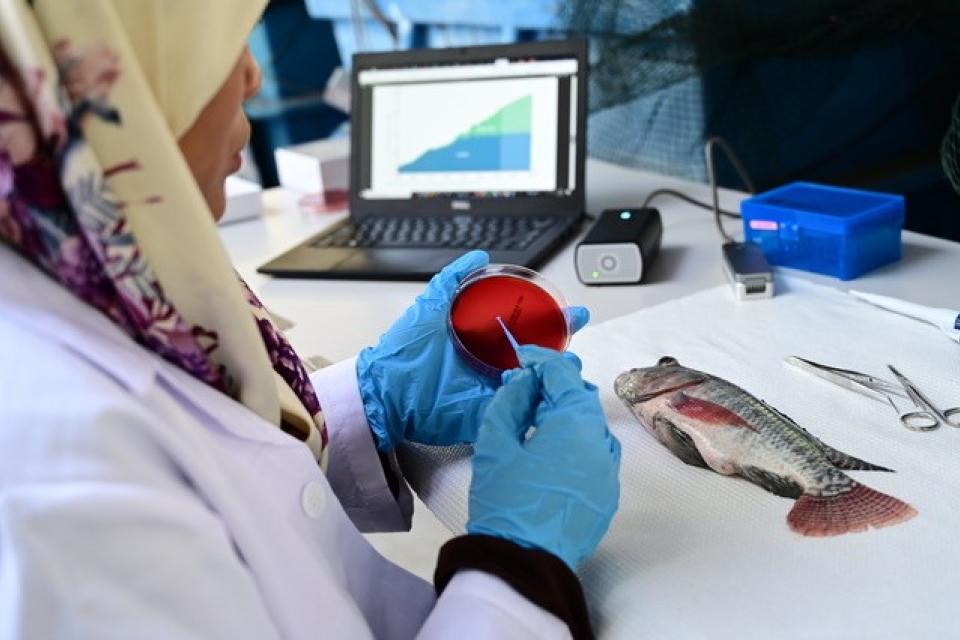
Image above: Sampling tilapia for rapid pathogen sequencing. Credit: WorldFish

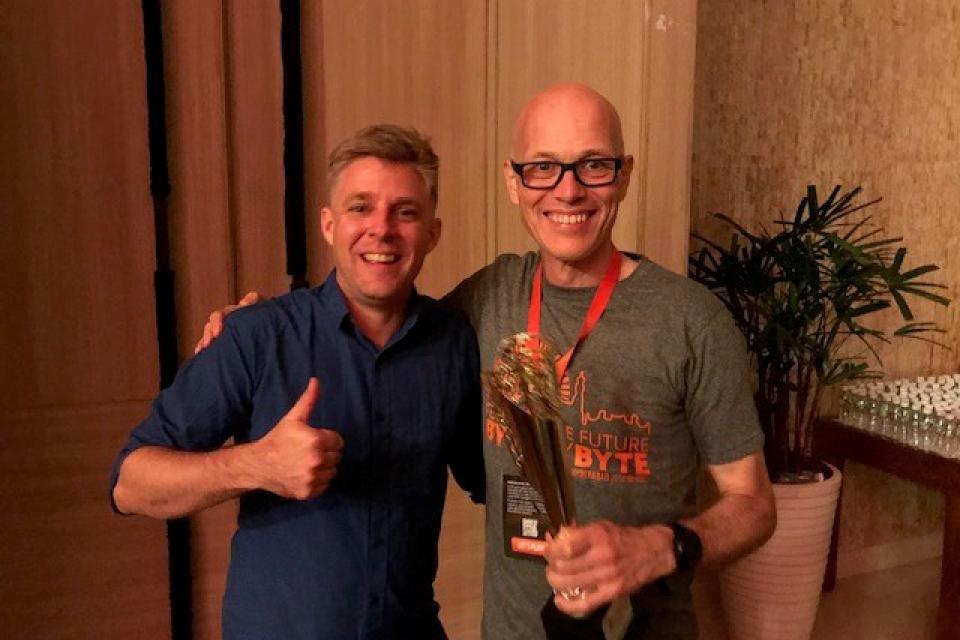
(L-R) Dr Jerome Delamare-Deboutteville and Dr Andrew Barnes celebrating their win in Hyderabad.

Media: Dr Andrew Barnes, a.barnes@uq.edu.au, +61 414 850 833; Dominic Jarvis, dominic.jarvis@uq.edu.au, +61 413 334 924.

Related articles

Three researchers wearing blue protective lab gowns stand among rows of potted chickpea plants inside a controlled-environment plant research facility.

Turning up the heat on chickpea yield

A University of Queensland study has outlined a practical pathway for accelerating the development of heat adapted chickpeas using data from new ‘omic’ technologies. PhD candidate Callum Jamie said the suite of technologies offered tremendous opportunities to understand how a complex trait like heat tolerance works. “The narrow genetic diversity in the elite chickpea gene pool has limited conventional breeding’s effectiveness for stress tolerance,” Mr Jamie said. “These technologies have improved our capacity to dissect trait architecture and phenotype secondary traits but their use in chickpeas has been limited.” The technologies include genomics, epigenomics, transcriptomics, proteomics, metabolomics, phenomics and enviromics, and help provide a comprehensive picture of biological systems. Epigenomics helps understand what controls gene activity; transcriptomics considers gene expression; proteomics protein production; metabolomics looks at biochemical processes; phenomics observes traits; and enviromics considers environmental factors influencing outcomes. Mr Jamie said previous studies had focused on just 1 to 2 -omic datasets, a small number of genotypes, and single tissues. This has meant it was hard to infer what results meant for trait architecture and mechanisms and the ability to extrapolate the information to breeding populations was limited. There have also been challenges around cost, scalability and integrating very different types of data to make the technologies useful. To overcome the hurdles, Mr Jamie’s research at the Queensland Alliance for Agriculture and Food Innovation has resulted in a proposed staged approach. It would start with genomic prediction and phenotyping, before adding -omic layers as costs fall and unknowns were resolved. “These technologies are novel and we still don’t know which information provides added value and how best to integrate all of this data to achieve an outcome,” Mr Jamie said. His PhD is supported by the Grains Research and Development Corporation (GRDC) and the International Research Training Group (IRTG) Accelerating Crop Genetic Gain and is aligned to a project which aims to fast-track the development of chickpea varieties adapted to high temperatures. Project leader Dr Millicent Smith said heat stress causes severe yield implications through flower and pod loss, reduced pollen viability and impaired grain filling. “Late sown chickpea is particularly in the firing line across most of Australia's crop in southern Queensland and northern New South Wales,” Dr Smith said. “We want to ensure that Australian growers maintain their competitive edge. “New varieties with improved genetics to cope with heat stress are essential for the future. “This work, suggesting a staged approach to utilising the new -omic technologies, is an exciting frontier.” The research was published by Food and Energy Security. Callum Jamie’s PhD is supported by the Grains Research and Development Corporation (GRDC) and the International Research Training Group (IRTG) Accelerating Crop Genetic Gain.
15 October 2026
Close-up photograph of a red-bellied black snake coiled across pale, weathered wood. The snake has glossy black scales on its back and vivid red coloration along its sides and underside. The image highlights the texture of the scales and the contrast between the dark body and the light wood background.
Analysis

Deadly fungi are harming Australia’s wild reptiles. This is how to stop the spread

With spring underway and the weather warming, reptiles are on the move in suburbs, parks and bushland across Australia. Snake catchers and wildlife carers are responding to calls for help, and reptile enthusiasts – known as “herpers” – are heading outdoors in search of their next sighting.
13 October 2026

Media contact

Subscribe to UQ News

Get the latest from our newsroom.