Skip to menu Skip to content Skip to footer
News

UQ charging up for a sustainable future
6 January 2020
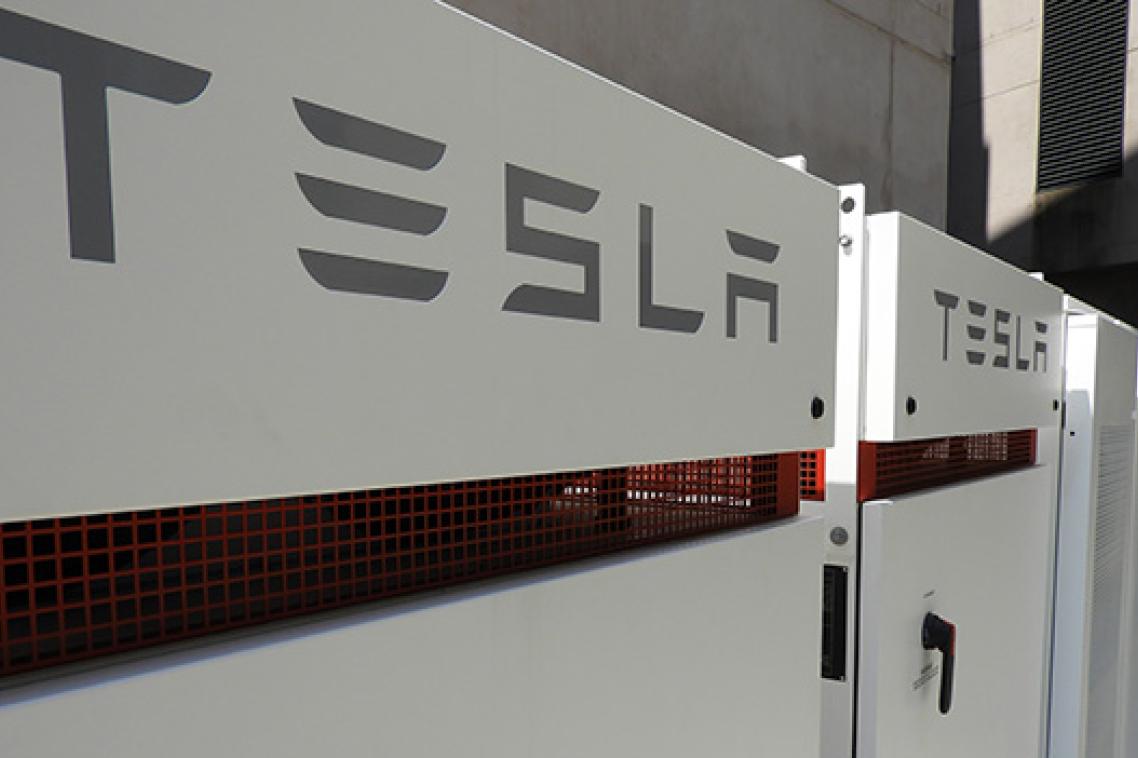
UQ's Engineering Precinct Battery system

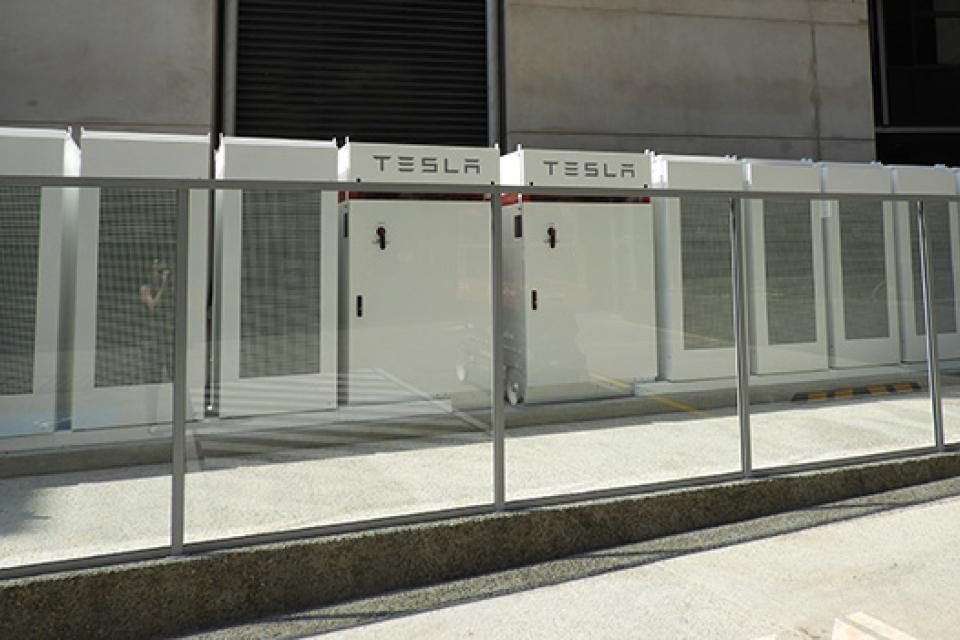
The switch has been flicked on one of Queensland’s largest behind-the-meter battery storage systems, capable of powering 175 average homes for 24 hours.  

The Tesla Powerpack battery system delivers 2 megawatt-hours of energy storage and will help The University of Queensland meet its renewable energy goals.

UQ Chief Operating Officer Greg Pringle said the large-scale battery and inverter system could store enough energy to power up to 10 per cent of the St Lucia campus for two hours.

“To put it into perspective, the university uses a large amount of electricity to power lecture theatres, laboratories, libraries and other facilities for more than 50,000 students and staff,” Mr Pringle said. 

“We are on track to become the first university in the world to offset 100 per cent our electricity use using our own renewable energy generation.

“This battery storage system will help us to support that ambitious goal - it will complement the Warwick Solar Farm which is nearing completion, and recently won a coveted Australasian Green Gown Award.”

The $2 million investment, funded through the earnings generated from UQ’s rooftop solar arrays, has the energy storage equivalent of around 500,000 standard AA batteries.
Decorative
UQ’s Energy and Sustainability Manager Andrew Wilson said the battery storage system was a key component of the University’s plan to become an active participant in the energy market from the start of 2020.

“We can now trade in the wholesale energy market – the goal is to charge when prices are low and renewable energy is abundant, and then discharge when demand and prices are high,” Mr Wilson said.

“To facilitate this we are using a custom control system which was developed by one of our engineering graduates to monitor wholesale energy prices around the clock and automatically control our trading of energy.

“Combined with the other services we are able to provide to the grid such as frequency control during faults, we expect the battery system to earn around $250,000 in revenue each year.”

UQ Chair in Sustainable Energy Futures Professor Peta Ashworth said battery storage systems would play a significant role in the future.

“With the rising cost of electricity, more and more householders are investigating and investing in solar and battery systems for their home,” Professor Ashworth said.

“These systems allow them to store the solar collected during the day, and use the energy when prices are higher during peak evening times.   

“Looking into the future, with cheaper consumer battery systems becoming available, households may follow UQ down the path of buying and selling energy in real time.” 

The public can view UQ’s battery activity and performance in real time, as well as access historical data, via a dedicated webpage – http://dashboards.sustainability.uq.edu.au/engineering-precinct-battery/interactive/

MEDIA: Danielle Esterhuysen, d.esterhuysen@uq.edu.au, +61 7 3365 1452; UQ Communications, communications@uq.edu.au, 07 3365 1120.

Related articles

Three researchers wearing blue protective lab gowns stand among rows of potted chickpea plants inside a controlled-environment plant research facility.

Turning up the heat on chickpea yield

A University of Queensland study has outlined a practical pathway for accelerating the development of heat adapted chickpeas using data from new ‘omic’ technologies. PhD candidate Callum Jamie said the suite of technologies offered tremendous opportunities to understand how a complex trait like heat tolerance works. “The narrow genetic diversity in the elite chickpea gene pool has limited conventional breeding’s effectiveness for stress tolerance,” Mr Jamie said. “These technologies have improved our capacity to dissect trait architecture and phenotype secondary traits but their use in chickpeas has been limited.” The technologies include genomics, epigenomics, transcriptomics, proteomics, metabolomics, phenomics and enviromics, and help provide a comprehensive picture of biological systems. Epigenomics helps understand what controls gene activity; transcriptomics considers gene expression; proteomics protein production; metabolomics looks at biochemical processes; phenomics observes traits; and enviromics considers environmental factors influencing outcomes. Mr Jamie said previous studies had focused on just 1 to 2 -omic datasets, a small number of genotypes, and single tissues. This has meant it was hard to infer what results meant for trait architecture and mechanisms and the ability to extrapolate the information to breeding populations was limited. There have also been challenges around cost, scalability and integrating very different types of data to make the technologies useful. To overcome the hurdles, Mr Jamie’s research at the Queensland Alliance for Agriculture and Food Innovation has resulted in a proposed staged approach. It would start with genomic prediction and phenotyping, before adding -omic layers as costs fall and unknowns were resolved. “These technologies are novel and we still don’t know which information provides added value and how best to integrate all of this data to achieve an outcome,” Mr Jamie said. His PhD is supported by the Grains Research and Development Corporation (GRDC) and the International Research Training Group (IRTG) Accelerating Crop Genetic Gain and is aligned to a project which aims to fast-track the development of chickpea varieties adapted to high temperatures. Project leader Dr Millicent Smith said heat stress causes severe yield implications through flower and pod loss, reduced pollen viability and impaired grain filling. “Late sown chickpea is particularly in the firing line across most of Australia's crop in southern Queensland and northern New South Wales,” Dr Smith said. “We want to ensure that Australian growers maintain their competitive edge. “New varieties with improved genetics to cope with heat stress are essential for the future. “This work, suggesting a staged approach to utilising the new -omic technologies, is an exciting frontier.” The research was published by Food and Energy Security. Callum Jamie’s PhD is supported by the Grains Research and Development Corporation (GRDC) and the International Research Training Group (IRTG) Accelerating Crop Genetic Gain.
15 October 2026
Close-up photograph of a red-bellied black snake coiled across pale, weathered wood. The snake has glossy black scales on its back and vivid red coloration along its sides and underside. The image highlights the texture of the scales and the contrast between the dark body and the light wood background.
Analysis

Deadly fungi are harming Australia’s wild reptiles. This is how to stop the spread

With spring underway and the weather warming, reptiles are on the move in suburbs, parks and bushland across Australia. Snake catchers and wildlife carers are responding to calls for help, and reptile enthusiasts – known as “herpers” – are heading outdoors in search of their next sighting.
13 October 2026

Media contact

Subscribe to UQ News

Get the latest from our newsroom.