Skip to menu Skip to content Skip to footer
News

Cracking a tough nut for macadamia growers
24 January 2021
Macadamias are Australia’s second-biggest nut export, predicted to be worth $350 million by 2025.

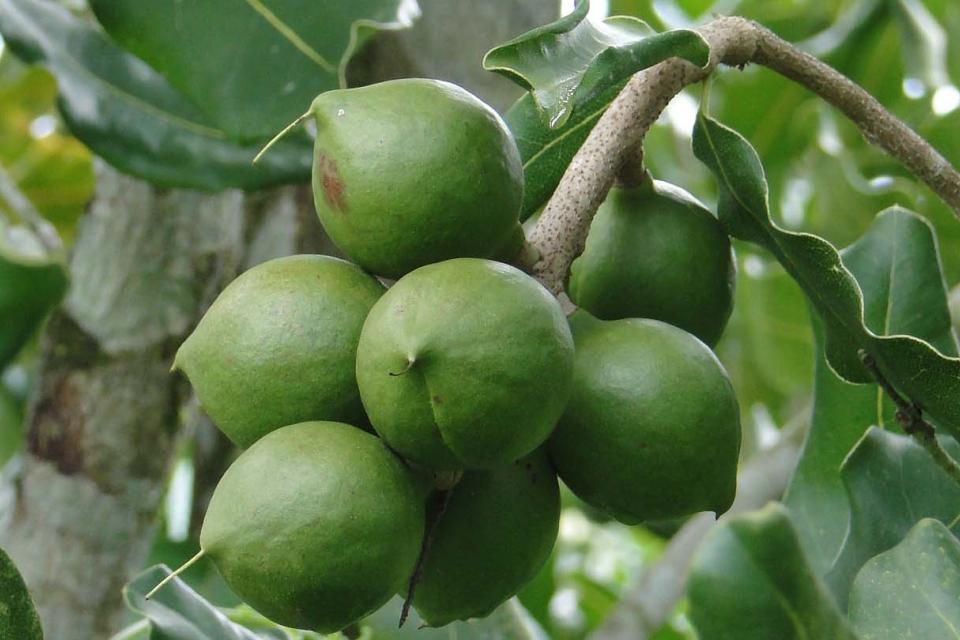
Macadamia researchers are breeding thinner shells for bigger kernels and tougher husks for resisting pests. 

The University of Queensland’s Professor Bruce Topp said these combined attributes would boost Australia’s $270 million industry, which earns $190 million in export income annually.

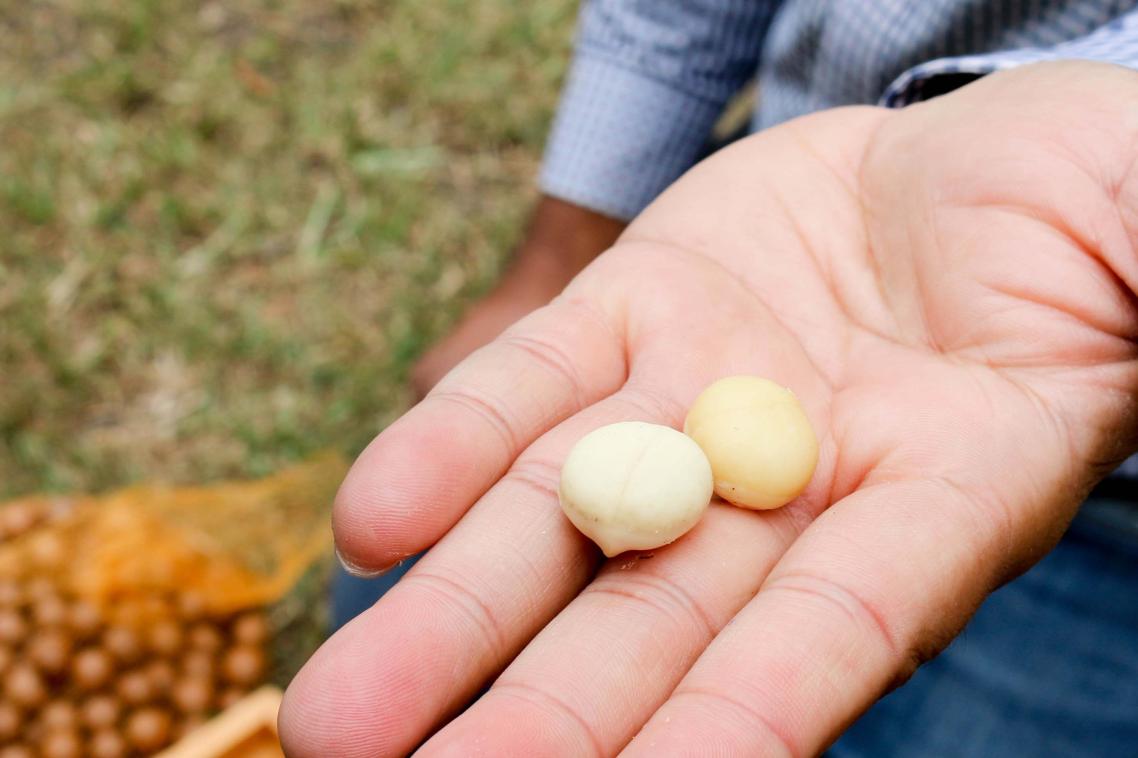
“Two thirds of every harvested kilogram is in the weight of the macadamias’ extremely tough shells. That’s a lot of wasted productivity,” Professor Topp said.

“The goal for many growers is to produce less shell and more kernel from each nut but with the shell still tough enough to resist pests.”

Macadamias are native to south-east Queensland and northern New South Wales but are grown commercially in places including Hawaii, South Africa and Brazil.

UQ, industry and the Queensland Government are jointly funding the Queensland Alliance for Agriculture and Food Innovation research.

“Tough outer husks help protect the nuts from pests, and thinner, inner shells produce larger nuts and profits,” said Professor Topp (pictured).

“Thinner shells however improve access for the macadamia nut borer, a native pest which causes a lot of damage to young fruit.

Decorative
“This requires more on-farm management, but biological control strategies are used widely and successfully.

“Growers introduce wasps to control borer moths and owls to eat rats; rats and cockatoos quickly identify trees with thinner-shelled nuts.”

Professor Topp leads the over-arching $2.2 million, Horticulture Innovation Australia–funded National Macadamia Breeding and Evaluation Program.

“Building on decades of macadamia research, we are trialling sophisticated genomic technologies in the field, aiming to boost Australian macadamia growers’ productivity and profitability,” he said.

Hort Innovation’s Dr Vino Rajandran said the global macadamia industry was currently using cultivars more than 60 years old and just a few generations from the wild.

“As a comparison, almonds have been cultivated for millennia,” Dr Rajandran said.

“Based on other horticultural tree crops, we estimate that the macadamia is only yielding around 30 per cent of its potential.
Decorative
“We are identifying molecular markers for key growth and production traits in diverse, wild macadamia samples.

“We hope this research will make Australian-bred macadamia cultivars the commercial, global varieties of choice.”

Macadamias are Australia’s second-biggest nut export, predicted to be worth $350 million by 2025.

Professor Topp said the program also was breeding for genetic resistance to “husk spot”, a fungal disease causing immature nut drop and cutting $10 million from industry profits a year.

It was also breeding smaller, warmer climate-adapted, high-yielding macadamia trees.

This research is funded by Hort Innovation using the Macadamia Research and Development Levy, Australian Government contributions, with support from the Queensland Department of Agriculture and Fisheries and UQ. 

Contact: Professor Topp, b.topp@uq.edu.au, +61 (0)427 682 384; QAAFI Communications, Margaret Puls, m.puls@uq.edu.au, +61 (0)419 578 356.

Related articles

Three researchers wearing blue protective lab gowns stand among rows of potted chickpea plants inside a controlled-environment plant research facility.

Turning up the heat on chickpea yield

A University of Queensland study has outlined a practical pathway for accelerating the development of heat adapted chickpeas using data from new ‘omic’ technologies. PhD candidate Callum Jamie said the suite of technologies offered tremendous opportunities to understand how a complex trait like heat tolerance works. “The narrow genetic diversity in the elite chickpea gene pool has limited conventional breeding’s effectiveness for stress tolerance,” Mr Jamie said. “These technologies have improved our capacity to dissect trait architecture and phenotype secondary traits but their use in chickpeas has been limited.” The technologies include genomics, epigenomics, transcriptomics, proteomics, metabolomics, phenomics and enviromics, and help provide a comprehensive picture of biological systems. Epigenomics helps understand what controls gene activity; transcriptomics considers gene expression; proteomics protein production; metabolomics looks at biochemical processes; phenomics observes traits; and enviromics considers environmental factors influencing outcomes. Mr Jamie said previous studies had focused on just 1 to 2 -omic datasets, a small number of genotypes, and single tissues. This has meant it was hard to infer what results meant for trait architecture and mechanisms and the ability to extrapolate the information to breeding populations was limited. There have also been challenges around cost, scalability and integrating very different types of data to make the technologies useful. To overcome the hurdles, Mr Jamie’s research at the Queensland Alliance for Agriculture and Food Innovation has resulted in a proposed staged approach. It would start with genomic prediction and phenotyping, before adding -omic layers as costs fall and unknowns were resolved. “These technologies are novel and we still don’t know which information provides added value and how best to integrate all of this data to achieve an outcome,” Mr Jamie said. His PhD is supported by the Grains Research and Development Corporation (GRDC) and the International Research Training Group (IRTG) Accelerating Crop Genetic Gain and is aligned to a project which aims to fast-track the development of chickpea varieties adapted to high temperatures. Project leader Dr Millicent Smith said heat stress causes severe yield implications through flower and pod loss, reduced pollen viability and impaired grain filling. “Late sown chickpea is particularly in the firing line across most of Australia's crop in southern Queensland and northern New South Wales,” Dr Smith said. “We want to ensure that Australian growers maintain their competitive edge. “New varieties with improved genetics to cope with heat stress are essential for the future. “This work, suggesting a staged approach to utilising the new -omic technologies, is an exciting frontier.” The research was published by Food and Energy Security. Callum Jamie’s PhD is supported by the Grains Research and Development Corporation (GRDC) and the International Research Training Group (IRTG) Accelerating Crop Genetic Gain.
15 October 2026
Alt text goes here

Unlocking AI as a research tool for plant microscopy

Software created by University of Queensland scientists could help AI platforms overcome a blind spot limiting their value in plant research.
30 September 2026

Media contact

Subscribe to UQ News

Get the latest from our newsroom.