Skip to menu Skip to content Skip to footer
News

A genetic solution to ensure sorghum stands firm
31 March 2021
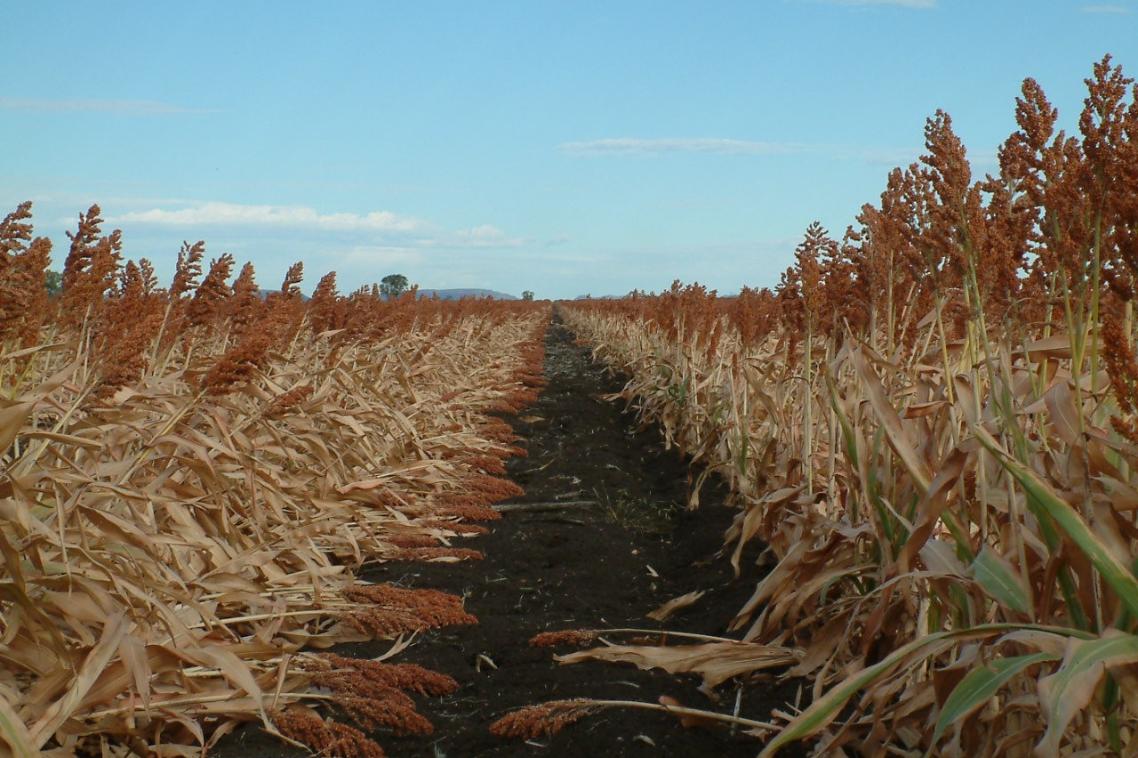
Sorghum crop lodging, with stalks fallen over onto the ground
Skip row sorghum lodge at Springsure, Queensland.

After decades of study, University of Queensland researchers have identified a genetic solution to the problem of sorghum lodging and falling down, which affects 10 per cent of sorghum crops each year.

Professor David Jordan from UQ’s Queensland Alliance for Agriculture and Food Innovation (QAAFI) said lodging was when the stems of plants carrying high grain yields were weakened by loss of water.  

“Losing a bumper grain crop because plants fall over is heartbreaking for growers and undermines efforts to increase production to improve food security,” Professor Jordan said.

Working with the Department of Agriculture and Fisheries at the Hermitage Research Facility in Warwick, Professor Jordan found that lodging occurs whenever water scarcity halted photosynthesis.

“This forces the plants to rely on carbohydrates stored in the stems,” he said.

“The metabolic shift ultimately weakens the stems, culminating in their death, while pathogens can invade and further weaken stems, causing them to break.”

Doctoral student Xuemin Wang analysed data from 14 seasons and found that the most severe lodging – greater than 20 per cent – occurred in 2005, 2006 and 2017.

He found that the differences in air pressure recorded on the Southern Oscillation Index explained 29 per cent of the season variation in lodging frequency.

“Our data also found that despite substantial breeding efforts and turnover of commercial cultivars, the level of resistance to lodging does not appear to have improved,” Professor Jordan said.
Decorative
The research team, which also includes Dr Emma Mace who works for QAAFI and the Department of Agriculture and Fisheries and Professor Graeme Hammer, found that traits used to drive up yields also introduced a susceptibility to lodging.

An example is plant height, which is essential to achieving higher yields but also raises the risk of lodging-inducing stem failure.

“The higher the yield potential of a sorghum hybrid, the more likely it is to suffer from lodging, creating a challenge for breeders trying to improve both traits,” Professor Jordan said.

He said to meet this challenge, scientists undertook one of the world’s largest genome-wide association studies in sorghum.

“This study looked at 2308 unique hybrids grown in 17 Australian sorghum trials over three years,” he said.

“A genome-wide view of the genetics is important as it means we can search the network of lodging-associated genes for those pathways we can target for improvement without sacrificing yield potential.”

Professor Jordan said the team found one way to increase stem strength would be to alter the composition of the molecules used by the plant to assemble the supportive cell wall.

Bolstering disease resistance at the same time would offer additional protection.
Decorative
The research team is now poised to translate these insights into targeted breeding strategies to directly benefit the Australian sorghum industry.

Previously, Queensland sorghum researchers introduced greater drought resistance into Australian cultivars by transferring ‘stay-green genes’ from sorghum sourced from Ethiopia.

Stay-green genes are now recognised to have introduced a level of resistance to lodging by delaying photosynthesis shutdown and stem death in response to water scarcity.

“We are at the point where we have come as far as we can with the stay-green mechanism for reducing the incidence of lodging,” Professor Jordan said.

“By generating the new genetic map, we can now identify new leads for breeding greater lodging resistance into high-yielding sorghum hybrids.”

The sorghum core pre-breeding project was funded by the Department of Agriculture and Fisheries (DAF) Queensland, Grains Research and Development Corporation (GRDC) and UQ.

Xuemin Wang is financially supported by an Australian Government Research Training Program Scholarship and a Centennial Scholarship from UQ.

The research was published in Theoretical and Applied Genetics.

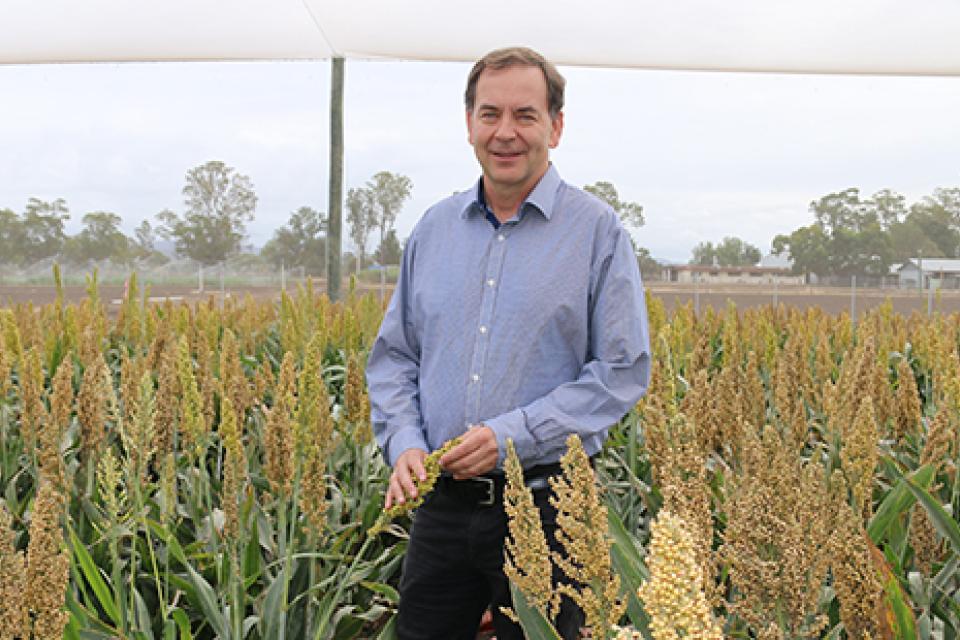
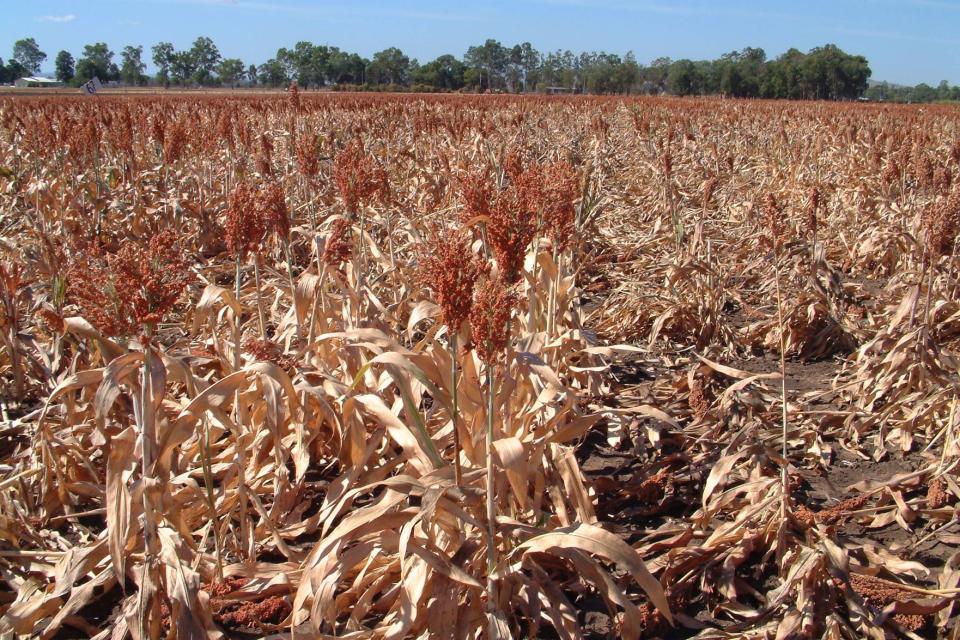
Image above left: Professor David Jordan views sorghum crop at the Gatton Research Facility. Above right: sorghum crop in Biloela, Queensland. Further images are available in DROPBOX.

Media: Professor David Jordan, david.jordan@uq.edu.au, +61 7 4542 6722; Carolyn Martin, QAAFI Communications, carolyn.martin@uq.edu.au, +61 (0) 439 399 886.

Related articles

Three researchers wearing blue protective lab gowns stand among rows of potted chickpea plants inside a controlled-environment plant research facility.

Turning up the heat on chickpea yield

A University of Queensland study has outlined a practical pathway for accelerating the development of heat adapted chickpeas using data from new ‘omic’ technologies. PhD candidate Callum Jamie said the suite of technologies offered tremendous opportunities to understand how a complex trait like heat tolerance works. “The narrow genetic diversity in the elite chickpea gene pool has limited conventional breeding’s effectiveness for stress tolerance,” Mr Jamie said. “These technologies have improved our capacity to dissect trait architecture and phenotype secondary traits but their use in chickpeas has been limited.” The technologies include genomics, epigenomics, transcriptomics, proteomics, metabolomics, phenomics and enviromics, and help provide a comprehensive picture of biological systems. Epigenomics helps understand what controls gene activity; transcriptomics considers gene expression; proteomics protein production; metabolomics looks at biochemical processes; phenomics observes traits; and enviromics considers environmental factors influencing outcomes. Mr Jamie said previous studies had focused on just 1 to 2 -omic datasets, a small number of genotypes, and single tissues. This has meant it was hard to infer what results meant for trait architecture and mechanisms and the ability to extrapolate the information to breeding populations was limited. There have also been challenges around cost, scalability and integrating very different types of data to make the technologies useful. To overcome the hurdles, Mr Jamie’s research at the Queensland Alliance for Agriculture and Food Innovation has resulted in a proposed staged approach. It would start with genomic prediction and phenotyping, before adding -omic layers as costs fall and unknowns were resolved. “These technologies are novel and we still don’t know which information provides added value and how best to integrate all of this data to achieve an outcome,” Mr Jamie said. His PhD is supported by the Grains Research and Development Corporation (GRDC) and the International Research Training Group (IRTG) Accelerating Crop Genetic Gain and is aligned to a project which aims to fast-track the development of chickpea varieties adapted to high temperatures. Project leader Dr Millicent Smith said heat stress causes severe yield implications through flower and pod loss, reduced pollen viability and impaired grain filling. “Late sown chickpea is particularly in the firing line across most of Australia's crop in southern Queensland and northern New South Wales,” Dr Smith said. “We want to ensure that Australian growers maintain their competitive edge. “New varieties with improved genetics to cope with heat stress are essential for the future. “This work, suggesting a staged approach to utilising the new -omic technologies, is an exciting frontier.” The research was published by Food and Energy Security. Callum Jamie’s PhD is supported by the Grains Research and Development Corporation (GRDC) and the International Research Training Group (IRTG) Accelerating Crop Genetic Gain.
15 October 2026
Man sits amongst grass and flowers while blowing his nose

Hay fever can strike even when grass pollen concentrations are low

A low pollen count does not always mean a symptom-free day for those with asthma or hay fever, with new research showing some people still experience symptoms even when grass pollen levels are classified as low.
6 October 2026

Media contact

Subscribe to UQ News

Get the latest from our newsroom.