
Irrigation could help reverse male sea turtle drought
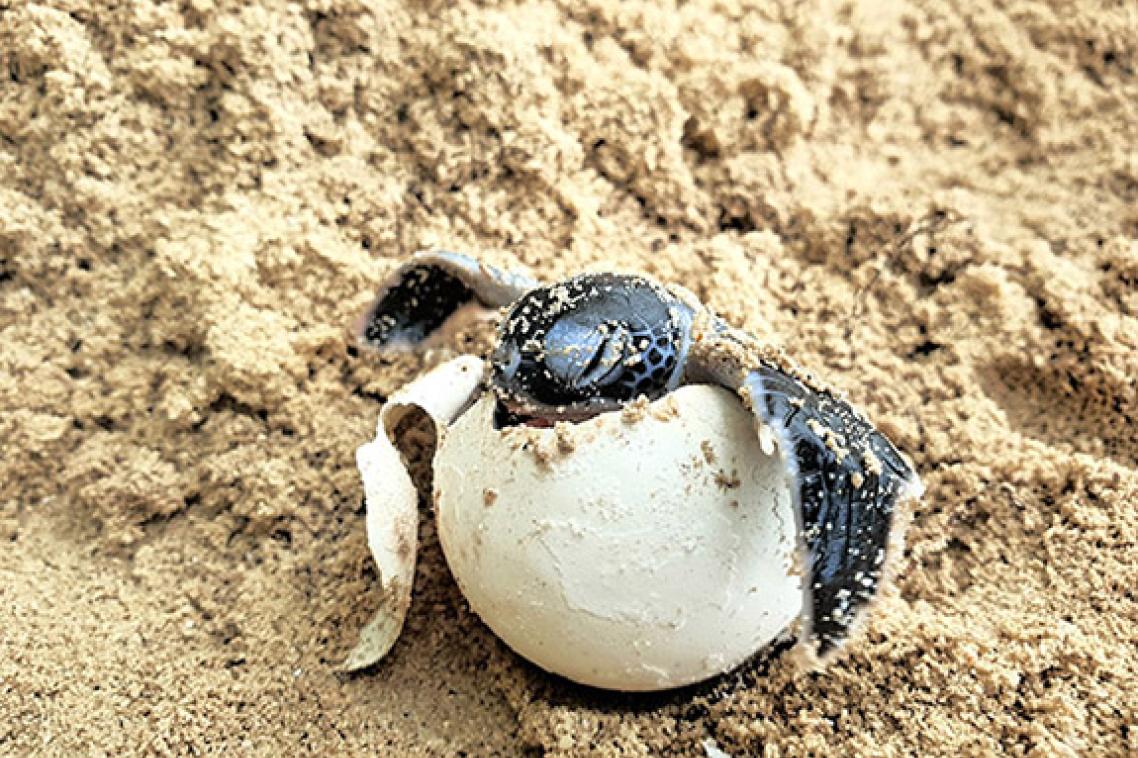
Climate change is causing the “feminisation” of green turtle populations in far north Queensland, but a study shows seawater irrigation could potentially reverse the male drought.
The research, part of the Turtle Cooling Project including The University of Queensland’s Dr David Booth and PhD student Melissa Staines, found that a single application of seawater could theoretically create male hatchlings.
“In 2018, scientists revealed that more than 99 per cent of green turtles being born in the northern Great Barrier Reef are female,” Dr Booth said.
“The incubation temperature of eggs determines the sex of sea turtles, with a warmer nest resulting in more females.
“Rising temperatures, caused by climate change, is to blame for the lack of male hatchling production.
“This is highly problematic for the future of one of the largest green turtle populations in the world – if we reach a situation where no males are being produced then the northern Great Barrier Reef population of green turtles will go into a rapid decline.
The project has been investigating shade structures and freshwater or seawater irrigation, as possible ways to cool turtle nests to generate male turtles.
“But on remote islands closer to the equator – and Raine Island where most northern Great Barrier Reef green turtles nest – building shade structures is not always practical, and freshwater is in short supply,” Dr Booth said.
“So we conducted research on Heron Island in the 2019-20 nesting season, determining if seawater could cool nests without dehydrating embryos.”
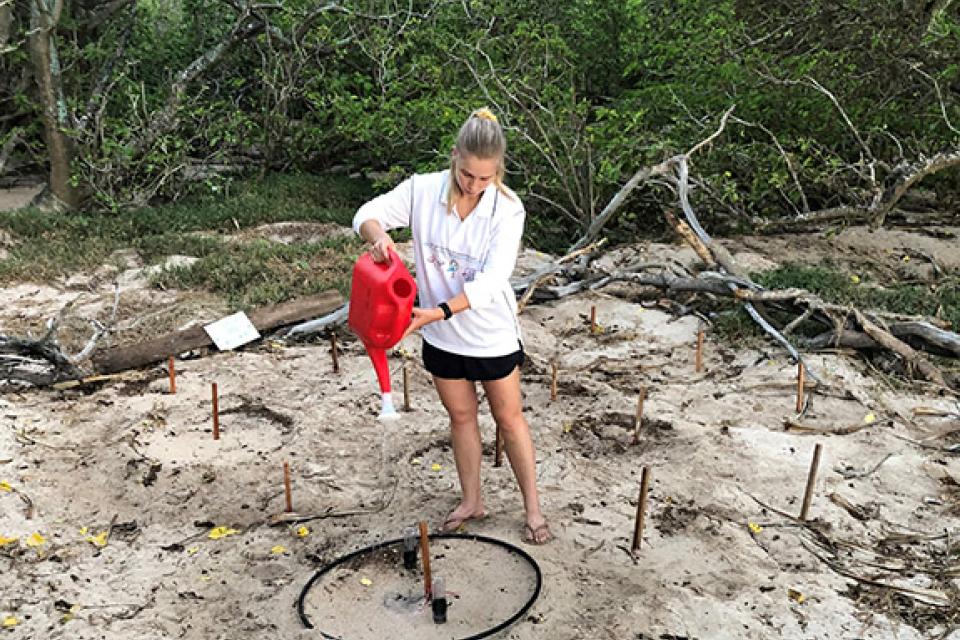
Nests were given a one-off application of either 50 litres of seawater or 50 litres of freshwater, equal to about 100-120 millimetres of rain, while control nests received no irrigation.
Both the seawater and freshwater-treated nests saw an immediate 1.3 degrees Celsius drop in temperature which lasted four days, while control nest temperatures remained constant.
In freshwater-treated nests, 83.8 per cent of eggs successfully hatched, 71.2 per cent in seawater-treated nests, and 63.5 per cent in control nests.
Seawater irrigation was also trialled in the Conflict Islands, Papua New Guinea, with sand temperatures in this region cooled by about 2 degrees Celsius when seawater irrigation was applied.
WWF-Australia Marine Species Conservation Project Officer Caitlin Smith, lead author of the paper, said the results were extremely promising.
“A one-off seawater application cooled nests, for potentially long enough to create males, and did not significantly impact embryonic survival,” she said.
“Despite our concern about dehydration, the seawater-treated nests were actually more successful than the control nests.
“Seawater now needs to be trialled on a larger scale at other rookeries, like Raine Island, that are in critical need of male production.”
The study found that seawater irrigation was worth further investigation, as a way to ensure at least some males are being produced to buy turtles some time.
The research has been published in Marine Ecology Progress Series (DOI: 10.3354/meps13721).
Funding of $1.5 million has been provided by furniture company Koala to WWF-Australia, a part of which is helping fund this project.
The project was a collaboration between UQ, Koala, the World Wide Fund for Nature-Australia and the Conflict Island Conservation Initiative.
Pictured above: Irrigating turtle nests on Heron Island as part of the Turtle Cooling Project. Credit: Chris Hof/WWF-Australia.
Media: Dominic Jarvis, dominic.jarvis@uq.edu.au, +61 413 334 924.
Related articles

What makes a winning environmental campaign? We studied six decades of activism to find out
