Skip to menu Skip to content Skip to footer
News

'Digital twins' concept boosts food production
30 July 2021
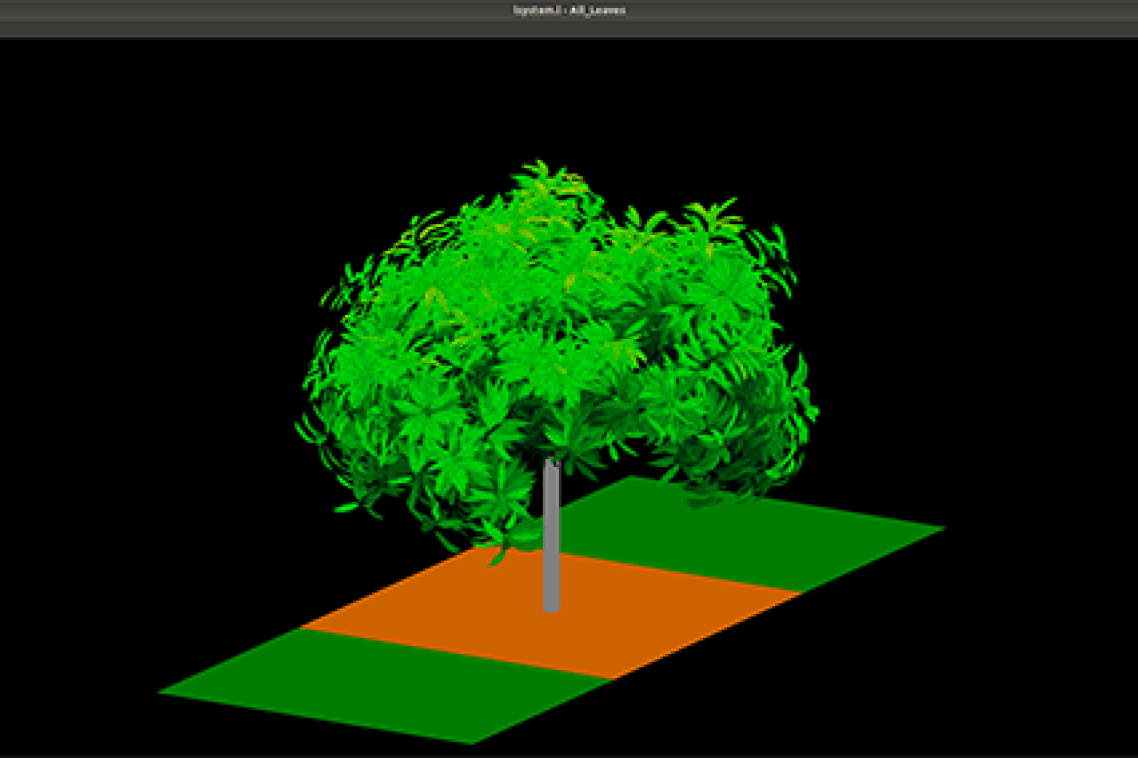
Digital image of mango tree by Dr Liqi Han

Using technology familiar to computer gamers, University of Queensland scientists are creating ‘digital twins’ of mango and macadamia orchards to help boost food production.

Professor Neena Mitter, the Director of the Centre of Horticultural Science at Queensland Alliance for Agriculture and Food Innovation (QAAFI), said it was an example of how computers were changing the industry.

“Developing a digital model for an orchard with slow growing crops like mango and macadamia enables us to run virtual experiments at a scale and speed never before possible,” Professor Mitter said.

“Digital technologies offer an unprecedented acceleration in innovation that will help make food production more productive, resilient, and sustainable.”

Lead researcher Dr Liqi Han said the technology would particularly benefit slow growing crops like fruit trees. 

 “The digital modelling provides untapped opportunities for users to rapidly trial new ideas and acquire a reliable indicator of how to best optimise production systems," Dr Han said.
 

Decorative

“We call this technology ‘DigiHort’, short for Digital Horticulture.”

The computer simulations can be a conceptual design of an orchard that doesn’t yet exist, a digital twin or detailed replica of an existing orchard, or a digital variant, where changes are made to a digital twin.

“All three forms can be integrated with environmental and management simulators,” Dr Han said.

“For example, this might include sunlight and chemical spray simulations to allow for evaluation and optimisation of orchard management practice.”

Virtual trials start with the design, with software users able to decide where in a landscape to plant trees, the density of the canopies and the configuration of the rows.

Users then consider how the trees are maintained, wielding virtual pruners and testing the impact of different – and even unconventional – tree training systems.

This innovation is based on new LiDAR scanning technology applications undertaken with industry partner, Riegl Australia, and state government research stations in Queensland, Western Australia and Northern Territory.

It relies on High Performance Computing (HPC), which allows Dr Han to run extremely fast virtual experiments without loss of accuracy.

“These days, we talk more and more about precision agriculture,” Dr Han said.

“We enhance precision by looking at the details, such as how much light can be captured by each leaf or fruit, or the distribution of sprayed chemicals across the canopy.

Watch Digital twins used to mirror and solve key food production challenges - Demonstration on YouTube.


“We can accumulate small benefits into big benefits or prevent big losses from occurring.

“And we’ve found that small differences can have a big impact.”

The DigiHort platform was designed as a decision-support service for industry and will be accessible via the internet.

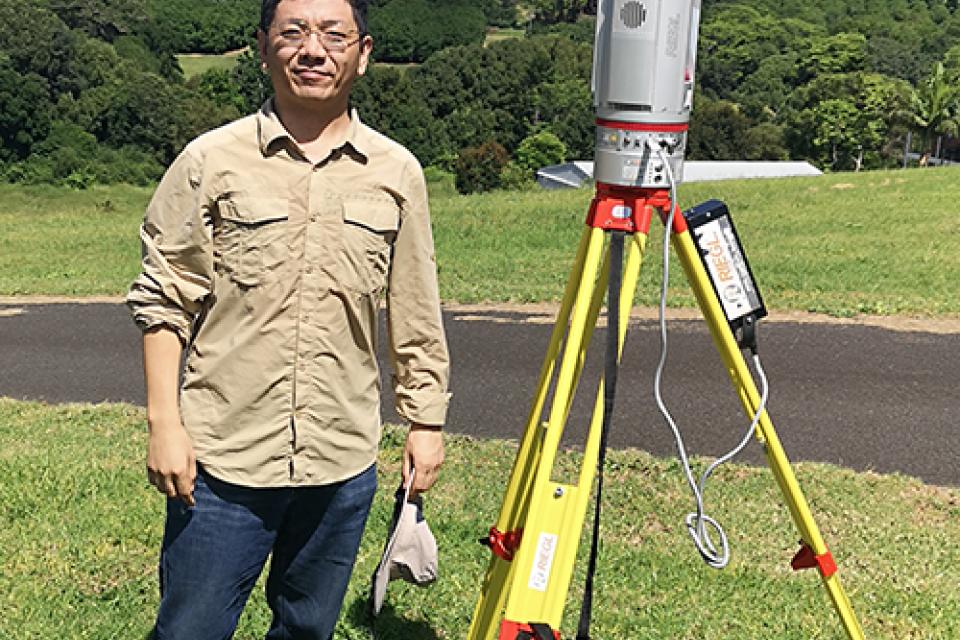
Image above left: Dr Liqi Han with the terrestrial LiDAR scanner in the field.

Media: Professor Neena Mitter, n.mitter@uq.edu.au, +61 (0)434 628 094, +61 (0)7 3346 6513; Dr Liqi Han, liqi.han@uq.edu.au, +61 (0)403 057 719, +61 (0)7 3365 1872; Margaret Puls, m.puls@uq.edu.au, +61 (0)419 578 356.

Related articles

Three researchers wearing blue protective lab gowns stand among rows of potted chickpea plants inside a controlled-environment plant research facility.

Turning up the heat on chickpea yield

A University of Queensland study has outlined a practical pathway for accelerating the development of heat adapted chickpeas using data from new ‘omic’ technologies. PhD candidate Callum Jamie said the suite of technologies offered tremendous opportunities to understand how a complex trait like heat tolerance works. “The narrow genetic diversity in the elite chickpea gene pool has limited conventional breeding’s effectiveness for stress tolerance,” Mr Jamie said. “These technologies have improved our capacity to dissect trait architecture and phenotype secondary traits but their use in chickpeas has been limited.” The technologies include genomics, epigenomics, transcriptomics, proteomics, metabolomics, phenomics and enviromics, and help provide a comprehensive picture of biological systems. Epigenomics helps understand what controls gene activity; transcriptomics considers gene expression; proteomics protein production; metabolomics looks at biochemical processes; phenomics observes traits; and enviromics considers environmental factors influencing outcomes. Mr Jamie said previous studies had focused on just 1 to 2 -omic datasets, a small number of genotypes, and single tissues. This has meant it was hard to infer what results meant for trait architecture and mechanisms and the ability to extrapolate the information to breeding populations was limited. There have also been challenges around cost, scalability and integrating very different types of data to make the technologies useful. To overcome the hurdles, Mr Jamie’s research at the Queensland Alliance for Agriculture and Food Innovation has resulted in a proposed staged approach. It would start with genomic prediction and phenotyping, before adding -omic layers as costs fall and unknowns were resolved. “These technologies are novel and we still don’t know which information provides added value and how best to integrate all of this data to achieve an outcome,” Mr Jamie said. His PhD is supported by the Grains Research and Development Corporation (GRDC) and the International Research Training Group (IRTG) Accelerating Crop Genetic Gain and is aligned to a project which aims to fast-track the development of chickpea varieties adapted to high temperatures. Project leader Dr Millicent Smith said heat stress causes severe yield implications through flower and pod loss, reduced pollen viability and impaired grain filling. “Late sown chickpea is particularly in the firing line across most of Australia's crop in southern Queensland and northern New South Wales,” Dr Smith said. “We want to ensure that Australian growers maintain their competitive edge. “New varieties with improved genetics to cope with heat stress are essential for the future. “This work, suggesting a staged approach to utilising the new -omic technologies, is an exciting frontier.” The research was published by Food and Energy Security. Callum Jamie’s PhD is supported by the Grains Research and Development Corporation (GRDC) and the International Research Training Group (IRTG) Accelerating Crop Genetic Gain.
15 October 2026
Alt text goes here

Unlocking AI as a research tool for plant microscopy

Software created by University of Queensland scientists could help AI platforms overcome a blind spot limiting their value in plant research.
30 September 2026

Media contact

Subscribe to UQ News

Get the latest from our newsroom.