Skip to menu Skip to content Skip to footer
News

A 3D approach to protecting biodiversity on the high seas
5 April 2022
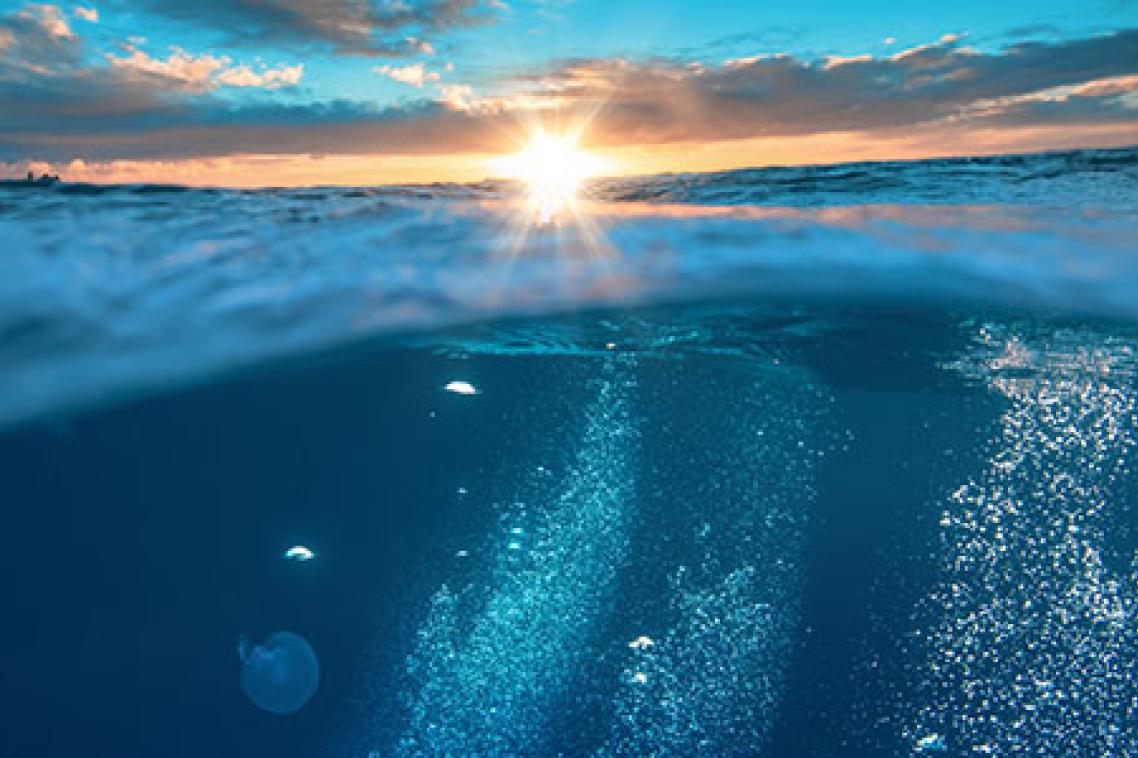
View of the ocean and sky, with the sun beaming in the centre of screen and emitting rays of golden light

A three-dimensional approach to marine conservation could help expand protected ocean areas by up to 30 per cent this decade, according to international researchers.

Dr Issac Brito-Morales helped develop the strategy while at The University of Queensland and said it could help conservationists and governments assess the biodiversity of our oceans in unprecedented detail.

“We need to stop thinking about the world as a two-dimensional map when it comes to conservation,” Dr Brito-Morales said.

“Our approach allows us to observe the world’s oceans in their full three dimensions, observing depth zones and the seafloor as different layers of our complex marine system.

“In the past, most marine protected areas were designated in shallow coastal areas – such as coral reefs – and considered the biodiversity in the water column and on the seafloor as one system.

“This may work in shallow marine environments, but in the open ocean, the surface can be many kilometres away from the sea floor – they’re completely different ecosystems.

“We’re attempting to conserve biodiversity in different depth zones while also observing how climate change is impacting each zone.”

The researchers hope the approach will help inspire the creation of larger, more detailed and effective marine protection areas.

“By looking at the high seas, which make up 61 per cent of the total ocean area, we’ve identified areas where species are less likely to migrate from as our oceans warm – think of them as climate change refuges,” Dr Brito-Morales said.

“These areas make up only about six per cent of the high seas, but are home to a number of at-threat species, such as marine mammals, seabirds, sea turtles and many fish species.

“As the high seas are exploited by the world’s fisheries, we can use our detailed 3D models to avoid unnecessary economic disruption, while maximising the protection of vulnerable species.

 “Getting protection in these deep-sea refuges would be a promising start in protecting the world’s oceans.”

Currently, 71 countries including Australia have a goal of increasing marine protection targets to 30 per cent of the world’s oceans by 2030.  

Senior UQ and CSIRO researcher Professor Anthony Richardson said the biggest challenge facing this effort was that most marine protected areas are within coastal zones inside the ‘marine borders’ or exclusive economic zones of each country.

“If we want to achieve the target without protection for high seas habitats, then marine protected areas would need to cover 75 per cent of the area of these zones, which is an unlikely and expensive outcome,” Professor Richardson said.

“So, protecting high seas habitat – or critical areas of it – is essential.

“The high seas are the least protected biome on the planet, with only 1.2 per cent under some kind of protection and 0.7 per cent fully protected while facing risks of overfishing, shipping, underwater cabling and proposed mining of the seafloor.

“If we don’t conserve these areas now, these threats will increasingly impact biodiversity.”

The global team included UQ’s Dr Jason Everett, Dr Carissa Klein, Dr Daniel Dunn and Professor Hugh Possingham, collaborating with Professor David Schoeman from the University of the Sunshine Coast, Hokkaido University’s Associate Professor Jorge García Molinos and Professor Michael Burrows from the Scottish Association for Marine Science.

The research is published in Nature (DOI: 10.1038/s41558-022-12323-7).

Media: Jessica Brown jbrown@conservation.org, +1 (734) 748-7361 (US), @isaaksonbm; Dominic Jarvis, dominic.jarvis@uq.edu.au, +61 (0)413 334 924, (Australia).

Related articles

A blonde woman in jeans and sneakers sits on a rock in the bush smiling.

Transforming communities: 2026 UQ Alumni Award winners

A Totally Wild legend, a leading parenting expert and a pioneer in Queensland’s community sector are among The University of Queensland’s 2026 Alumni Award winners.
16 October 2026
Three researchers wearing blue protective lab gowns stand among rows of potted chickpea plants inside a controlled-environment plant research facility.

Turning up the heat on chickpea yield

A University of Queensland study has outlined a practical pathway for accelerating the development of heat adapted chickpeas using data from new ‘omic’ technologies. PhD candidate Callum Jamie said the suite of technologies offered tremendous opportunities to understand how a complex trait like heat tolerance works. “The narrow genetic diversity in the elite chickpea gene pool has limited conventional breeding’s effectiveness for stress tolerance,” Mr Jamie said. “These technologies have improved our capacity to dissect trait architecture and phenotype secondary traits but their use in chickpeas has been limited.” The technologies include genomics, epigenomics, transcriptomics, proteomics, metabolomics, phenomics and enviromics, and help provide a comprehensive picture of biological systems. Epigenomics helps understand what controls gene activity; transcriptomics considers gene expression; proteomics protein production; metabolomics looks at biochemical processes; phenomics observes traits; and enviromics considers environmental factors influencing outcomes. Mr Jamie said previous studies had focused on just 1 to 2 -omic datasets, a small number of genotypes, and single tissues. This has meant it was hard to infer what results meant for trait architecture and mechanisms and the ability to extrapolate the information to breeding populations was limited. There have also been challenges around cost, scalability and integrating very different types of data to make the technologies useful. To overcome the hurdles, Mr Jamie’s research at the Queensland Alliance for Agriculture and Food Innovation has resulted in a proposed staged approach. It would start with genomic prediction and phenotyping, before adding -omic layers as costs fall and unknowns were resolved. “These technologies are novel and we still don’t know which information provides added value and how best to integrate all of this data to achieve an outcome,” Mr Jamie said. His PhD is supported by the Grains Research and Development Corporation (GRDC) and the International Research Training Group (IRTG) Accelerating Crop Genetic Gain and is aligned to a project which aims to fast-track the development of chickpea varieties adapted to high temperatures. Project leader Dr Millicent Smith said heat stress causes severe yield implications through flower and pod loss, reduced pollen viability and impaired grain filling. “Late sown chickpea is particularly in the firing line across most of Australia's crop in southern Queensland and northern New South Wales,” Dr Smith said. “We want to ensure that Australian growers maintain their competitive edge. “New varieties with improved genetics to cope with heat stress are essential for the future. “This work, suggesting a staged approach to utilising the new -omic technologies, is an exciting frontier.” The research was published by Food and Energy Security. Callum Jamie’s PhD is supported by the Grains Research and Development Corporation (GRDC) and the International Research Training Group (IRTG) Accelerating Crop Genetic Gain.
15 October 2026

Media contact

Subscribe to UQ News

Get the latest from our newsroom.