
Lasering lava to forecast volcanic eruptions
University of Queensland researchers have optimised a new technique to help forecast how volcanoes will behave, which could assist saving lives and property around the world.
Dr Teresa Ubide from UQ’s School of Earth and Environmental Sciences and a team of international collaborators have trialled a new application of the tongue-twisting approach: laser ablation inductively coupled plasma quadruple mass spectrometry.
“It’s a mouthful, but this high-resolution technique offers clearer data on what’s chemically occurring within a volcano’s magma, which is fundamental to forecasting eruption patterns and changes,” Dr Ubide said.
She described magma as the ‘computer code’ of volcanoes, providing information on the eruption style and lava flow.
“The chemical changes that occur within the liquid portion of the magma during a vol

“The magma is made up of liquid melt, gas and crystals that combine inside the volcano.
“There are often so many meddling crystals that the magma looks like rocky road, and it’s difficult to observe its chemistry.
“To get these crystals out of the way, we blast the cooled melt – which is known as the rock matrix – with a laser like those used for eye surgery.
“Then we analyse the material measuring its chemical make-up.”
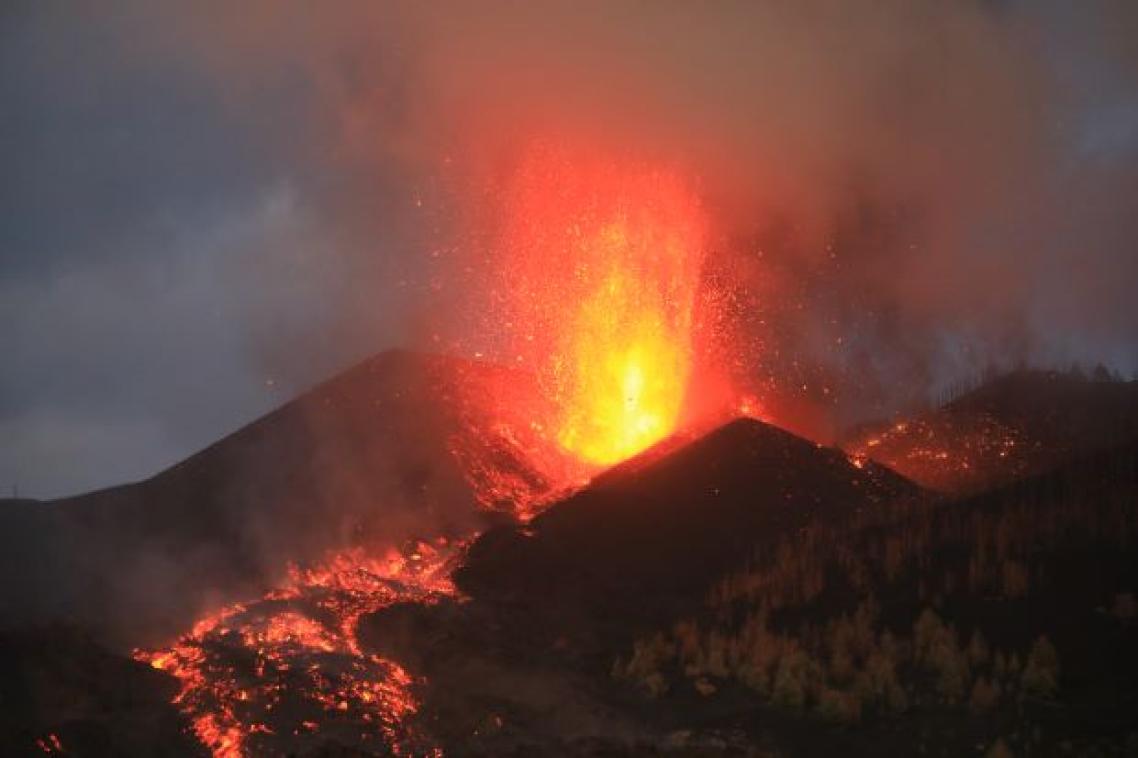
Dr Ubide and the team tested the method on samples collected during the spectacular but damaging 2021 eruption on the Canary Island of La Palma, which lasted 85 days.
“The eruption covered more than 12 square kilometres with 159 cubic metres of lava destroying around 1,600 homes and forcing the evacuation of more than 7,000 people – it cost the country the equivalent of around $1.4 billion,” Dr Ubide said.
“To understand how volcanic eruptions may evolve and to provide warnings and advice to people, live monitoring data is critical.
“Earthquakes, ground changes and gas data provide indirect information on what is happening inside an active volcano but the chemistry of the melt is a direct measure of the ‘personality’ of the magma, its behaviour upon eruption and potential impact on populations and infrastructure.
“The information we gathered during this eruption could help inform volcano monitoring and hazard management in the future.”
The team is now trialling a similar technique on volcanic ash, which can be sampled more readily during a volcanic event.
“We are excited to collaborate with volcano observatories to implement the method as a monitoring tool,” Dr Ubide said.
The research is published in Science Advances : https://www.science.org/doi/10.1126/sciadv.adg481
Media contact
Dr Teresa Ubide
t.ubide@uq.edu.au
Faculty of Science Media
science.media@uq.edu.au
+61 438 162 687
Related articles

Mapping the green transition of Asia Pacific economies
