
Beefing up cattle supplements
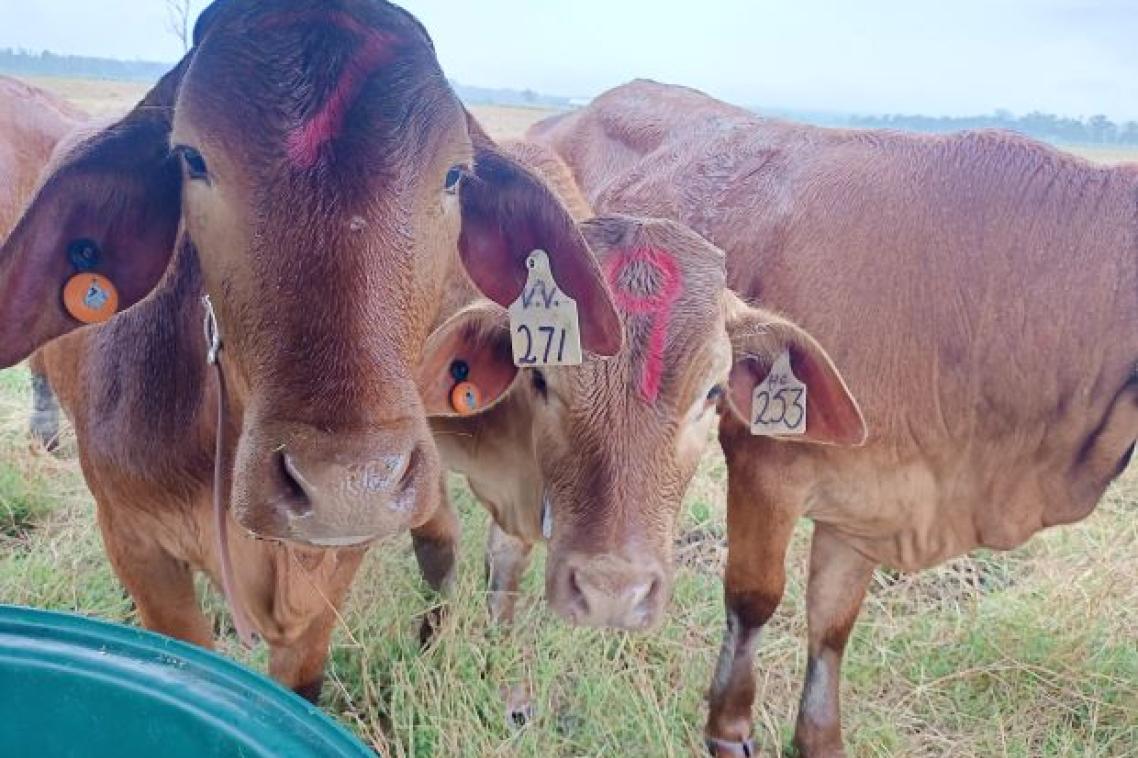
Simple on-animal sensors could be a game changer for Australian beef cattle nutrition, according to University of Queensland research.
Queensland Alliance for Agriculture and Food Innovation master’s student Tamara Freitas-Kirk is using wireless technology and motion detection cameras to monitor individual food intake of a trial herd.
“Current methods are only able to estimate feed intake of a herd, assuming all animals are consuming a predetermined amount,” Mrs Freitas-Kirk said.
“But there’s no such a thing as uniform consumption – with one kilogram of supplements for 10 animals, two animals could be eating 500 grams each while the other animals miss out.”
To solve this problem Mrs Freitas-Kirk used biometric wireless ear-tags and a camera to track the movement of 14 heifers in a 10-hectare paddock at UQ Gatton over 12 weeks.
“Previous research has shown that time at the feed trough correlates to intake,” she said.
“After tracking the animals and collating the data I developed an equation based on the time each animal spent at the trough.
“The results show more than 70 per cent of the variation in individual intake can be explained by the ear-tags and the equation.
“While you will never get a precise measurement, it provides a much better estimate of the feed intake of individual animals than current methods.”
Mrs Freitas-Kirk anticipates the wireless ear-tags will become an important tool for cattle producers.
“With supplementing, producers really want to use the minimum amount because of the cost so if we can be more effective in this area, costs will decrease over time,” she said.
“It will be a big deal for the beef industry in the long run, ensuring it is more sustainable and resilient.”
She said the new method could also help producers grappling with one of the industry’s biggest challenges, reducing methane emissions.
“We can ensure each animal is eating the correct amount of feed additives to have an effect on methane production.”
The next step for Mrs Freitas-Kirk is further proof of concept trials, with the results presented at industry conferences in tandem with QAAFI’s Calf Alive project.
Images are available via Dropbox.
Media: Tamara Freitas-Kirk, t.freitas@uq.edu.au, 0498 578 089; QAAFI Comms, Natalie MacGregor, n.macgregor@uq.edu.au, +61 409 135 641
Related articles

What makes a winning environmental campaign? We studied six decades of activism to find out
