Skip to menu Skip to content Skip to footer
News

Bringing new life to an ancient nut
22 April 2024
Decorative

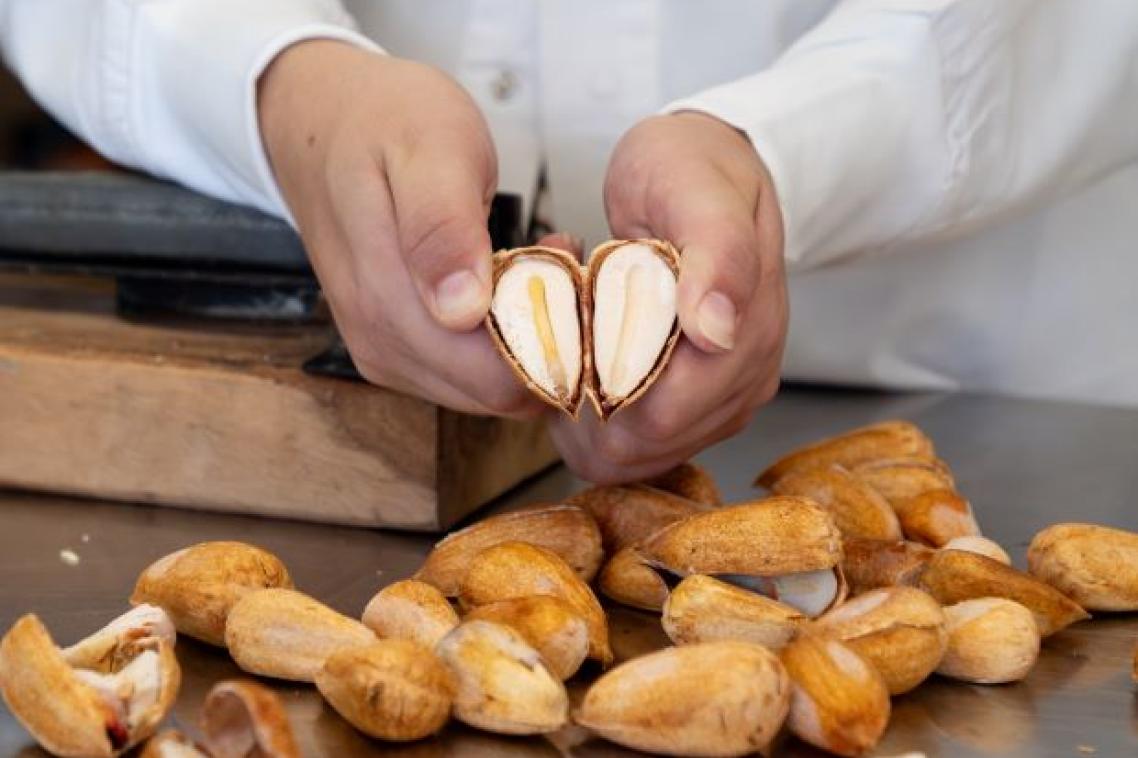
A culturally significant Australian nut dating back to Jurassic times could have a big future thanks to University of Queensland-led research revealing its substantial health benefits. 

Dr Jaqueline Moura Nadolny from UQ’s Queensland Alliance for Agriculture and Food Innovation said the bunya nut (Araucaria bidwillii) was an energy and nutrient dense bushfood with huge commercial potential.

Key points

  • The bunya nut has been a significant food source for Indigenous Australians for thousands of years.
  • Research has shown the nut has remarkable nutritional benefits.
  • Australia's bunya trees face environmental threats, but if overcome the nuts could be a thriving Indigenous enterprise.

“Bunya nuts are low in fat, high in fibre, gluten free and contain all the essential amino acids, protein and folate, while the husk is high in antioxidant compounds,” Dr Nadolny said. 

“Indigenous Australians boiled and roasted them, but they can be eaten straight out of the cone, ground into flour, brewed into tea and even fermented.”

Dr Nadolny said bunya nuts could be as commercially successful as similar nuts from the same family in Brazil and Chile, but the industry in Australia faced environmental challenges.

“Established bunya trees are under threat from phytophthora, a root rot that causes dieback,” she said.

“It’s critical new trees are planted, as well as grafted to speed up fruiting to within five or six years.

“Each tree can produce hundreds of cones, each containing up to 100 nuts.

“In South America, grafting has helped boost production.”

Shannon Bauwens, Cultural Services Coordinator for the Bunya People’s Aboriginal Corporation has welcomed Dr Nadolny’s research. 

“The bunya nut has a strong cultural significance to traditional owners and other Indigenous peoples who gathered for thousands of years in pre-colonial times for feasting and ceremonies,” Mr Bauwens said. 

“The Bunya Mountains in southern Queensland are home to the largest known stand of the species in the world, and the trees live for hundreds of years. 

“Creating an industry surrounding the bunya nut would not only ensure its survival but create a sustainable industry for mob, allowing them to share their knowledge with the community.”

Dr Nadolny said bunya nuts could be the centre of a thriving Indigenous enterprise. 

“I work with Indigenous communities who are interested in harvesting, selling and producing food products from the nuts, creating jobs and income,” she said. 

“Taking measures now to ensure a healthy future for Australia’s bunya trees could lead to showcasing this incredible Indigenous food and its potential to the world,” she said. The research paper was published in Food Research International.


The ARC Centre for Uniquely Australian Foods is supported by the Australian Government through the Australian Research Council’s Industrial Transformation Training Centre funding scheme (project IC180100045), the Department of Agriculture and Fisheries and the University of Queensland.

Media assets

Download images and video via Dropbox

Media contacts

Dr Jaqueline Moura Nadolny
j.mouranadolny@uq.edu.au
+61 466 918 630 

QAAFI Media, Natalie MacGregor
n.macgregor@uq.edu.au
+61 409 135 651

Related articles

A blonde woman in jeans and sneakers sits on a rock in the bush smiling.

Transforming communities: 2026 UQ Alumni Award winners

A Totally Wild legend, a leading parenting expert and a pioneer in Queensland’s community sector are among The University of Queensland’s 2026 Alumni Award winners.
16 October 2026
Three researchers wearing blue protective lab gowns stand among rows of potted chickpea plants inside a controlled-environment plant research facility.

Turning up the heat on chickpea yield

A University of Queensland study has outlined a practical pathway for accelerating the development of heat adapted chickpeas using data from new ‘omic’ technologies. PhD candidate Callum Jamie said the suite of technologies offered tremendous opportunities to understand how a complex trait like heat tolerance works. “The narrow genetic diversity in the elite chickpea gene pool has limited conventional breeding’s effectiveness for stress tolerance,” Mr Jamie said. “These technologies have improved our capacity to dissect trait architecture and phenotype secondary traits but their use in chickpeas has been limited.” The technologies include genomics, epigenomics, transcriptomics, proteomics, metabolomics, phenomics and enviromics, and help provide a comprehensive picture of biological systems. Epigenomics helps understand what controls gene activity; transcriptomics considers gene expression; proteomics protein production; metabolomics looks at biochemical processes; phenomics observes traits; and enviromics considers environmental factors influencing outcomes. Mr Jamie said previous studies had focused on just 1 to 2 -omic datasets, a small number of genotypes, and single tissues. This has meant it was hard to infer what results meant for trait architecture and mechanisms and the ability to extrapolate the information to breeding populations was limited. There have also been challenges around cost, scalability and integrating very different types of data to make the technologies useful. To overcome the hurdles, Mr Jamie’s research at the Queensland Alliance for Agriculture and Food Innovation has resulted in a proposed staged approach. It would start with genomic prediction and phenotyping, before adding -omic layers as costs fall and unknowns were resolved. “These technologies are novel and we still don’t know which information provides added value and how best to integrate all of this data to achieve an outcome,” Mr Jamie said. His PhD is supported by the Grains Research and Development Corporation (GRDC) and the International Research Training Group (IRTG) Accelerating Crop Genetic Gain and is aligned to a project which aims to fast-track the development of chickpea varieties adapted to high temperatures. Project leader Dr Millicent Smith said heat stress causes severe yield implications through flower and pod loss, reduced pollen viability and impaired grain filling. “Late sown chickpea is particularly in the firing line across most of Australia's crop in southern Queensland and northern New South Wales,” Dr Smith said. “We want to ensure that Australian growers maintain their competitive edge. “New varieties with improved genetics to cope with heat stress are essential for the future. “This work, suggesting a staged approach to utilising the new -omic technologies, is an exciting frontier.” The research was published by Food and Energy Security. Callum Jamie’s PhD is supported by the Grains Research and Development Corporation (GRDC) and the International Research Training Group (IRTG) Accelerating Crop Genetic Gain.
15 October 2026

Media contact

Subscribe to UQ News

Get the latest from our newsroom.