Skip to menu Skip to content Skip to footer
News

Biodiversity at risk in most rainforests
10 December 2024
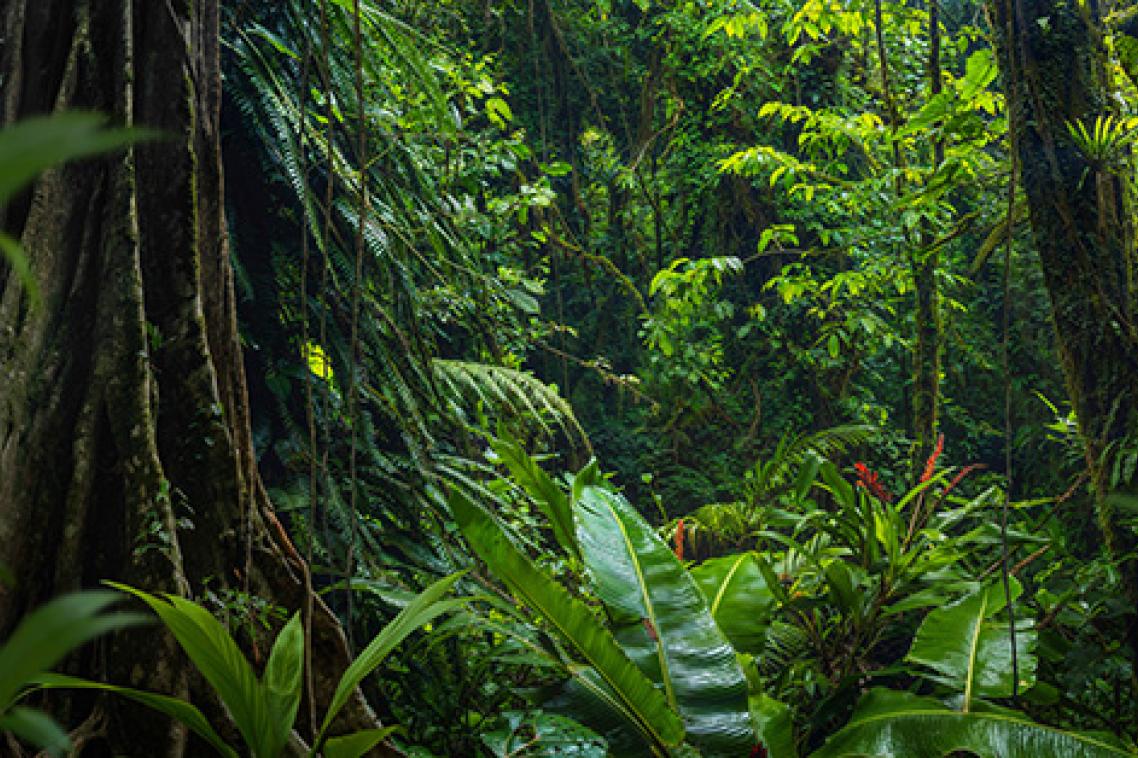
a view of very green dense foliage and a large tree trunk covered in ferns
Image: Adobe.

New research has revealed less than a quarter of the remaining tropical rainforests around the globe can safeguard thousands of threatened species from extinction.

The research, co-authored by The University of Queensland’s Professor James Watson, evaluated the global availability of structurally intact, minimally disturbed tropical rainforests for more than 16,000 species of mammals, birds, reptiles, and amphibians.

“Using remote sensing and forest integrity indicators, we analysed the quality of the rainforests across the ranges of the forest-dependent vertebrates,” Professor Watson said.

“Overall, up to 90 per cent of forest cover still remains within these species’ ranges but only 25 per cent of it is of high quality, which is a critical factor in reducing extinction risk.

“We knew high-integrity rainforests were vital for biodiversity, but no one had quantified just how limited these key habitats have become.

“Our research shows that structurally intact rainforests – which are essential for many forest-dependent species – are alarmingly rare, particularly in regions most affected by human pressures such as logging and infrastructure development.”

The study also revealed contrasts in habitat quality based on the conservation status of different species.

“Only 8 per cent of the rainforest habitat for species classified as threatened or with declining populations is of high integrity,” Professor Watson said.

“In comparison, non-threatened species have ranges with about 25 per cent of high-integrity rainforest habitat, highlighting how habitat degradation disproportionately impacts species already at risk.”

The golden bowerbird (Prionodura newtonia), which is classified as having a decreasing population in Queensland’s wet tropics, was included in the study which found while 84 per cent of its habitat remained, only 36 per cent is high-integrity rainforest.

University of Northern British Columbia’s Dr Rajeev Pillay, who led the research, said the results point to the urgent need for conservation strategies that go beyond preserving forest cover to maintaining forest quality.

“Simply having forest cover isn’t enough if the structural complexity and low human disturbance necessary for biodiversity are gone,” Dr Pillay said.

“To protect the remaining high-integrity tropical rainforests, global coordination to minimise human disturbance is key, especially in unprotected forests that remain vital for biodiversity.

“As international conservation targets emphasise ecosystem integrity, this study provides a critical baseline.

“Protecting high-integrity rainforests is essential to meeting the Convention on Biological Diversity’s 2030 targets and to averting further biodiversity loss.

“As human pressures continue to mount, preserving these remaining forests may be the best hope to secure a sustainable future for the planet’s biodiversity.”

The research is published in Proceedings of the National Academy of Sciences.

Media contacts

UQ Faculty of Science Media
science.media@uq.edu.au
+61 438 162 687

Related articles

Three researchers wearing blue protective lab gowns stand among rows of potted chickpea plants inside a controlled-environment plant research facility.

Turning up the heat on chickpea yield

A University of Queensland study has outlined a practical pathway for accelerating the development of heat adapted chickpeas using data from new ‘omic’ technologies. PhD candidate Callum Jamie said the suite of technologies offered tremendous opportunities to understand how a complex trait like heat tolerance works. “The narrow genetic diversity in the elite chickpea gene pool has limited conventional breeding’s effectiveness for stress tolerance,” Mr Jamie said. “These technologies have improved our capacity to dissect trait architecture and phenotype secondary traits but their use in chickpeas has been limited.” The technologies include genomics, epigenomics, transcriptomics, proteomics, metabolomics, phenomics and enviromics, and help provide a comprehensive picture of biological systems. Epigenomics helps understand what controls gene activity; transcriptomics considers gene expression; proteomics protein production; metabolomics looks at biochemical processes; phenomics observes traits; and enviromics considers environmental factors influencing outcomes. Mr Jamie said previous studies had focused on just 1 to 2 -omic datasets, a small number of genotypes, and single tissues. This has meant it was hard to infer what results meant for trait architecture and mechanisms and the ability to extrapolate the information to breeding populations was limited. There have also been challenges around cost, scalability and integrating very different types of data to make the technologies useful. To overcome the hurdles, Mr Jamie’s research at the Queensland Alliance for Agriculture and Food Innovation has resulted in a proposed staged approach. It would start with genomic prediction and phenotyping, before adding -omic layers as costs fall and unknowns were resolved. “These technologies are novel and we still don’t know which information provides added value and how best to integrate all of this data to achieve an outcome,” Mr Jamie said. His PhD is supported by the Grains Research and Development Corporation (GRDC) and the International Research Training Group (IRTG) Accelerating Crop Genetic Gain and is aligned to a project which aims to fast-track the development of chickpea varieties adapted to high temperatures. Project leader Dr Millicent Smith said heat stress causes severe yield implications through flower and pod loss, reduced pollen viability and impaired grain filling. “Late sown chickpea is particularly in the firing line across most of Australia's crop in southern Queensland and northern New South Wales,” Dr Smith said. “We want to ensure that Australian growers maintain their competitive edge. “New varieties with improved genetics to cope with heat stress are essential for the future. “This work, suggesting a staged approach to utilising the new -omic technologies, is an exciting frontier.” The research was published by Food and Energy Security. Callum Jamie’s PhD is supported by the Grains Research and Development Corporation (GRDC) and the International Research Training Group (IRTG) Accelerating Crop Genetic Gain.
15 October 2026
Close-up photograph of a red-bellied black snake coiled across pale, weathered wood. The snake has glossy black scales on its back and vivid red coloration along its sides and underside. The image highlights the texture of the scales and the contrast between the dark body and the light wood background.
Analysis

Deadly fungi are harming Australia’s wild reptiles. This is how to stop the spread

With spring underway and the weather warming, reptiles are on the move in suburbs, parks and bushland across Australia. Snake catchers and wildlife carers are responding to calls for help, and reptile enthusiasts – known as “herpers” – are heading outdoors in search of their next sighting.
13 October 2026

Media contact

Subscribe to UQ News

Get the latest from our newsroom.