
Cardboard panels offer lightweight, sustainable solution for temporary housing
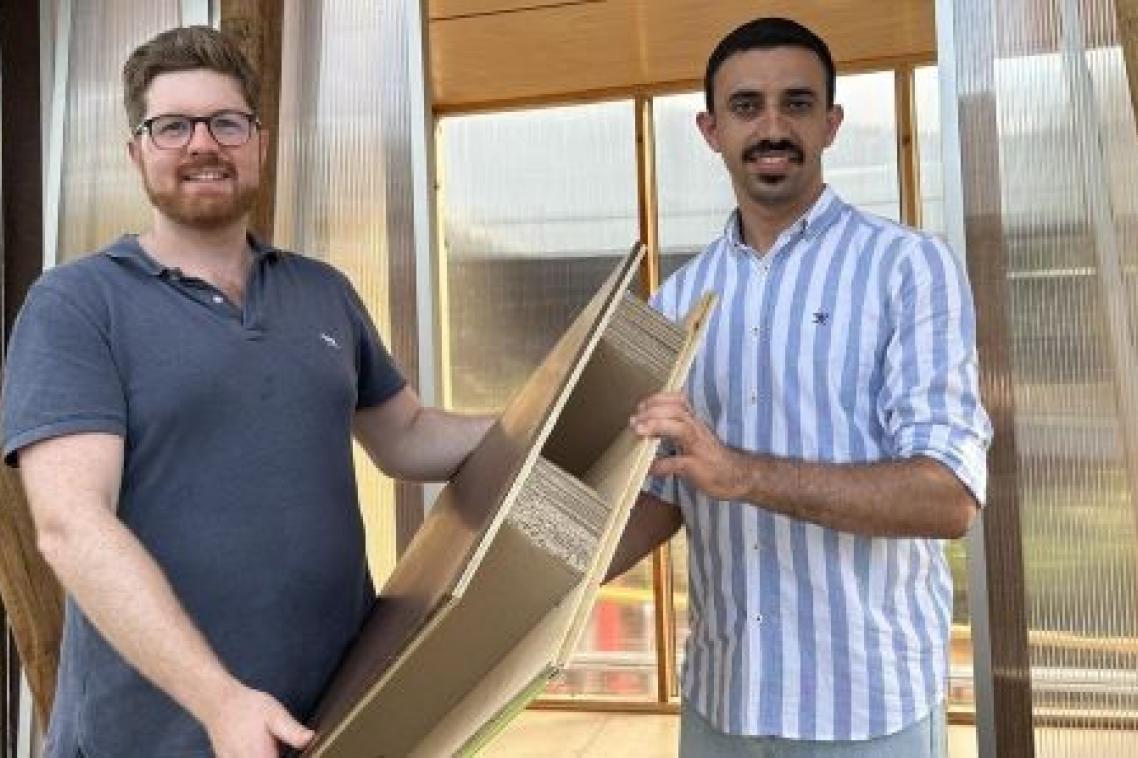
Associate Professor Joe Gattas (left) and PHD student Mahmoud Abu-Saleem with one of their timber-cardboard web-core sandwich (TCWS) panels.
(Photo credit: The University of Queensland )
Temporary housing for people displaced by natural disasters could become cheaper, lighter and more sustainable with innovative new timber-cardboard construction panels developed by University of Queensland researchers.
The panels are 50 per cent lighter than a previous design but retain the same strength, according to a new paper by structural engineering PhD candidate Mahmoud Abu-Saleem and Associate Professor Joe Gattas, both from UQ’s School of Civil Engineering.
Dr Gattas said extensive use of cardboard reduces the cost and environmental impact of the panels, meaning builders of temporary housing are less exposed to the shortages and soaring costs of traditional construction materials.
“Cardboard is one of the most highly recycled materials for packaging in Australia,” he said.
“There’s no impact on waste generated and no increase in resource consumption. You're essentially extending the service life of that material before it gets recycled again.”
The timber-cardboard web-core sandwich (TCWS) panels consist of thin timber facings separated by cardboard studs and air pockets.
They were introduced in the research paper as a development of timber-cardboard sandwich (TCS) panels, which featured a solid monolithic cardboard core.
Lab testing found the TCWS panels were 50 per cent lighter than the TCS panels and just as strong, or stronger, for their weight.
The TCWS panels were also 33 per cent stronger than similar foam or bio-based panels.
Dr Gattas said introducing the air gap helped reduce the weight, so 2 people can comfortably handle the panels.
“The panels are intended for short-term use, possibly for temporary housing or granny flats for people displaced by natural disasters,” he said.
“The fact they are lighter means they will be easier to lift and fit together quickly in a post-disaster scenario, where temporary structures are in high demand.
“We need systems that suit short-term use cases as there's a lot of need for this class of accommodation in Australia, and internationally.”
The panels have been used in a prototype ‘cardboard house’ constructed at UQ’s Pinjarra Hills Research Facility and have held up well to the wet Queensland summer.
The researchers have kept the elements at bay by incorporating the same principles used for timber-clad homes – including substantial eaves, often seen on iconic Queenslander-style homes.
Mr Abu-Saleem said while replacing some of the monolithic cardboard in the TCS with the air gaps reduced the weight, this could also reduce the insulation effectiveness of the panels.
“This could be addressed in future by adding another waste material like paper into the air gaps to improve their insulation properties,” he said.
The research paper is published in Structures.
Related articles

Researchers transforming bioplastics into ‘superstructure’ medical hydrogels
