
Running faster equals disaster
Trading maximum speed for manoeuvrability may be essential to surviving a run-in with a predator, a new study shows.
University of Queensland researchers have investigated quoll crashes during high-speed cornering, which can impact individual quolls and ecosystems.
Associate Professor Robbie Wilson of UQ’s School of Biological Sciences said the research helped to understand the dynamics of movement, which underlie all animal behaviours.
“Studies of animal performance and its ecological consequences usually assume that animals use their maximum speed in survival situations, but this is rarely the case,” he said.
“Animals have to trade-off between escaping a situation at maximum speed or slowing down to safely manoeuvre around obstacles.
“The consequences of a mistake made at high speed can lead to death, but the consequences of a slow escape can also be disastrous.
“The balance of predator and prey success has effects on entire ecosystems.”
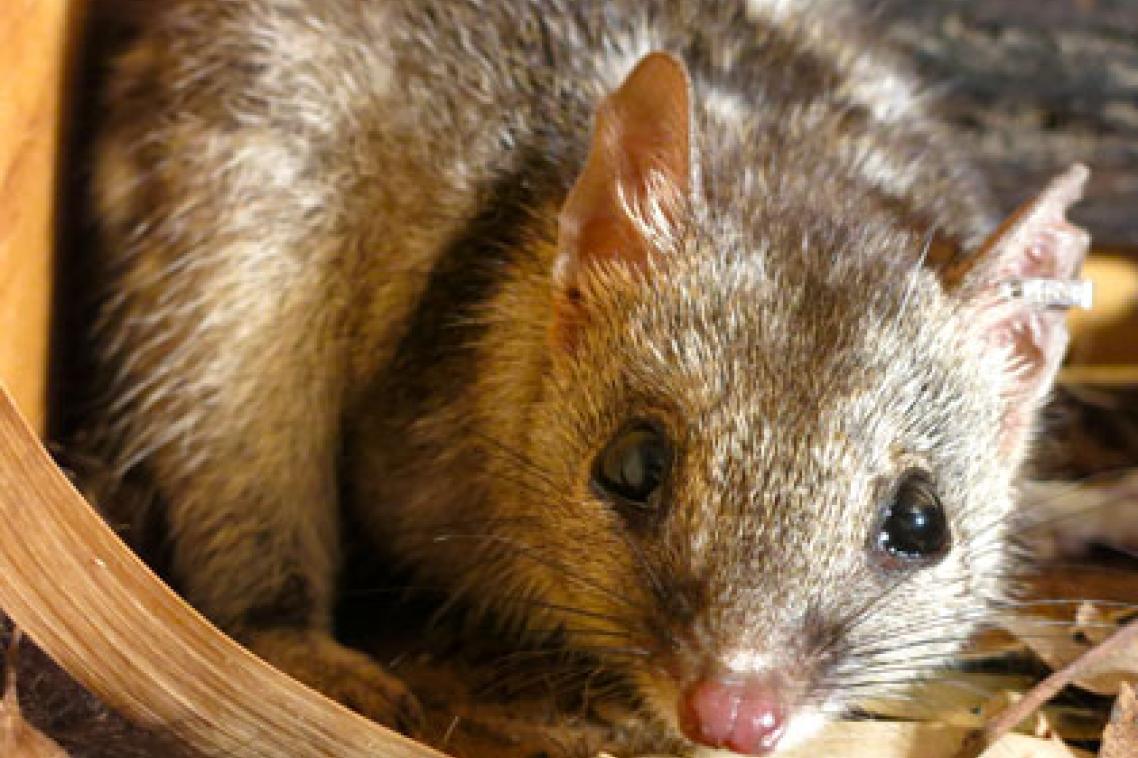
The researchers studied 66 northern quolls and used physical tests to determine maximum sprint speed as well as manoeuvrability when running around corners.
Quolls raced along straight and curved tracks, with increasing corner angles.
“We saw that the faster a quoll approached a corner, the higher the probability that it would crash, which could be fatal when running to escape a predator,” Dr Wilson said.
“The quolls naturally reduced their speed as corner angles increased, a behaviour that’s been shown in other animals including lizards.
“Movement speeds, even during extreme situations like escaping predation, should be based on a compromise between high speed, manoeuvrability and motor control.”
The research is published in the Journal of Experimental Biology (5 February 2015).
Media: Associate Professor Robbie Wilson, 0458 204 962, r.wilson@uq.edu.au, @UQrobbiewilson
Topics
Related articles

From birdsong to galaxies: unleashing the potential of citizen science
