
Plugging the gap in oil and gas
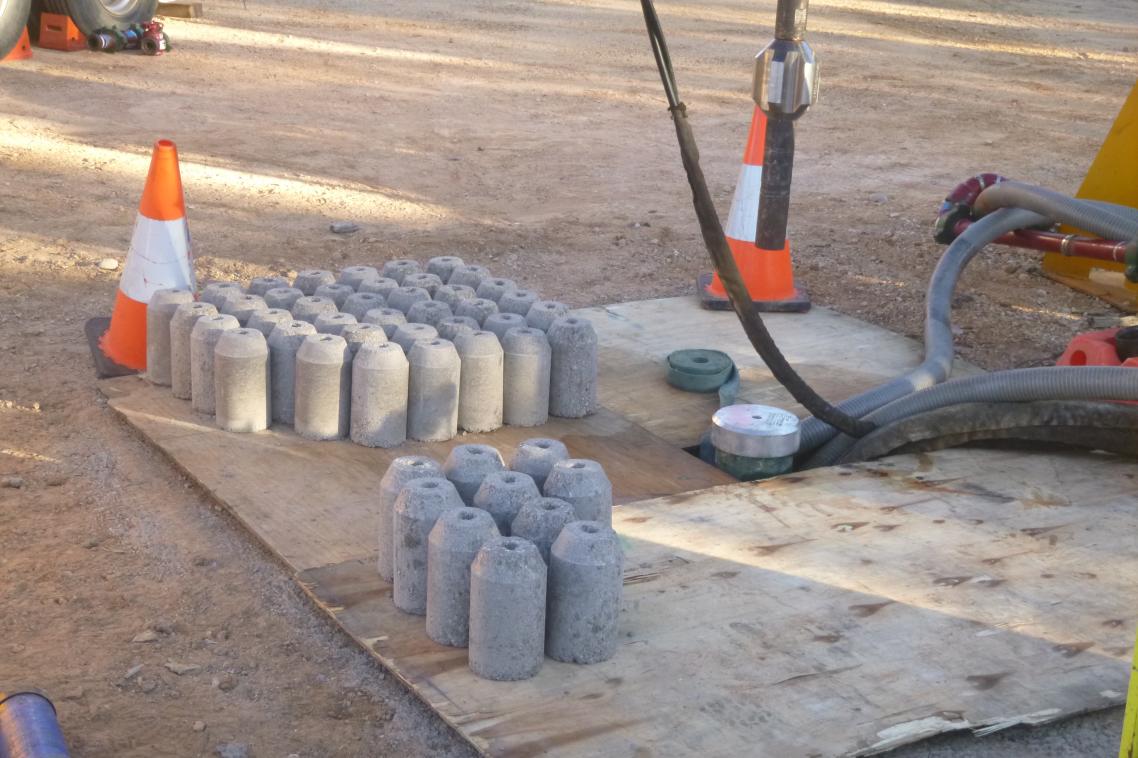
Plugging decommissioned oil and gas wells may become safer and more economical with a solution championed by University of Queensland researchers.
Professor Brian Towler’s team from the UQ Centre for Coal Seam Gas and School of Chemical Engineering is using bentonite, a naturally-occurring clay, to manufacture plugs.
“Bentonite is not only cheap, but also easier to handle,” Professor Towler said.
“Once bentonite is hydrated it creates a potentially more reliable plug that is flexible and self-healing.
“The number of CSG wells in Queensland has skyrocketed in the past decade and there are still many more planned.
“Over the next few decades tens-of-thousands of holes will eventually need to be plugged.”
To plug wells with bentonite, the dry clay is compressed into a cylindrical shape, then dropped or lowered down the vertical CSG hole or water well, usually into a standing water column.
The hole is then filled up with water and the clay is allowed to hydrate, causing it to seal the hole by swelling out against the sides.
The bentonite plug remains in place, sealing the hole indefinitely.
Professor Towler said bentonite plugs could be superior to cement plugs because of their malleable, self-healing characteristics.
He said bentonite was cost-effective, and extensive deposits were available in Queensland.
“This could mean local jobs for regional Queensland, not only in mining bentonite, but also manufacturing and inserting the plugs.”
Professor Towler and his team were awarded a $175,000 Advance Queensland Grant and have partnered with Shell (formerly QGC), Santos, Arrow Energy and Australia Pacific LNG through the Centre for Coal Seam Gas to develop cost-effective plugging technology for CSG wells, water wells and coal bores.
UQ offers a Master of Petroleum Engineering for skilled engineers wanting to face the technological and commercial challenges of hydrocarbon exploration and production.
Email enquiries@eait.uq.edu.au to discuss eligibility.
Media: Professor Brian Towler, b.towler@uq.edu.au , 07 3346 1233; Genevieve Worrell, g.worrell@uq.edu.au, 0408 432 213.
Topics
Related articles

UQ researchers send an unblockable message using gravity
