
Collaboration is key for science research
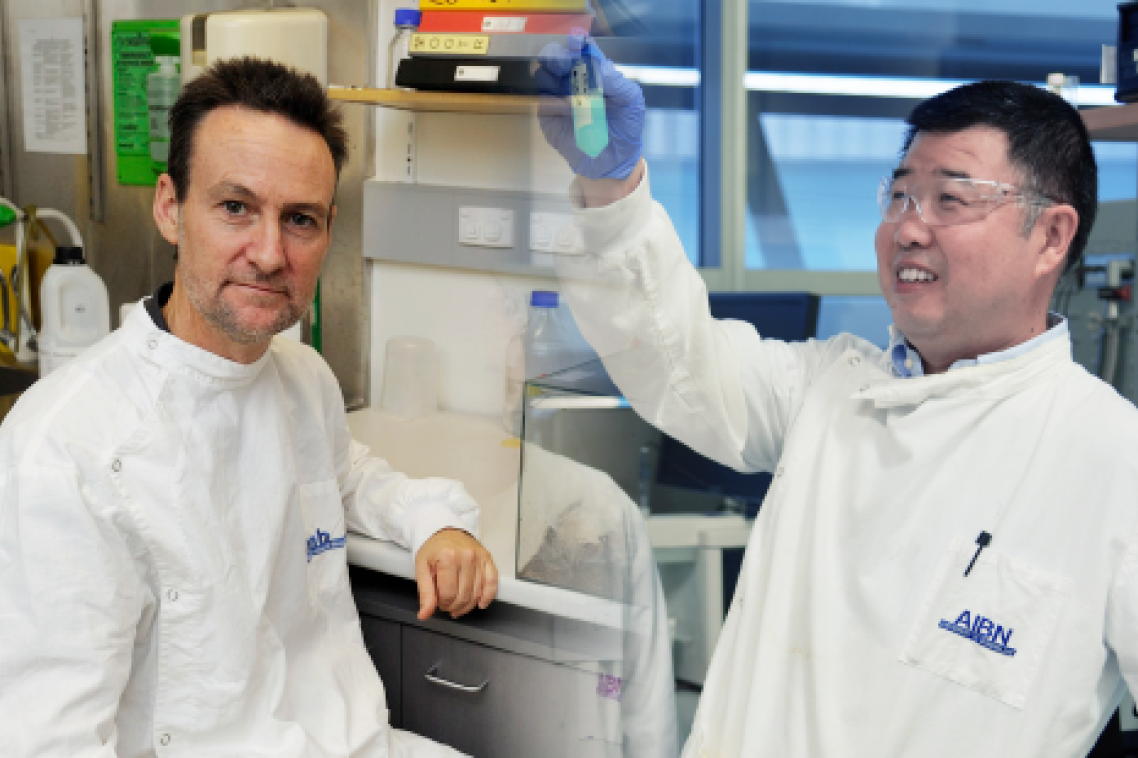
University of Queensland research projects into chronic pain and Alzheimer’s disease have received $125,000 each in funding under the Queensland-Chinese Academy of Science (Q-CAS) Collaborative Science Fund, announced today (31 October).
A project using molecules from spider venom to develop improved treatments for chronic pain and stroke will be undertaken by Institute for Molecular Bioscience (IMB) Professor Glenn King in partnership with University of Science and Technology of China.
“Chronic pain and stroke are major clinical problems in both Australia and China, but drugs to treat chronic pain have limited effectiveness in many people and can come with serious side effects, while there are no drugs available to protect the brain from stroke-induced injury,” Professor King said.
“Pain and stroke both involve acid-sensing ion channels, which transmit impulses including pain signals and the impulses that cause the death of brain neurons after stroke.”
“We discovered that molecules originally found in spider venom can inhibit different types of acid-sensing ion channels, meaning some can be deployed to block pain while others are highly protective of brain neurons after stroke.”
Professor King will work with Professor Changlin Tian to develop painkillers that are safe and non-addictive, and also to develop a drug to protect the brain after stroke.
Australian Institute for Bioengineering and Nanotechnology (AIBN) Professor Zhi Ping (Gordon) Xu has received funding for a project aiming to develop novel nanomedicines for efficient treatment of Alzheimer’s disease.
To achieve this, he will use nanotechnology to produce medicines that are better at penetrating the blood-brain barrier and can be more easily taken up by brain cells.
“The nanomedicines will be able to deliver up to four carefully-selected therapeutics to the brain, enabling clinicians to simultaneously target and reduce the toxic ‘clumps’ of sticky proteins in and around brain cells, which are a major hallmark of Alzheimer’s disease,” Professor Xu said.
“The project will provide a better understanding of how this disease progresses, and it is anticipated that the resulting nanomedicines will reduce symptoms and improve prognosis for Alzheimer’s patients.
“The project will also provide early career researchers with training in frontline nanotechnology and the latest advances in neurosciences, promoting Queensland’s and China’s international competitiveness in nanomedicine, Alzheimer’s drug discovery and neuroscience.”
Professor Xu will work with UQ Foundation Chair in Molecular Neuroscience Professor Perry Bartlett on the project.
Media: UQ Communications, communications@uq.edu.au, 3365 3439.
Related articles
UQ rises 22 places in 2027 QS Sustainability Rankings
