
Bamboo lights a fire under Australian construction industry
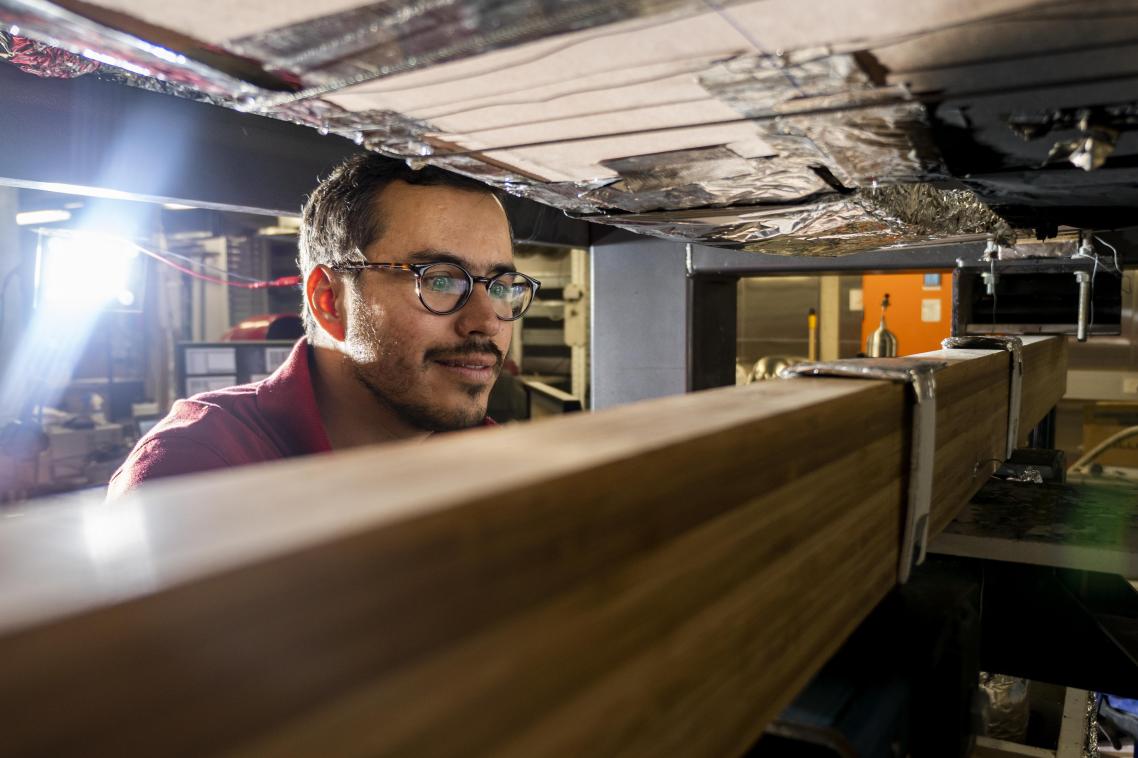
A passion for sustainable construction led University of Queensland PhD student Mateo Gutierrez to explore the potential of bamboo as an environmentally friendly local building material.
Bamboo is fast becoming a popular choice in Australia for flooring and furniture, but Mr Gutierrez said global construction industries could be transformed if building regulations incorporated bamboo as a structural building material option.
“Bamboo is an excellent building material because it is highly renewable and it has remarkable mechanical properties, it’s light-weight, flexible and strong,” Mr Gutierrez said.
“It’s fast-growing as it is actually a grass, which increases the turnaround of harvests from timber’s 30 years to three years for bamboo poles – there are many benefits.”
After joining the University’s fire safety engineering research group UQ Fire in 2016, Mr Gutierrez, a structural engineer by trade, began looking at the performance of bamboo structures when exposed to fire.
Global company MOSO International has provided the UQ Fire team with industry support, contributing engineered bamboo beams for laboratory-based fire testing.
“During testing, we found that when burning, bamboo creates a char layer that protects the inner layers that are not directly exposed to fire, which means it’s relatively hard-wearing in a fire” he said.
“Like timber, bamboo suffers a reduction in structural integrity at high temperatures, but our goal is to understand how that reduction occurs and how we can predict the failure of load-bearing elements in a building.
“We aim to develop design frameworks that can predict how bamboo buildings will fare in fires, and these could be used to inform revisions of the Australian building regulations, and perhaps see bamboo in Australian urban environments.”
Mr Gutierrez said bamboo still had some limitations as a structural material that needed to be worked through, like weak production chains, a lack of harvesting and engineering technology in the developing countries where it is mostly produced, as well as the misconception that bamboo isn’t as strong or long-lasting as other materials.
But despite this, the material has already been used around the world to create amazing architectural marvels like Ibuku’s Sharma Springs residence in Bali and in the beautiful designs of acclaimed architect Simon Velez, in Mr Gutierrez’s home country of Colombia.
 In the face of climate catastrophe, Mr Gutierrez said bamboo offers the construction industry a sustainable solution with a far lower carbon footprint than other options.
“With research advancing in the area of bamboo fire safety, bamboo buildings in Brisbane are closer than we might think.”
Media: Mateo Gutierrez, m.gutierrezgonzalez@uq.edu.au, 0416 354 954; UQ Communications, Genevieve Worrell, g.worrell@uq.edu.au, 0408 432 213.
Related articles

What you need to know about COP31
