
Try science at home with the #StayHome BiodiversityChallenge
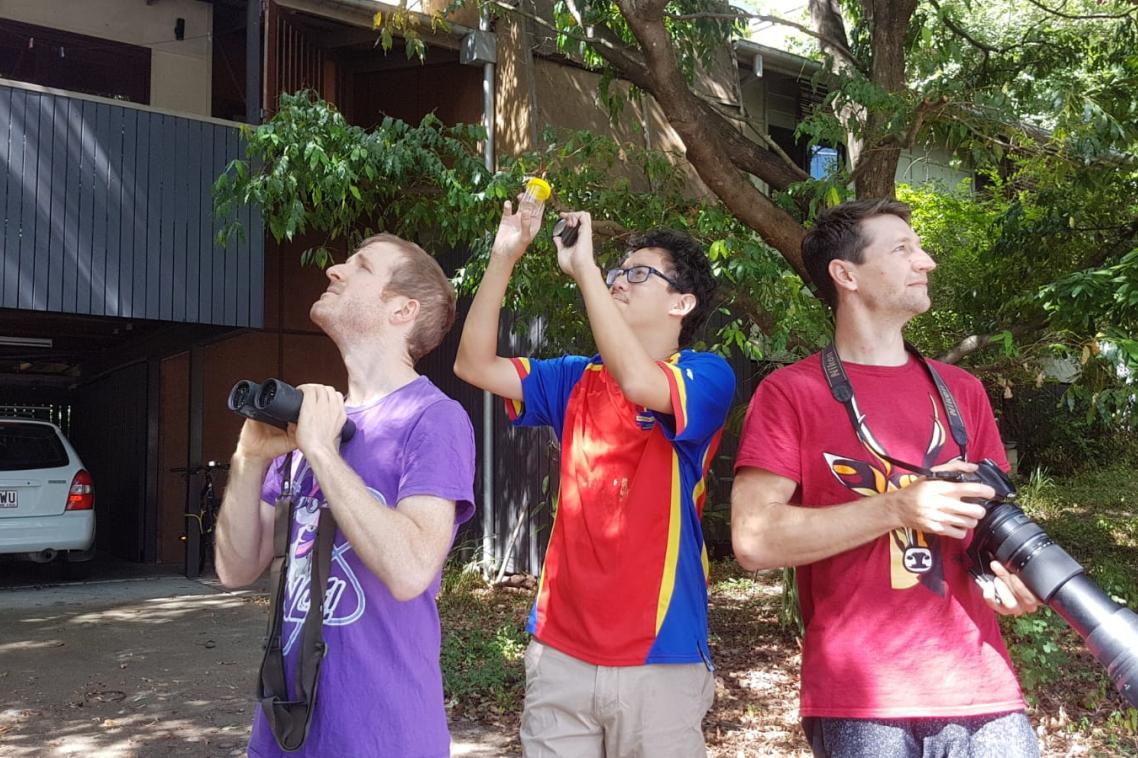
Stuck together in isolation, three University of Queensland scientists have started a new online challenge to get us more acquainted with our (very) local wildlife.
The #StayHomeBiodiversityChallenge is the brainchild of housemates Dr Russell Yong, Dr Andrew Rogers and Dr Matthew Holden – a UQ taxonomist, ecologist, and mathematician.
The scientists are hoping people around the world will take notice of the species that live in their homes and backyards, tweeting their findings and photos with the hashtag #StayHomeBiodiversityChallenge.
“It all started when I was cleaning my room out of sheer boredom at the beginning of this ‘new normal’ - lockdown,” biodiversity researcher Dr Rogers said.
“I was trying to move all the spiders outside, instead of vacuuming them up, and I had to move a lot of spiders.
“I wondered how many spiders I share the house with, quickly followed by wondering how many moths, flies, butterflies, reptiles and plants share the house with us all.”
Housemate Russell Yong was quick to get involved.
“I’m a career taxonomist in the UQ Marine Parasitology Lab, so I’ve always been one for counting and cataloguing species around me, so when Andrew and Matt suggested we do this, I was on board,” Dr Yong said.
“We live on an average-sized property in the thick of inner-Brisbane suburbia, but importantly we do little to interfere with the environment in our yard – no spraying, extensive lopping, or slashing etc.
“As such, our overall species richness has always been noticeably high, compared to the surrounding neighbourhood and most of inner suburban Brisbane.”
Two weeks after counting began the scientists had logged more than 280 species of plants and animals.
“Moths were the most diverse group in our survey with 70 species, more than 10 per cent of all moth species ever recorded in the Brisbane region, and that’s in just two weeks,” Dr Yong said.
“The rate of discovery is starting to slow, as we enter a bit of a cold period and insect numbers dwindle.
“But we fully expect we’ll get more than 300, maybe even 400 species by the time work/travel restrictions are lifted.
“It’s a truly stunning number for a small, 430 square metre property."
The trio hopes the hashtag will prompt kids shut away in home schooling to get involved in science.
“Parents and kids can post pictures to forums on social media for insect, plant, reptile, bird and mammal identification and use the phone app, ‘iNaturalist’, which makes suggestions about what animals are in submitted photos,” Dr Rogers said.
“It would be great to get kids off the couch and passionate about the natural world, helping build their scientific skills while also helping them develop a clear picture of the state of our local environments.”
Media: Dr Russell Yong, rqy.yong@uqconnect.edu.au, +61 405 202 780; Dr Andrew Rogers, a.rogers@uq.edu.au, +61 420433722; Dr Matthew Holden, m.holden1@uq.edu.au, +61 406 557 706; Dominic Jarvis, dominic.jarvis@uq.edu.au, +61 413 334 924.
Related articles

UQ researchers send an unblockable message using gravity
