
The biodiversity debate is over – now let’s save the planet
Conservation researchers have debated two different approaches to protecting biodiversity for years, but an international team of scientists has found a combination could achieve the best results.
University of Queensland’s Professor James Watson said the team used computer modelling, big data and satellite imaging to piece together a map that ‘flipped the debate on its head’.
“The world is facing a biodiversity crisis, with up to half a million species under imminent threat of extinction over coming decades,” Professor Watson, Director of Science and Research Initiative with the Wildlife Conservation Society said.
“Rather than trying to extol the virtues of either strategy, we’re getting down to business and finding exactly which parts we need to protect now.
Professor Watson said that retaining remaining natural habitat for biodiversity was crucial in limiting extinctions, but there had been ongoing debate as to which areas were the most important.
“One strategy suggests proactively retaining large contiguous areas with the least human impact – such as wilderness areas like the vast savannahs of northern Australia and the Brazilian Amazon.
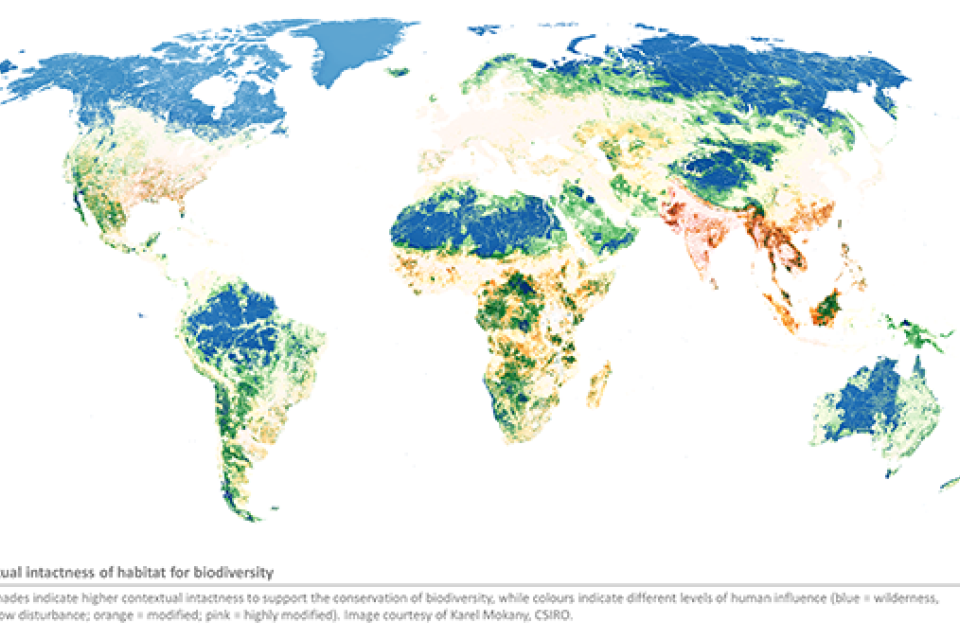
The team managed to integrate both perspectives, identifying high-value biodiversity habitat globally, in both intact and highly modified regions.
“Alarmingly though, the team found only 18.6 per cent of the proposed requirements for protecting biodiversity was currently under protection - it’s simply not enough,” Professor Watson said.
“This map will guide where protection is needed and allow us to get ambitious about species protection and double down on our conservation efforts before it’s too late.
“It allows for local people to assess how serious specific governments and landholders are when it comes to protecting the world’s most vulnerable species.
“We’ve got the map for success – it’s time to follow it.”
The research was published in PNAS (DOI: 10.1073/pnas.1918373117) and was funded by the Wildlife Conservation Society.
Media: Professor James Watson, jwatson@wcs.org, +61 409 185 592; Dominic Jarvis, dominic.jarvis@uq.edu.au, +61 413 334 924.
Related articles

Public trust crucial for ecotourism in Australia’s protected areas
