
Battle for the skies: Drones and endangered birds
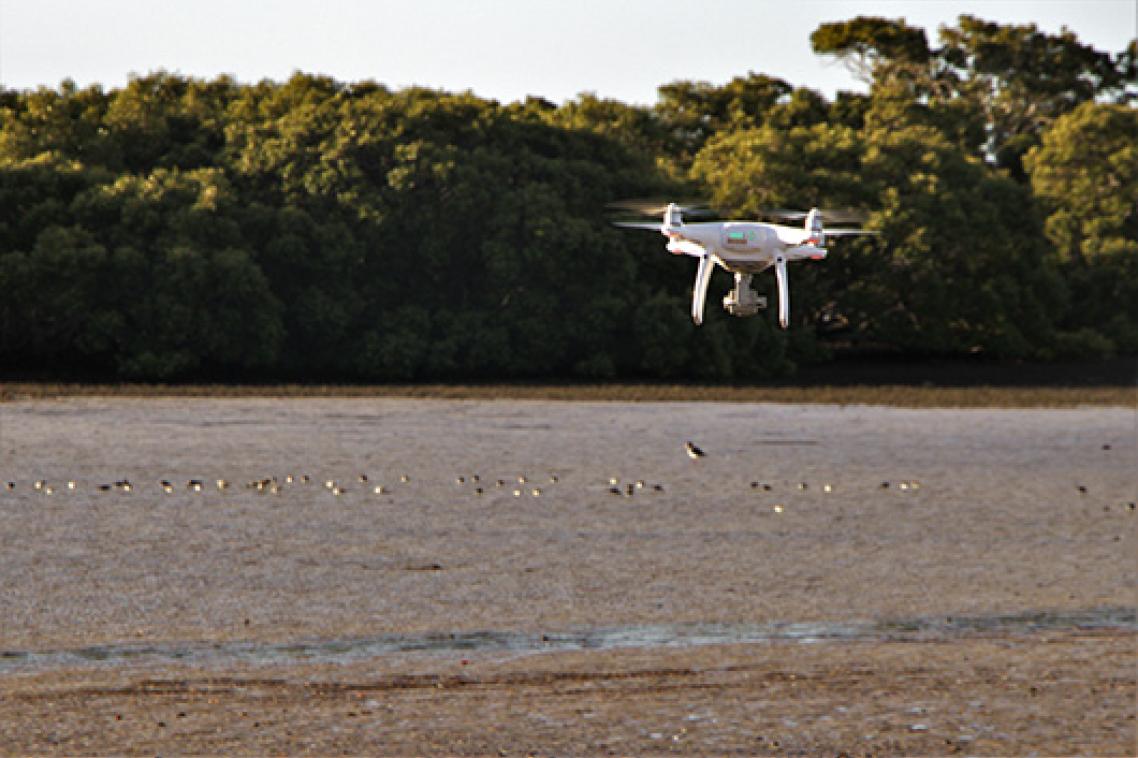
The alarming impact of drones on one critically endangered shorebird species has been revealed in research led by The University of Queensland.
PhD candidate Joshua Wilson from UQ’s School of the Environment led the research, which involved conducting 240 drone approaches of flocks of birds in Moreton Bay.
“11 species were generally unaffected by the drones, with less than 20 per cent probability that they would take flight when approached by a drone flying higher than 60 metres,” Mr Wilson said.
“The stark exception was the critically endangered eastern curlew, which reacted by becoming startled and flying away even when we flew above them at the legal ceiling of 120 metres.
“This then had a domino effect on nearby species, which would also become startled and fly away in response to the eastern curlew’s reaction.”
Mr Wilson said this result was alarming not only for the future of critically endangered curlews, but also for the knock-on effects it is likely to have on other species nearby.
“Drone use is increasing dramatically, leading to concerns they are yet another source of disturbance for birds that are already critically endangered,” he said.
[VIDEO::https://youtu.be/FSMSwsCE0yg::aVideoStyle]
“Drones can interrupt birds as they try to rest or feed, and birds avoid habitats that are regularly disturbed.
“If the birds are consistently interrupted or scared away from their preferred habitats, species like the eastern curlew, which migrates thousands of kilometres to breed, may find it difficult to gain the energy they need to survive and reproduce.”
Eastern curlew numbers have dropped by more than 80 per cent in the past 30 years, mainly due to habitat degradation.
Researchers are not calling for a ban on drones, acknowledging their commercial and recreational benefits and their usefulness as a tool to survey birds in hard-to-reach locations.
“Drones have proven to be very helpful when observing birds in places that are hard to reach on foot, such as seabirds breeding on remote islands in the Pacific Ocean, or penguins nesting on freezing Antarctic outcrops,” Mr Wilson said.
“In some cases, they can also be more accurate and reduce disturbance compared to traditional ground-based survey methods – but it’s important that we identify when and how drones can be used safely near birds.
“Our findings provide clear numbers on how much space we need to give birds when flying a drone to keep disturbance to a low level – in most cases this is about 60 metres, but some species are more sensitive.
“We recommend that organisations that can influence this problem, such as the Civil Aviation Safety Authority and Parks and Wildlife Services, regulate drone use near bird flocks, especially those containing at-risk and highly sensitive species.
“We also encourage researchers considering adding drones to their conservation toolkit to carefully evaluate the risk of disturbance before conducting drone wildlife surveys.”
The research was supported by The Moreton Bay Foundation and the Queensland Wader Study Group. It was conducted under strict ethical clearance with the purpose of benefiting the birds with the knowledge gained.
This research is published in the Journal of Applied Ecology.
Video is available via Dropbox.
Media: Mr Joshua Wilson, joshua.wilson1@uq.edu.au, +61 488 045 581; Faculty of Science Media; +61 438 162 687, science.media@uq.edu.au.
Related articles

UQ researchers send an unblockable message using gravity
