
Language a barrier in biodiversity work
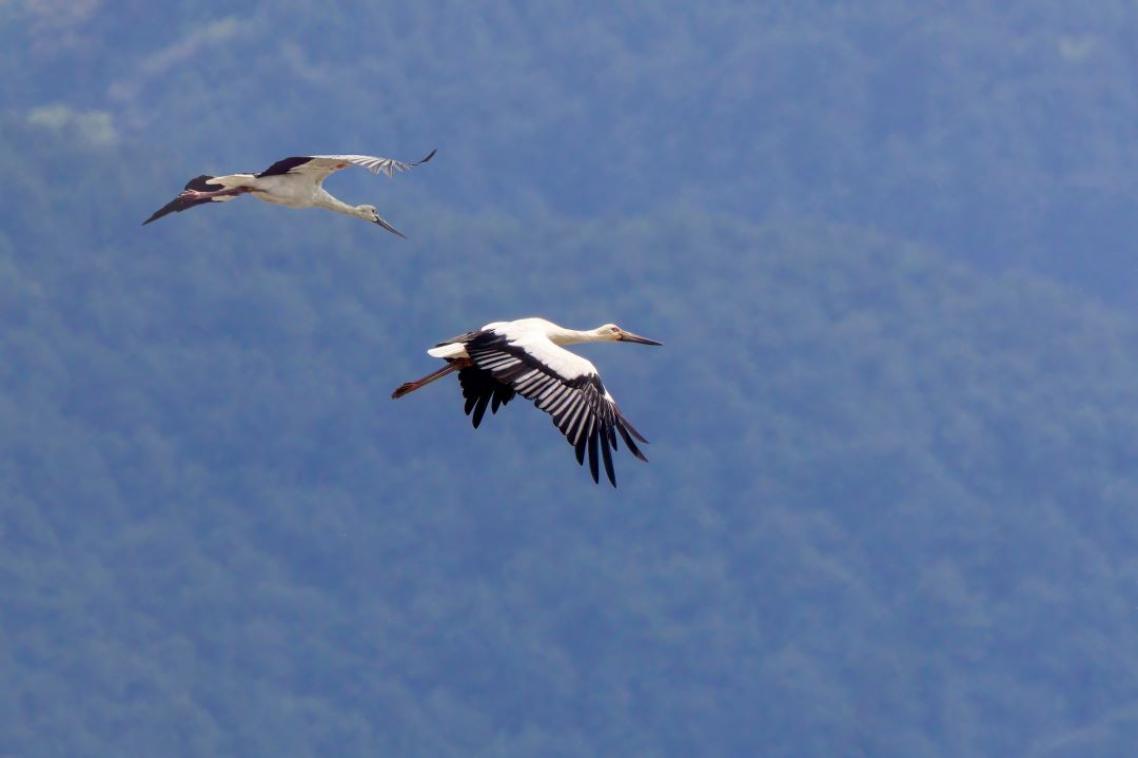
Oriental storks are endangered across a number of countries but Japanese research is not cited in any other language.
(Photo credit: Adobe stock )
A University of Queensland study has shown scientific knowledge on the conservation of endangered species is often overlooked when not presented in English.
PhD candidate Kelsey Hannah examined articles about the protection and management of birds, mammals, and amphibians and compared how often those in English and 16 other languages were cited in further work.
“The 500 papers in my study were published in peer-reviewed journals and available internationally to people working in conservation,” Ms Hannah said.
“Across the board, the non-English language papers had significantly fewer citations.
“The English-language articles had a median of 37 citations while the non-English articles had a median of zero.”
Ms Hannah said the number of citations was unchanged regardless of the robustness of the study design or even the conservation status of the study species.
“This suggests the reason this work isn’t being noticed is a lack of visibility or lack of search effort because of language barriers,” she said.
“One thing that did make a difference for non-English-language articles was providing an English abstract – those articles had 1.5 times as many citations.”
The analysis showed that many non-English-language studies had a high number of citations within their own language, but cross-language citations were very low.
“A Japanese study of the Oriental stork in 2011 for example only had citations in Japanese – even though the species is also endangered in China, Korea and Russia,” Ms Hannah said.
“This means timely and relevant work may not be being seen by the people who can use it to understand and address the conservation challenges of many species.”
Associate Professor Tatsuya Amano at UQ’s School of the Environment said it was crucial that language was not a barrier in addressing the ongoing global biodiversity crisis.
“A lot of the world's biodiversity is in areas where English is not the primary language,” Dr Amano said.
“If we're missing out on information from those regions, and not making decisions using that expertise, conservation efforts could have less impact.
“We encourage researchers to think about the accessibility of their work and consider providing multi-lingual abstracts.
“Importantly, English speaking scientists could remember to look beyond English language studies when conducting research to gain a broader perspective.”
This work is a part of translatE and is supported by an Australian Research Council Future Fellowship, an Australian Research Council Discovery Project, and a University of Queensland Research Training Program Scholarship.
The research is published in Conservation Biology.
Related articles

Snail shells are surprise weather time capsules
