
From war-torn Liberia to the UQ Law School: a graduate’s inspiring family legacy
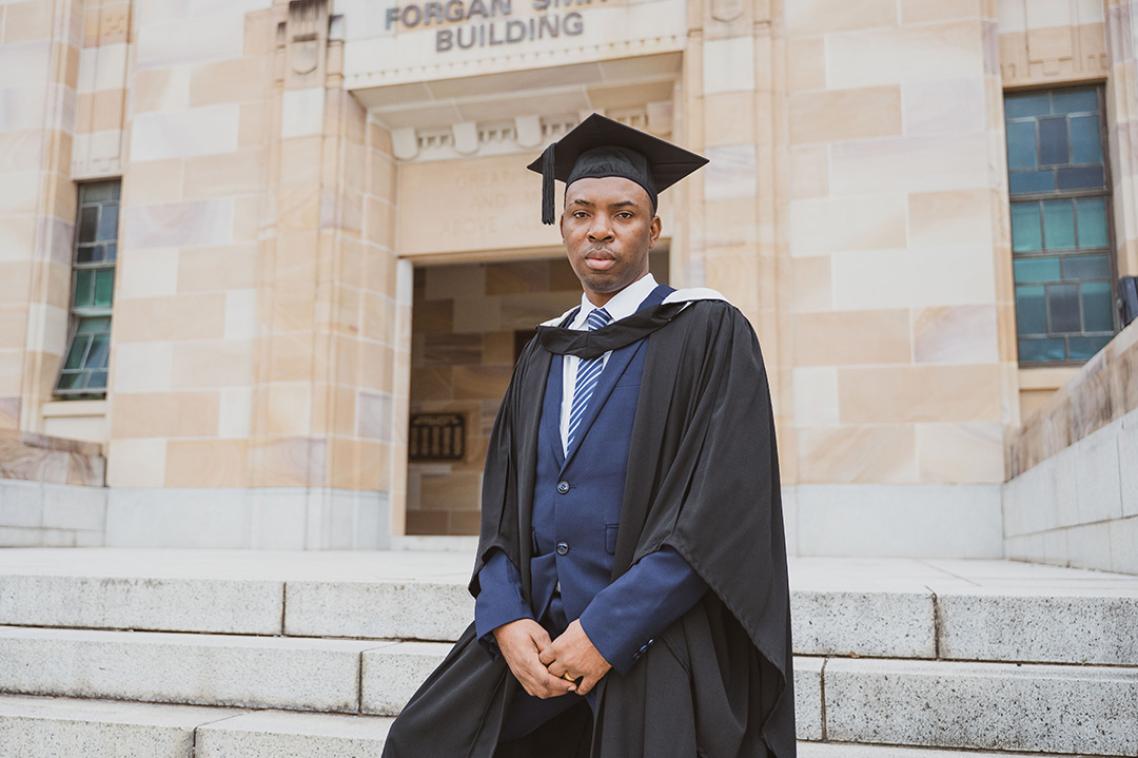
UQ Law School 2025 graduate Alfred Brownell.
(Photo credit: The University of Queensland. )
Key points
- Alfred Brownell grew up in Liberia during a civil war.
- He graduated from the UQ Law School this week, fulfilling a family legacy dating back more than 100 years.
- His great-grandfather and father became world-renowned lawyers who championed human rights and the environment.
Alfred Brownell sat school exams with the sound of gunfire and explosions in the distance.
“I was born in Liberia during a coup and civil war started when I was 5,” Mr Brownell said.
“There were times in class in the capital Monrovia when we heard shooting from a nearby rebel attack on government forces, and we had to run for our lives.
“You hoped you weren’t running towards trouble ... I was very lucky, but some of my friends were not.
“Thousands of civilians died, caught in crossfire.”
Mr Brownell recalls a childhood moving regularly around Liberia as the political unrest continued.
“Life there was very challenging, heartbreaking,” he said.
“I fled the country 3 times as a refugee, sometimes as an unaccompanied minor, going to neighbouring parts of West Africa.”
Incredibly, Mr Brownell managed to finish high school and set his sights on university.
This week he graduated from The University of Queensland with a Bachelor of Laws (Honours) – fulfilling a long-standing family legacy.

Alfred Brownell as a toddler (seated on chair) surrounded by family in Liberia.
(Photo credit: Supplied. )

Alfred Brownell with his father and siblings at his graduation from Cuttington University, Liberia, 2009.
(Photo credit: Supplied. )
Generations of change makers
Mr Brownell comes from a family of legal professionals who have made a significant impact on the world, fighting for justice and the rule of law.
His great-grandfather Nete Sie Brownell graduated from law school in 1919 and rose to the position of Liberia’s Attorney-General.
“He’d been a farmer who saw great injustice and decided to train as a lawyer to do something about it,” Mr Brownell said.
“In the 1920s, migrant labourers were recruited from Liberia and sent to Europe via the then-Spanish colony of Fernando Po.
“My great-grandfather challenged this practice on the grounds of colonial repression and slavery before the League of Nations.
“This brought pressure on the Liberian government, leading to significant labour reforms and ultimately the resignation of the government.“
Nete Sie Brownell later headed up the Brownell Commission which investigated the 1979 Rice Riots, when state security forces turned on unarmed citizens peacefully protesting a government plan to hike rice prices.
The incident is considered a turning point in Liberia’s history.
Standing up for the environment
The family’s ties to the legal profession continued down the generations.
“My great-grandfather’s eldest son Lincoln became a lawyer – as well as my father Alfred,” Mr Brownell said.
Alfred Brownell Senior is a world-renowned environmental lawyer who successfully campaigned to stop the clear-cutting of Liberia’s tropical forests by palm oil plantation developers.
“This has protected more than half-a-million acres of forest considered one of the world’s most important biodiversity hotspots,” Mr Brownell said.
“But it came at a cost – he has faced violent threats and for his own safety now lives in exile in the United States.”
Alfred Brownell Senior was awarded the 2019 Goldman Environmental Prize, known as the ‘green Nobel Prize’.

Alfred Brownell Snr at a 2019 demonstration in San Francisco against palm oil harvesting in Liberia.
(Photo credit: San Francisco Chronicle/GettyImages )
Forging his own path
Mr Brownell said his own journey to law came via a passion for the environment.
“I did a Bachelor of Science in Liberia before coming to UQ and graduating from a Master of Environmental Management,” he said.
“I planned on returning home to work alongside my father on environmental protection.
“Liberia is beautiful – it’s considered the lungs of West Africa with forests, beaches and rich in natural resources.”
Mr Brownell said going back was impossible at that time as the situation for his father deteriorated.
“I had no knowledge of where he was for 3 years, and then COVID hit,” he said.
“I wasn’t an Australian citizen yet and found it hard to get work experience, so I decided to go on and study law.
“The family calling found me.”
Mr Brownell received a T.C. Beirne School of Law scholarship in 2021 and 2023.

Alfred Brownell receiving a QLD Day award in 2021 for volunteering in the community from then Premier Annastacia Palaszczuk and Member for Oxley Milton Dick.
(Photo credit: Supplied.)
During his studies, his pro bono work involved two organisations he feels an affinity with – the Refugee and Immigration Legal Service and the Environmental Defenders Office.
“I found there were similar issues and hardships from my own experience,” Mr Brownell said.
“I do feel an obligation that I must carry, and my son has now shown some interest in human rights and the law.
“So perhaps this is not a story that ends.”
Mr Brownell graduated this week at UQ’s St Lucia campus.
UQ will host 17 graduation ceremonies in July with more than 4100 students attending.
Related articles

Turning up the heat on chickpea yield
