Lizard genetics provide new perspective on evolution
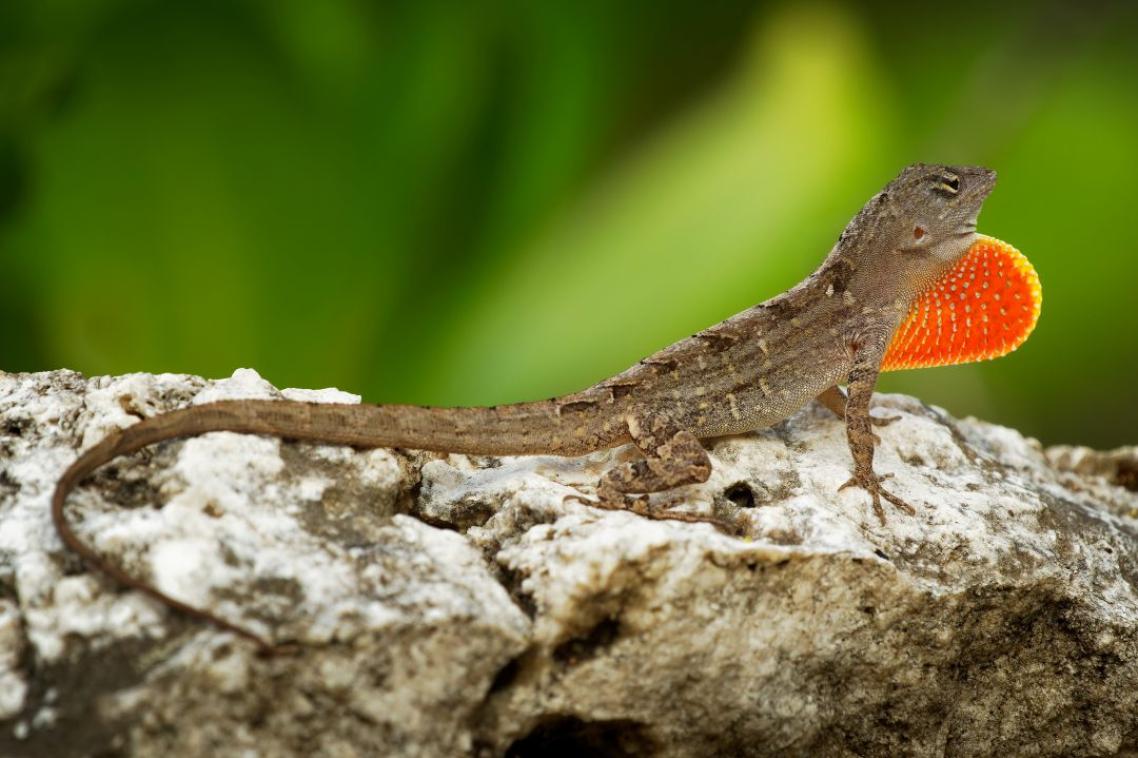
A dataset of Anolis lizard genetics was used to develop the evolutionary model.
(Photo credit: phototrip.cz / Adobe Stock )
Some colourful lizards and a mathematical formula from the finance sector have been used to build a new framework to model evolution.
Developed by Dr Simone Blomberg from The University of Queensland’s School of the Environment, it is the first mathematical model to combine short-term natural selection (microevolution) with the way species evolve over millions of years (macroevolution).
“There has been a big debate about whether microevolution can explain all of macroevolution,” Dr Blomberg said.
“We can now resolve the debate with a model that incorporates both, while tracking the way traits within a species change together over time.
“The model will allow researchers to study how traits and their genetic relationships evolve over both short and long timescales.”
The new evolutionary model borrows mathematics developed to illustrate share portfolios and how the share prices of different companies are related to each other over time.
“Economics has been a source of ideas in evolutionary biology since the time of Charles Darwin more than 160 years ago,” Dr Blomberg said.
In this study a dataset of the genetic traits and evolution of a genus of Central American lizard, called Anolis, was applied to the share portfolio equations.
“There are 7 species of these colourful and small Anolis lizards with data on the variations in 8 traits, including leg bone lengths, jaw size and head width,” Dr Blomberg said.
“We fitted the business mathematical model to the lizard data, which was very exciting.
“For the first time, the relationship between the traits as they evolved together into the different species of Anolis can be expressed in a mathematical model.
“We were able to use advanced geometrical methods to trace the evolution of the Anolis species, keeping true to the genetic relationships among traits.
“This area of mathematics is not well known among biologists, but it proved essential in uniting the micro- and macro-evolutionary frameworks.”
Dr Blomberg wants other scientists to now use the model and explore its possibilities.
“I want this mathematical model to be tested with datasets of more species,” she said.
“It can be used to test theories about trait convergence and the role of natural selection in shaping the evolutionary history of organisms.”
The research has been published in Evolution Letters which also published the Anolis lizard dataset collated by a team led by Virginia Tech.
Related articles
How Aussie skinks outsmart lethal snake venom