
New modelling shows difficult future for the GBR under climate change

Coral bleached by high water temperatures in the Pacific Ocean.
(Photo credit: Professor Peter Mumby )
The most sophisticated modelling to date forecasts that under the current global emissions pathway the Great Barrier Reef could lose most of its coral by the end of the century, but curbing climate change and strategic management will help coral resilience.
A research team led by The University of Queensland simulated different future climate scenarios driven by a range of plausible global emissions trajectories.
Dr Yves-Marie Bozec from UQ’s School of the Environment said the comprehensive modelling of individual corals included their ability to adapt to warmer water, large-scale reef dynamics and their interconnections on ocean currents.
“We ran all of those factors with the most up to date climate projections – and the news was not good,” Dr Bozec said.
“We forecast a rapid coral decline before the middle of this century regardless of the emissions scenario.
“Corals may partially recover after 2050, but only if ocean warming is sufficiently slow to allow natural adaptation to keep pace with temperature changes.
“Adaptation may keep pace if global warming does not exceed 2 degrees by 2100.
“For that to happen, more action is needed globally to reduce carbon emissions which are driving climate change.”
The ecosystem model, ReefMod-GBR, simulated the lifecycles of multiple coral species on 3,806 individual reefs.
Each modelled reef had tailored environmental settings including water quality, larval connectivity with neighbouring reefs, outbreaks of the coral-eating Crown of Thorns starfish and the risk of cyclones and coral bleaching until 2100.
Professor Peter Mumby said the model was tested extensively against long-term historic monitoring of the Great Barrier Reef to ensure it was as accurate as possible.
Professor Mumby said it showed that the rate of global warming was critical.
“We saw that many reefs could persist under the Paris Agreement target of 2 degrees of warming," he said.
“However, higher emissions leading to faster temperature rises would drive most reefs to a near collapse.”
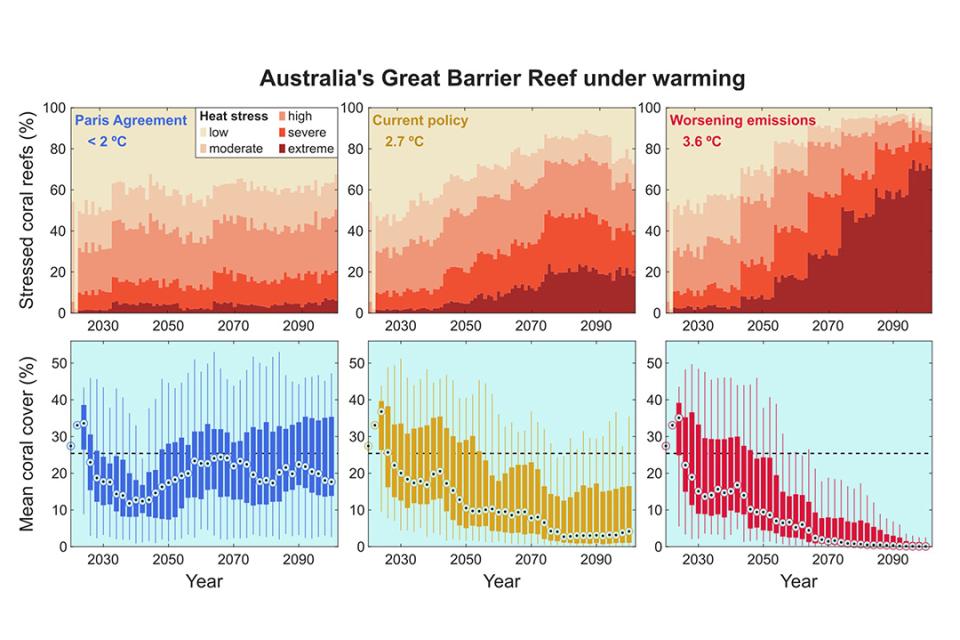
The study has a glimmer of hope, even on the current emissions trajectory as shown in this graph.
“Importantly, reefs in areas where the water doesn’t heat up so dramatically because it is well mixed, fared better than others,” Professor Mumby said.
“And the better-connected reefs with good access to larval replenishment from other nearby reefs were healthier.
“This shows management efforts to safeguard strategic parts of the coral reef network have a tangible benefit in promoting reef health.
“Reef management remains vitally important even on our current emissions trajectory.”
“The window for meaningful action is closing rapidly but it hasn’t shut,” Dr Bozec said.
“Reducing global emissions and addressing local stressors can still make a difference.”
Executive Director of the Reef Restoration and Adaptation Program, Dr Cedric Robillot said the collaborative research within the program shows that the local response of marine ecosystems to ocean warming is complex and nuanced.
“These findings confirm our understanding that coral reefs and the communities they support are facing an existential threat,” Dr Robillot said
“We must curb greenhouse gas emissions drastically, redouble our current management efforts, and develop new interventions to assist coral reefs while ocean warming is gradually arrested.”
The research is published in Nature Communications.
Collaboration and acknowledgements
This work was funded by the Reef Restoration and Adaptation Program, a partnership between the Australian Government’s Reef Trust and the Great Barrier Reef Foundation. It was completed with collaborators at CSIRO and The Australian Institute of Marine Science.
Related articles

Turning up the heat on chickpea yield
