Increased investment needed in early-stage homegrown tech

(Photo credit: Adobe Stock )
Not only is it the largest acquisition of a company commercialising intellectual property (IP) from an Australian university, but it also shows what can be accomplished when you combine quality research with a sophisticated commercialisation strategy.
It is a potent combination.
The IP commercialisation that culminated in this deal was more than a decade in the making.
It highlights what can be achieved with resilience, excellence in research, innovative commercialisation, investment in intellectual property, experienced management, and access to “patient” capital.
These same levers can drive huge improvements in the research commercialisation sector in Australia, boosting financial returns to fund further research and bring about significant public good.
To increase investment in homegrown early-stage technologies, we must increase our appetite for risk.
It’s essential to ensure more of our great ideas progress within Australia for as long as possible through the stages of technology development to manufacturing, and provide more jobs for Australians.
Quality research
With an exclusive licence to the Molecular Clamp technology from UniQuest, and substantial ongoing engagement with UQ’s research expertise, Vicebio had been developing a novel vaccine against two respiratory viruses – respiratory syncytial virus and human metapneumovirus – both causes of serious infections.
The Molecular Clamp technology gained worldwide attention in early 2020 when the Coalition for Epidemic Preparedness Innovations (CEPI) asked The University of Queensland to develop a potential vaccine for COVID-19.
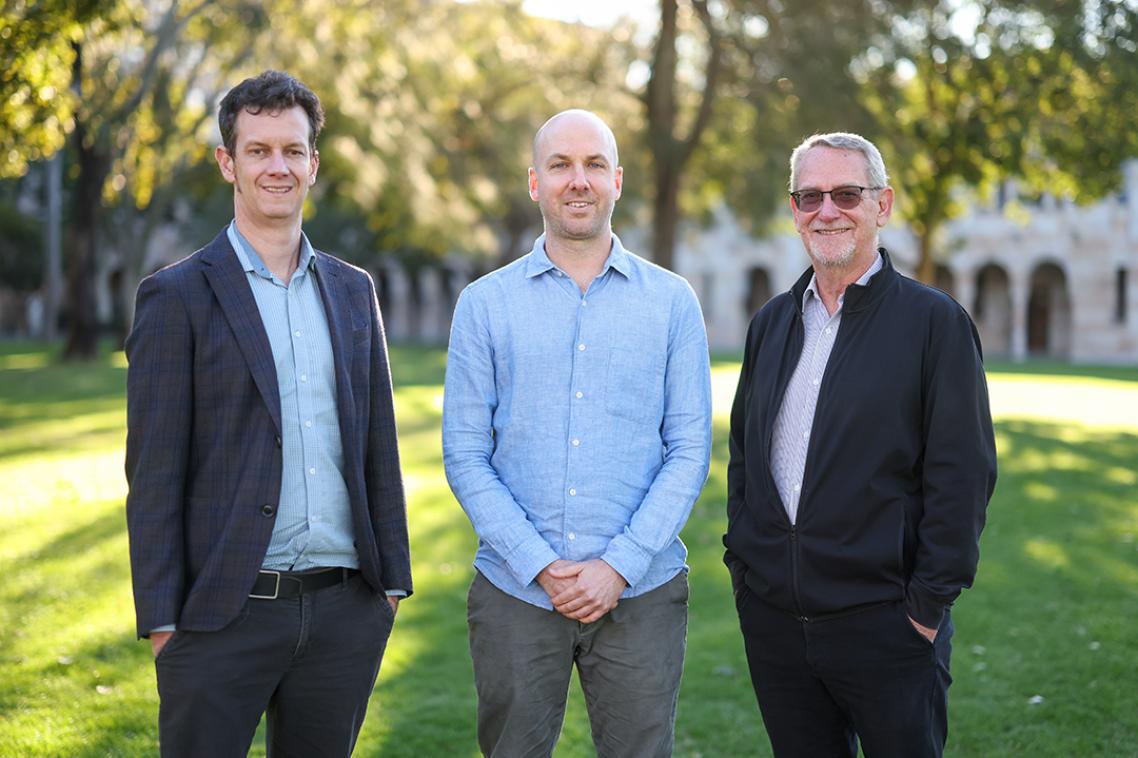
Professor Keith Chappell, Professor Daniel Watterson and Emeritus Professor Paul Young overcame the challenges and disappointments that journey presented – a true testament to their inspiring tenacity.

(L-R) Professor Keith Chappell, Professor Daniel Watterson and Emeritus Professor Paul Young, inventors of the Molecular Clamp technology.
(Photo credit: The University of Queensland.)
UQ’s commercialisation track record
Innovative commercialisation strategies are a hallmark of UniQuest’s 40-year track record, along with an experienced team, deep corporate knowledge, and sophisticated project management capabilities.
UniQuest has enjoyed long-term support from UQ to translate its research into impact, attracting a critical mass of talented, experienced people who can engage over longer periods to support commercialisation projects.
The three largest exits involving Australian university IP – Spinifex Pharmaceuticals, Inflazome and now Vicebio – originated from UQ research and were successfully commercialised by UniQuest.
The missing ingredient
Before partnering with Medicxi, the UniQuest team and the researchers behind the Molecular Clamp technology had been unable to secure competitive grant funding or venture capital support.
Despite this UniQuest invested in protecting the intellectual property and provided funding alongside the Queensland Government for a key early proof-of-concept study.
This and other similar experiences were driving factors in establishing the $32m UniQuest Extension Fund in 2024, to provide “patient” capital to help develop UQ technologies like the Molecular Clamp.
(Photo credit: The University of Queensland)
And that’s because a key ingredient missing from the Australian innovation landscape is risk appetite, especially for early-stage technologies.
Without a healthy appetite for risk, we cannot effectively translate research with commercial potential to have global impact and retain a greater proportion of value here in Australia.
We also need to accept that it is appropriate and necessary in some sectors to partner internationally.
The key is investing in and then progressing our intellectual property up the development value chain and retaining more of the end value.
Exits of the scale of Vicebio will support market confidence that the risk-to-reward ratio is worthy of increased investment in R&D and early-stage technology development.
I believe this will have a flow-on effect in encouraging superannuation funds and other sources of capital to support early-stage technologies.
The Group of Eight is championing the adoption of a roadmap of policy reforms in its report Australia’s R&D Intensity: A Decadal Roadmap to 3% of GDP, the Group of Eight Universities Report to the Australian Government.
It argues that lifting investment in science and innovation is essential for Australia’s future prosperity and it can be realised, in part, by lifting Australia’s Research and Development (R&D) intensity to 3 per cent of GDP by 2035.
Congratulations to all involved in this momentous outcome for Vicebio: the UQ researchers I’ve mentioned above, as well as Dr Craig Belcher, Dr Tamsin Terry, Jane Malloch, Dani Milani, Dr Mark Ashton (now at Griffith University), Dr Ben Phillis, Dr Josephine Sutcliffe, Dr Belinda Hartmann and John Swinson.
Congratulations also to founding investor Medicxi and Series B investors TCGX, Goldman Sachs Alternatives, Avoro Ventures, venBio, and the UniQuest Extension Fund.
About the author

Dr Dean Moss is CEO of UniQuest, Australia’s leading university commercialisation entity, managing the intellectual property of The University of Queensland.
Dr Moss has more than 35 years’ experience in science, academia, business, management and commercialisation in Australia, the US and the UK. He has been managing director or senior business development executive of several health and biotech companies worldwide, including Agen Biomedical, Launch Diagnostics, AMRAD ICT, AMRAD Biotech, and United Drug.
Dr Moss is a board member of several Australian biotechnology companies and was a member of the investment committee of the pre-seed venture funds Uniseed, the Medical Research Commercialisation Fund and the New Zealand Government’s KiwiNet.
Dr Moss is Chair of the Group of Eight Universities Innovation and Commercialisation Group and, in 2018, was awarded the title of Adjunct Professor in the Office of the UQ’s Deputy Vice-Chancellor (Research & Innovation).

Related articles
UQ scientific excellence reaches the global pipeline in landmark deal